Moving From Denver to Boulder: Homes Take Longer to Sell
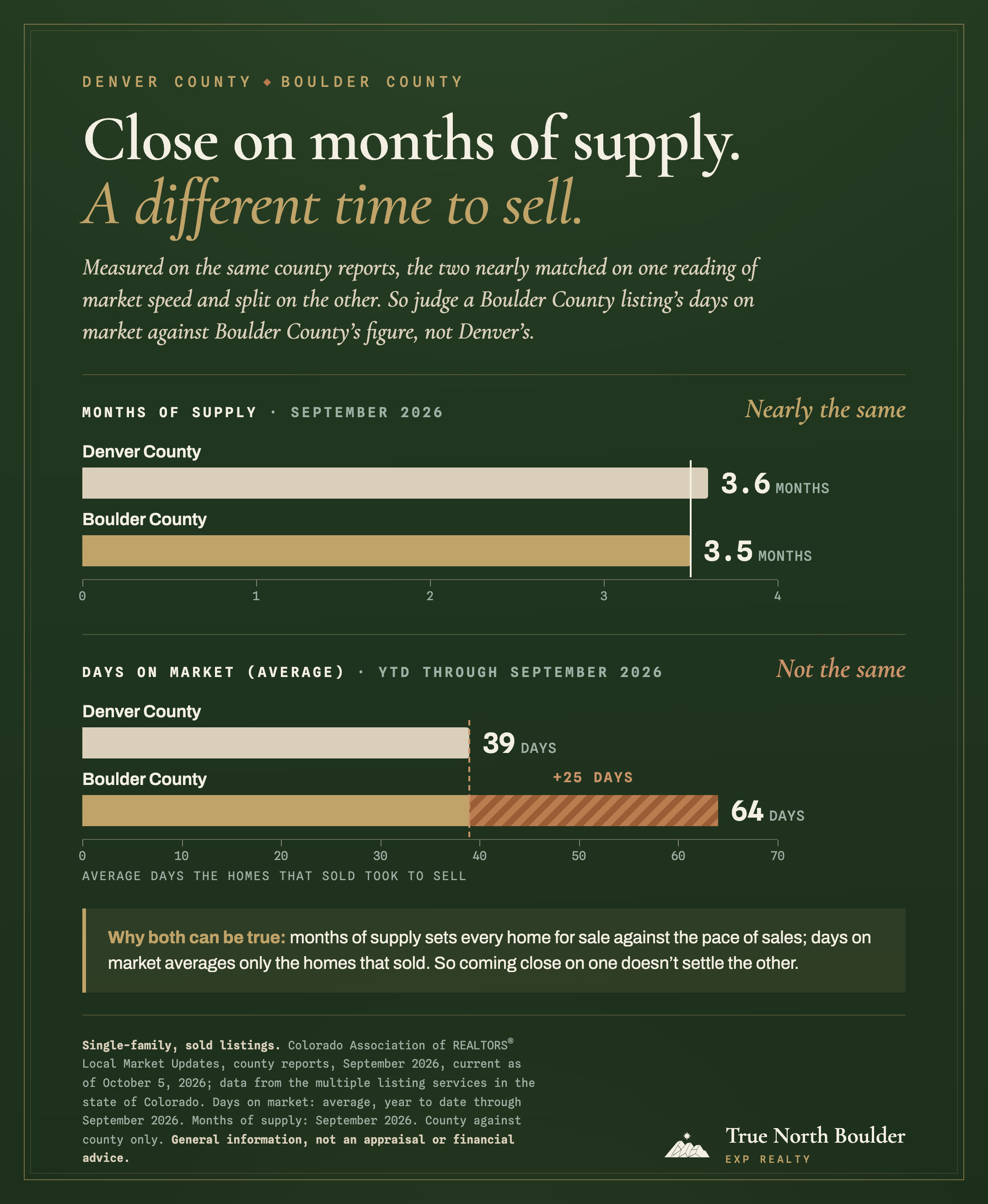
Moving from Denver to Boulder County, the contract, the disclosure form and the state's assessment rates stay the same. The pace doesn't: through September 2026, single-family homes took 64 days on average to sell in Boulder County and 39 in Denver County. Months of supply ran close, 3.5 and 3.6.
If you're moving from Denver to Boulder County to trade up, the worry is the stretch in between: paying for two houses at once, or selling first with nowhere yet to live. How long it lasts depends partly on how fast your Denver house sells, and on the county reports, Boulder County homes have been taking longer to sell than Denver's.
The contract and the disclosure form are the same as Denver's; what differs is a measurement. Carry a Denver-metro sense of normal up the road and an ordinary Boulder County listing reads as slow, which is the easy way to misjudge a house you want. Here are the two markets on one basis, and which report to read for each side.
How long do Boulder homes take to sell compared with Denver?
On the Colorado Association of REALTORS' reports, year to date through September 2026, single-family homes that sold took 64 days on average in Boulder County against 39 in Denver County, a 25-day gap. The town reports read 73 for Boulder and 58 for Longmont; the four metro counties measured ran 37 to 50. A year earlier the county gap was also 25 days.
Every row counts single-family homes that sold, from the Colorado Association of REALTORS' Local Market Updates, all September 2026 reports. Days on market, sale-to-list and the median cover the year to date through September 2026; months of supply is the September reading. The Boulder and Longmont rows are town reports; the rest are county reports.
| Area (report) | Days on market (average), YTD | Months of supply, September | % of list price received, YTD | Median sale price, YTD |
|---|---|---|---|---|
| Denver County | 39 | 3.6 | 98.9% | $710,000 |
| Jefferson County | 37 | 3.1 | 99.2% | $715,000 |
| Arapahoe County | 39 | 3.1 | 99.3% | $594,250 |
| Douglas County | 50 | 3.5 | 98.8% | $739,995 |
| Boulder County | 64 | 3.5 | 98.4% | $848,000 |
| Boulder (town report) | 73 | 4.3 | 97.5% | $1,295,000 |
| Longmont (town report) | 58 | 2.9 | 98.8% | $610,000 |
Read the county rows against each other: Boulder County's 64 days against a metro range of 37 to 50 is like against like. The Boulder and Longmont rows come from town reports, so setting them beside Denver County's 39 compares a town with a county.
It isn't one year's noise. Year to date through September 2025, as the 2026 reports restate it, Boulder County ran 64 days and Denver County 39: a 25-day gap, as wide as now.
Take a listing you're watching. A Boulder single-family home at day 60 is still under the town's average of 73, so a listing that would look stale in Denver may be nothing unusual here. The average counts only homes that sold, and the ones that sat longest pull it up, so one listing's day count is a weak read either way; your broker can pull its price history, including whether it was withdrawn and relisted. On its own, the count doesn't make the price soft or the seller flexible, and it's no reason to offer less.
What this table can and can't carry
What the figures leave out. The reports' price and sale-to-list figures don't account for seller concessions or down payment assistance, and sale-to-list is measured against each home's last list price, after any reductions.
None of these reports measures the gap at $800K to $1.5M. The range sits wholly above Denver County's $710,000 median; Boulder County's $848,000 median sits near its bottom, Boulder's $1,295,000 inside it and Longmont's $610,000 below it. So we can't say whether the 25-day gap holds at your price, and we won't estimate it. The closer read is two-sided: days on market for homes that sold over the past year at your Denver house's price, in its part of the metro, and at the price you're shopping in Boulder County. Ask your broker for both, with how many sold at each, since an average drawn from a handful of sales moves with every closing.
Why months of supply and days on market disagree
For single-family homes, Boulder County read 3.5 months of supply in September 2026 and Denver County 3.6, nearly the same; Boulder's town report sat higher, at 4.3. The two counties come close on months of supply and differ widely on how long their sold homes took, because months of supply sets every home for sale against the pace of sales, while days on market averages only the homes that sold.
CAR's own glossary defines months of supply as "the number of months it would hypothetically take to sell through all the available homes for sale, given current levels of home sales," and days on market as "a measure of how long it takes homes to sell, on average." The first sets the whole inventory against the pace of sales; the second averages the homes that did sell. Two markets can come close on the first and differ widely on the second, and on the September reports Boulder County and Denver County did. What months of supply measures gets its own note. Both figures are about how fast a market sells, and for these two counties they give different answers, so one won't stand in for the other.
Sale-to-list sets Boulder's town report apart. Through September it reads 97.5% of list price received against Denver County's 98.9%, 1.4 points lower; Boulder County, at 98.4%, and Longmont, at 98.8%, sit close to Denver. The figure says how near the sold homes came to their last list price, after any reductions, not whether prices moved.
A Denver-metro report counts Boulder County in
Whether "the Denver metro" includes Boulder depends on who drew the map. In CAR's Metro Denver Region report it does: the September 2026 edition maps seven counties, Boulder, Broomfield, Adams, Denver, Arapahoe, Jefferson and Douglas. So that report's days-on-market figures have already averaged Boulder County in with the very counties you'd compare it to, which pulls them toward Boulder's own figure and shrinks the gap you're trying to see. Its single-family overview does the same, on the same basis as the rows above; its total-market page adds townhouses and condos on top. It answers a regional question well. Yours is about two counties, so read their own reports.
What stays the same when moving from Denver to Boulder
Selling in California or Texas brings a second state's rules on the way out. From Denver, the forms and most of the rules carry over to a Boulder County purchase:
- The contract. On a resale, brokers in both places use the same Commission-approved Contract to Buy and Sell Real Estate (Residential), with the same dates and deadlines. New construction usually runs on the builder's own contract, here as in Denver.
- The seller's disclosure. Selling the Denver house, you complete the same Commission form a Boulder County seller does.
- A written agreement with your broker before you tour. Brokers in Denver and in Boulder County work under the same rules. Which of the two broker relationships to choose, and when to sign, is in our guide to relocating to Boulder County.
- Residential assessment rates. The state sets them, so they're the same in both counties. A house's bill also depends on the levies of the districts its parcel sits in, which vary by address, so look up the bill on the house itself instead of comparing counties.
- Listings. IRES, the MLS for this footprint, and REcolorado exchange listings with each other; which rulebook governs a listing here is in our off-market guide.
What can change is the parcel. Outside Boulder County's towns, a house may sit on a private well and a septic system, and selling it can trigger a county septic inspection. If you've only owned a house on city water and sewer, our Boulder County inspection guide covers what to check on those parcels.
If you keep the Denver house as a rental
Denver wants the rental licensed first. That's the City and County of Denver only; a house in Aurora, Lakewood or another metro city falls under that city's rules.
Under the city's rental-license rules, renting a home for 30 days or more requires a residential rental license, a requirement that has covered single-unit rentals since January 1, 2024. For a single home the application fee is $50 and the license fee is $50. You need a passing inspection first, from a private inspector holding the certifications the city requires (DRMC 27-192), and you apply within 90 days of it; the inspector, not the city, sets the price. A house built in the last four years may qualify for the city's new-construction exemption from that inspection. Where repairs are needed, the city says a qualified contractor must make them before the house is re-inspected.
The license lasts four years, a change of ownership needs a new one, and each renewal needs a fresh inspection completed within 90 days of the renewal application. Without a required license, the city says, "you will not be able to legally rent your unit," and it puts fines and citations at $150 to $5,000 (DRMC 27-203).
Whether the Denver rent helps you qualify for the purchase here is a lender's rule about any home you're leaving; keeping your current home as a rental when you move up explains it.
A report for each side of the move
The next step is two numbers on one measure. For the house you're selling, use the CAR Local Market Update for its county, Denver or another; for the house you're buying, Boulder County's report, or the Boulder or Longmont town report once you've narrowed it. Our Boulder market report and our Longmont market report update the town figures each month.
Those two numbers feed the sequencing decision, buy first, sell first or bridge, but they do different jobs. The Denver figure is your sale's clock, so it bears on how long that stretch runs. The Boulder figure describes how long Boulder sellers wait, not how long your own search will run. Neither is a closing date; each closing comes after, on its contract's own dates. If your offer depends on selling the Denver house, the Boulder seller will weigh how fast it's likely to go, and through September each metro county measured sold faster than Boulder County; a Denver house already under contract makes the stronger offer. The carrying arithmetic is in buying before you sell and a bridge loan against a sale contingency. Where to live for a Denver commute is a question the commute-corridor guide takes up.
True North Boulder is a real-estate team with eXp Realty. If your Boulder offer will lean on the Denver sale, we can help you write it.
This is general information, not tax, legal, or financial advice; confirm your specifics with a CPA or attorney before you act. Denver's rental-license rules are the city's, so confirm the current requirements with the city before you rent.
Frequently asked
Do homes take longer to sell in Boulder than in Denver?+
Yes, on the Colorado Association of REALTORS' single-family reports for sold homes, year to date through September 2026: 64 days on average in Boulder County against 39 in Denver County. The town reports, on the same window, read 73 for Boulder and 58 for Longmont. A year earlier the county gap was just as wide, 25 days. These reports don't break out the $800K to $1.5M range, so ask your broker for days on market on homes that sold at your Denver house's price and at the price you're shopping in Boulder County.
Is Boulder County a slower market than Denver on every measure?+
No. On the Colorado Association of REALTORS' single-family reports, months of supply read nearly the same in September 2026, 3.5 in Boulder County and 3.6 in Denver County, and year to date the two were close on sale-to-list, 98.4% against 98.9% of the last list price. Boulder's town report sits lower, at 97.5%. The clear difference between the two counties is how long the homes that sold took to sell: 64 days on average against 39.
Do I need a license to rent out my Denver house when I move?+
Inside the City and County of Denver, the city's rules require one for a rental of 30 days or more. For a single home the city charges $50 to apply and $50 for the license; the required inspection, by a private inspector with the city's certifications, is extra and priced by the inspector, and you apply within 90 days of it. The license lasts four years, each renewal needs a fresh inspection, and the city puts fines at $150 to $5,000. Other metro cities set their own rules; confirm the current requirements with the city before you rent.
Is the purchase contract different in Boulder County?+
No. On a resale, brokers in both places use the same Commission-approved Contract to Buy and Sell Real Estate (Residential), with the same dates and deadlines table. New construction usually runs on the builder's own contract, in both places.
Does a Denver-metro market report include Boulder?+
CAR's Metro Denver Region report does. Its September 2026 edition maps seven counties, Boulder among them, and even its single-family figures blend all seven. A days-on-market figure from it has already averaged Boulder County in with the counties you'd compare it to, so read each county's own single-family report instead.
Sources
- County figures: CAR Local Market Updates, single-family, sold, September 2026 and year to date, for Denver, Jefferson, Arapahoe, Douglas and Boulder counties.
- Town figures: CAR Local Market Update (IRES data), September 2026, for Boulder and Longmont.
- Definitions: CAR Metro Denver Region Monthly Indicators, September 2026 glossary.
- Denver rental license: City and County of Denver general FAQ, renewal FAQ, inspections and Healthy Residential Rentals for All.
- Assessment rates: Division of Property Taxation, Understanding Property Taxes in Colorado, January 2026; Boulder County Assessor, tax calculation.
- Contract: CREC Contract to Buy and Sell Real Estate (Residential), mandatory 2026.
- Listings exchange: REcolorado, IRES and REcolorado data exchange.