Colorado Contract Deadlines: What Happens If You Miss One
In Colorado the purchase contract is a clock, not a document. Every deadline runs itself, and missing one costs you a right or costs you cash. Here's the ten rows that do most of the damage, what silence does on each row, and the inspection trap that quietly ends deals.
In Colorado, the contract you sign to buy a home is a clock, not a document. The dates in it don't wait for anyone to act on them. Each one is self-executing, which is the legal way of saying the deadline is the event. Nobody sends a reminder. There's no grace period and no "we'll circle back Monday." When a date passes, something happens automatically: you either lose a right you never used, or, on one deadline that surprises almost everyone, you lose the whole deal.
That's the part most buyers get backwards. They assume silence keeps their options open. In a Colorado contract, silence spends them. (If you're moving from a state like California, this runs differently than you're used to.) What follows is not the whole table. These are the ten rows that do most of the damage, what each one costs if you let it slide, and the inspection trap where objecting to a few repairs can end the purchase you're trying to protect.
Colorado contract deadlines are self-executing: the date is the event
The short version: The Colorado Contract to Buy and Sell Real Estate runs on a Dates & Deadlines table near the front. Every row is a hard, automatic date. No notice is sent when one arrives, and no one is obligated to remind you. Miss one and the consequence lands on its own.
The standard form is the Colorado Real Estate Commission's Contract to Buy and Sell Real Estate (Residential), known as the CBS1. It's mandatory for licensed brokers, with a current version in use for contracts written on or after January 1, 2026. Its first substantive page is a grid of deadlines: when your loan application is due and when the loan's terms must satisfy you, when your inspection objection is due, when the appraisal exit closes, when you close. (One exception worth knowing up front: buying new construction usually means the builder's own contract rather than the CBS1, so this schedule doesn't apply the same way — we cover that separately.)
Here's the distinction that decides how much a missed date costs you, and it's worth holding onto through the rest of this guide.
- Silence on a right waives the right. Most deadlines protect an escape hatch, a way out if something's wrong. Let the date pass without acting and the hatch closes. You didn't lose money; you lost the option to walk. You're now committed to buying.
- Silence on an obligation costs cash. A few deadlines aren't options. They're things you promised to do, closing being the big one. Blow those and your earnest money is on the line: it's the seller's remedy where the contract's liquidated-damages option applies.
One kind of silence buys you a house you may not want. The other kind can cost you your deposit. Knowing which deadline is which is the entire game.
Every Colorado contract deadline, and what silence costs
The short version: Ten rows do most of the damage. The single sharpest one is the Inspection Resolution Deadline, because if you've filed an objection, silence there doesn't waive a right. It terminates the deal.
The windows below are typical, not fixed. Every date is negotiated and written into your specific contract's table, so yours may be tighter or looser. What doesn't change is the section of the contract each one lives in, and what happens when it passes.
| Deadline (CBS1 §) | Typical window | Right or obligation | What silence costs |
|---|---|---|---|
| Inspection Termination (§10.3.1) | ~7–14 days | Right (clean exit) | Lose your sole-discretion exit over the property's condition; other rights in the contract can still reach a later problem |
| Inspection Objection (§10.3.2) | same window | Right (objection) | Lose the right to ask for repairs; delivering it also ends your Termination exit |
| Inspection Resolution (§10.3.3) | a few days after an objection | Right, but inverted | If you objected: the deal terminates unless the seller receives your written withdrawal |
| New Loan Terms / New Loan Availability (§5.2) | ~2–3 weeks | Right (terminate on the terms, or on the lender's underwriting) | Lose the right to walk if the loan's terms or its availability fail. The form adds a warning in capitals: past the Availability Deadline, if the seller isn't in default and never received your written notice to terminate, the earnest money is nonrefundable, except where another exit in the contract (for example appraisal, title, or survey) still applies; that is the lost option in cash terms: the deposit now rides on your ability to close, the same way it does at the closing row |
| Appraisal Objection (§6.2) | ~2–3 weeks | Right (terminate, or object; an unresolved objection terminates the contract on the Appraisal Resolution Deadline) | No exit if the home appraises below your price |
| Association Documents Termination (§7.4) | ~7–14 days | Right (termination) | Accept the HOA/condo governing documents unread |
| Record Title Objection, incl. the Tax Certificate (§8.2, §8.5) | early | Right (terminate or object) | Accept the title commitment and its recorded exceptions, and the districts on the parcel, as disclosed. Objecting instead starts the Title Resolution clock, which terminates by default |
| Off-Record Title Objection (§8.3) | early | Right (objection) | Accept easements, ditch rights, and encroachments as-is |
| Property Insurance Termination (§10.5) | ~10–17 days | Right (termination) | Buy a house you may not be able to insure |
| Closing (§12; good funds at §4.4.1) | the closing date | Obligation | Default; earnest money is the seller's remedy where liquidated damages apply |
Nine of these ten rows work the way you'd expect: a date arrives, an escape hatch closes, you proceed. The third row is the one that inverts, and it's the one that catches experienced buyers. If you expected a lawyer to approve the contract first, the form has no attorney-review row in its Dates and Deadlines table.
The inspection trap: objecting can end your deal; terminating protects it
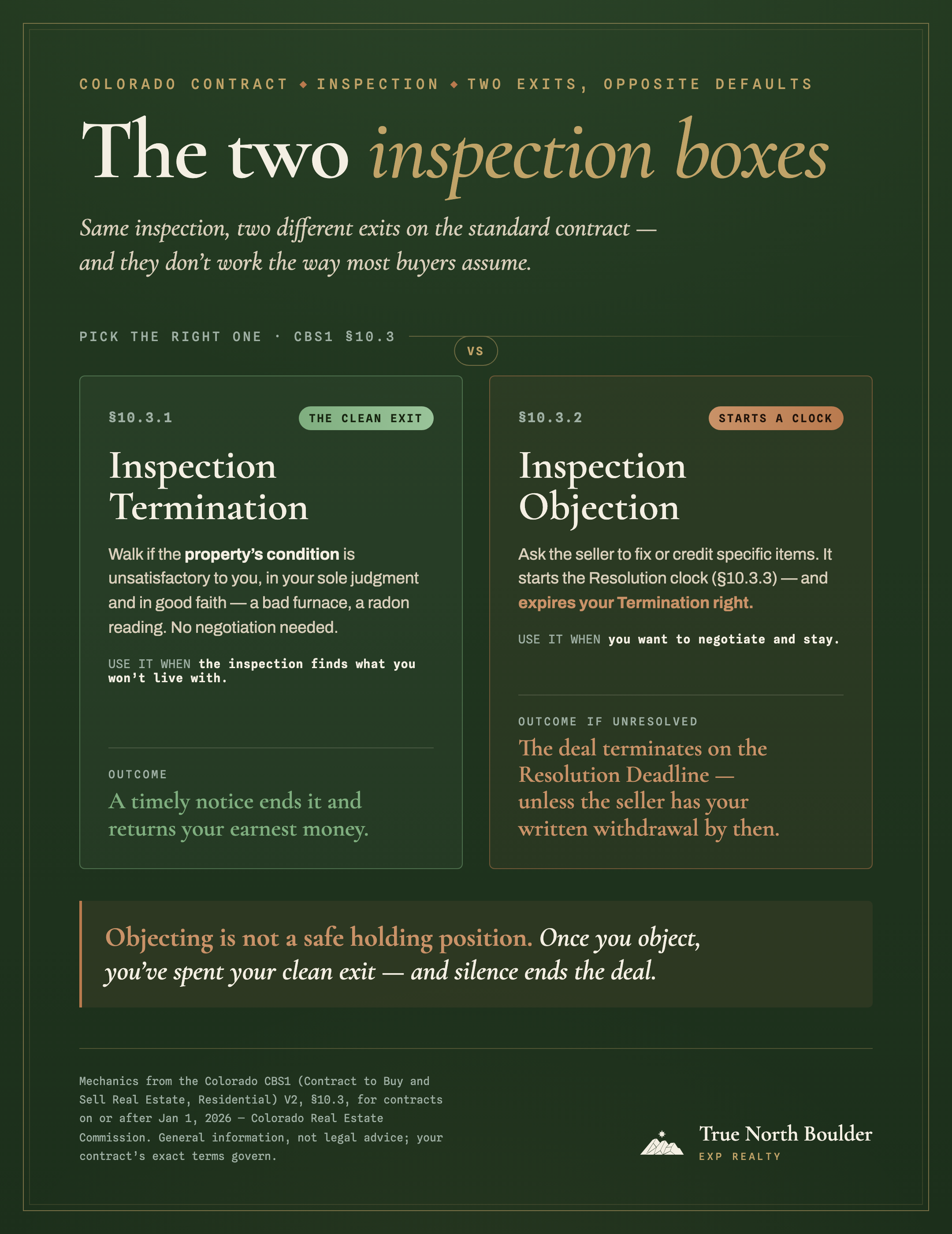
The short version: There are two separate inspection exits. Termination (§10.3.1) is your clean walk-away over the property's condition, judged in your sole subjective discretion, and a timely notice keeps your earnest money. Objection (§10.3.2) asks the seller to fix things, and it starts a resolution clock: if you don't reach a written agreement by the Inspection Resolution Deadline, the contract terminates unless the seller receives your written withdrawal of the objection by then. And they run in one direction: delivering an Objection expires your clean Termination right. Buyers who mean to negotiate reach for the wrong lever.
This is where a Boulder purchase most often goes sideways, usually on the older stock the $800K–$1.5M move-up buyer is competing for: a house whose furnace, roof and sewer line are all the same age as each other, and none of them new.
You get the inspection back and it's not perfect. You want the seller to address a few things. So you file an Inspection Objection, which is the right instinct and the right tool for negotiating. What it is not is a safe holding position. Filing an objection starts the Inspection Resolution clock, and Colorado's default here runs opposite to the termination and objection deadlines. If you and the seller haven't signed off on a resolution in writing by that date, the contract terminates, unless the seller receives your written withdrawal of the objection first. Do nothing, and the deal you were trying to improve dissolves on its own.
That surprises people because it feels like the opposite of how a deadline should work. On a termination or objection date, silence means you're in: you let it pass and you proceed. On a resolution date it flips, and once you've objected, silence means you're out. Worth carrying beyond this row, because the contract's other resolution deadlines behave the same way.
The clean exit is the other box entirely. An Inspection Termination lets you end the contract if the property's condition, its inclusions, services to it, a transportation project, or any activity, odor or noise is unsatisfactory to you, judged in your sole subjective discretion, with the form requiring you to act in good faith. A cracked heat exchanger or a radon reading are the plain cases. If your notice reaches the seller by the Inspection Termination Deadline, your earnest money comes back. If what you actually want is out, the clean tool on the standard form is the Termination, not the Objection. And the order is one-way: on the standard form, delivering an Objection expires your Termination right, so you can't object to push for repairs and still keep the clean walk-away in your back pocket. Which one fits your situation is a call to make with your broker, and with an attorney on anything you're unsure of.
So the decision at inspection is a fork. Broadly, on the standard form:
- You want to leave → Inspection Termination. Clean, keeps your deposit.
- You want to negotiate and stay if it works out → Inspection Objection, and then watch the Resolution Deadline. Reach a written agreement, or make sure the seller receives your written withdrawal, before the Resolution Deadline passes.
- You want to negotiate but leave if it doesn't work → objection, then let the Resolution Deadline do the terminating if you can't reach written agreement. Objecting has already spent your clean Termination exit, so this is now your way out. This is the sequence that costs buyers the house: they object, negotiations stall, they assume they can still walk cleanly, and they find the clean exit is already gone.
The most dangerous silence is on the form itself
The short version: A deadline row left blank, marked "N/A," or "Deleted" doesn't just skip a date. It deletes the right (§3.2). If the Property Insurance line is empty, you have no insurance exit at all. And every deadline is measured by delivery, not by when you hit send.
Before any of these clocks can protect you, the date has to be in the table. Under the contract, a Dates & Deadlines entry left blank or written as "N/A" or "Deleted" removes that provision, so the right is never created. This is the quietest way to lose an exit, because it happens at signing, in a cell nobody reads closely, weeks before it would have mattered. Read the whole table before you sign, and ask why any deadline that matters to you is empty.
Two more mechanics decide whether a right you do have actually lands.
- Delivery, not sending. A notice or a termination is effective when the other side receives it, not when you send it. Calendar every deadline as a "deliver-by," and build in margin. A termination emailed at 11:59 p.m. on the deadline is the kind of thing that gets litigated, and you don't want to be the test case.
- The right person, the right way. Notices go where and how the contract says. Your broker handles the mechanics, but know that a text to the listing agent is not the same as delivering a contractual notice.
The deadlines Boulder buyers actually blow
The short version: Beyond inspection, six deadlines catch buyers the most: New Loan Terms and New Loan Availability (feeling "approved" and letting them pass), Appraisal (waived to win, then no low-appraisal exit), Association Documents (the condo/townhome window), Record Title and the tax certificate (the recorded exceptions, and the metro districts on the parcel), and Off-Record Title (ditch rights and easements you didn't know about).
- New Loan Terms / New Loan Availability (§5.2). "We're pre-approved" is not the same as a clean loan file. These two deadlines are your exits: the first if the loan's payments, rate, conditions or costs aren't satisfactory to you (the form leaves that to your sole subjective discretion), the second if the lender's underwriting does not actually deliver the loan. Let them pass while your file is still shaky and you've kept the obligation without the escape. A rate that rises in the meantime is a terms question, and what the New Loan Terms Deadline means for your rate is that, if your contract dates that row, it's the last day the seller can receive your notice to terminate over the rate alone. The form says the rest in capitals: if the seller isn't in default and doesn't receive your written notice to terminate by the Availability Deadline, the earnest money is nonrefundable, except where another exit in the contract (for example appraisal, title, or survey) still applies.
- Appraisal (§6). In a competitive Boulder offer you may have waived this to win. That's a legitimate strategy, but understand what you gave up. If the home appraises under your price, there's no appraisal exit, and you cover the gap in cash. Waiving it is a decision, not a formality.
- Association Documents (§7). For a condo or townhome, this is your window to read the HOA's finances, reserves, insurance, and rules, and to walk if they're a problem. Special assessments and underfunded reserves hide here. Miss the window and you've accepted them. Late or incomplete delivery is common enough to have its own rules, which we cover in what to do when the HOA documents arrive late.
- Off-Record Title (§8). This is where ditch and water rights, access easements, and encroachments surface, common on Niwot, Gunbarrel, and rural-edge parcels. The objection window is how you raise them; silence accepts them. A ditch-company share is a different object from a ditch easement: the contract gives water stock its own blank with no default, so whether a ditch share comes with the house is a question this deadline won't settle; the contract's Water Rights Examination Deadline is the row that does.
- Record Title, and the tax certificate (§8). This row carries two deliveries on one date: the title commitment with its recorded exceptions, and a certificate listing every special and metropolitan district that affects the parcel. Silence by the Record Title Objection Deadline accepts both. On a newer subdivision, that certificate is where the districts you will pay for are named; if it reaches you late, it carries its own window: up to ten days from your receipt, and never past Closing. If it never arrives at all, the window runs to Closing; the tax certificate's termination deadline sets out all three cases.
Insurability is a deadline now
The short version: The Property Insurance deadline (§10.5) used to be a formality. After the Marshall Fire, it's a live exit for foothills, Lyons, and west-Loveland buyers facing non-renewals and wildfire-zone pricing. Confirm you can actually bind coverage before the date, because an uninsurable house after it is still your house.
For years the Property Insurance Termination deadline was something buyers cleared without thinking. That changed. Insurers have pulled back hard from the wildland-urban interface across the Front Range, and a home in the foothills west of Boulder, up in Lyons, or on the west side of Loveland can now be slow to insure, expensive to insure, or, in a bad case, effectively uninsurable on the terms your lender requires.
The Property Insurance deadline is your protection, but only if you use it as one. Don't treat it as a box to initial. Get a real, bindable quote in hand, not a "we'll figure it out" from an agent, before the date passes. If coverage isn't achievable on workable terms, this is the deadline that lets you walk. After it, the problem is yours. (Our Loveland market guide goes deeper on how insurability is reshaping the west-side move-up market, and the home-inspection guide covers what a WUI inspection should surface.)
Good funds, wire fraud, and what blowing the closing deadline costs
The short version: Closing is an obligation, not an option. Miss it and your earnest money is the seller's remedy. Colorado's good-funds law governs how closing money moves, and $1M+ purchases are exactly what wire-fraud schemes target. Verify wire instructions by phone, every time.
Everything above is about rights. Closing is the obligation. If you fail to perform by the closing date without a valid contractual out, you're in default. Where the contract's liquidated-damages remedy applies, your earnest money is what the seller keeps; depending on the remedy the contract specifies, your exposure can be more than the deposit. On an $800K–$1.5M purchase that's real money, often 1%–3% of the price sitting in escrow.
Two closing-day realities for move-up buyers deserve a plan.
- Good funds. Colorado's good-funds law (C.R.S. § 38-35-125) governs how closing money is delivered: cleared funds such as a wire or a certified or cashier's check, not a personal check for the balance. Your title company will walk you through it, so plan the wire days ahead, not the morning of.
- Wire fraud. High-value real-estate closings are a primary target for wire-fraud schemes, and a $1M+ Boulder purchase is exactly the profile criminals look for. They spoof title-company emails and send fake wire instructions at the last minute. One rule defeats this: verify wire instructions by phone, using a number you already have, never one from the email, before you send a cent.
Your broker holds the calendar, and that's the job
A good buyer's agent isn't valuable at inspection because they know a contractor. They're valuable because they hold this calendar: every deadline entered as a deliver-by, every clock tracked, and a straight answer at the fork about which box protects your money and which one starts a countdown. That's the un-glamorous core of representation, and it's exactly the part a self-executing contract punishes you for going without.
The deadlines are where buying a home in Boulder County stops being abstract. If you want someone who runs the schedule this way, and who'll tell you plainly when to terminate instead of object, start a conversation with us. We'll map the deadlines to your specific contract before you're staring down one of them.
True North Boulder is a real-estate team at eXp Realty. This guide is general information about the standard Colorado contract, not legal advice. Your contract's exact deadlines and terms are what govern, and a Colorado real-estate attorney can advise on your specific situation.
About this guide
The mechanics here come from the current Colorado Real Estate Commission Contract to Buy and Sell Real Estate (Residential), the CBS1, in use for contracts written on or after January 1, 2026. We reference the contract's sections, not the Dates & Deadlines row numbers, because the section numbering is stable across versions while the row numbers shift. The "typical window" ranges are common Boulder-market practice, not values fixed by the form, because every deadline is negotiated into your specific contract. Contract forms are revised periodically, so confirm your contract's version and its exact dates with your broker before you rely on any of this.
Frequently asked
Do I get a reminder before a Colorado contract deadline?+
No. Every date in the contract's Dates & Deadlines table is self-executing, which means the deadline itself is the event. Nobody from the state, the title company, or the other side is required to warn you. Your broker's job is to calendar every one of them.
What's the difference between an Inspection Objection and an Inspection Termination in Colorado?+
An Inspection Termination (CBS1 §10.3.1) is your clean exit: if the property's condition is unsatisfactory to you, judged in your sole subjective discretion and in good faith, you can end the contract, and a notice the seller receives by the deadline gets your earnest money back. An Inspection Objection (§10.3.2) is a request to the seller to fix or credit specific items, and it starts a resolution clock. If the objection isn't resolved in writing by the Inspection Resolution Deadline, the contract terminates unless the seller receives your written withdrawal of it by then. And the choice is one-way: delivering an Objection expires your Termination right, so you can't object and still keep the clean exit. Confusing the two is how buyers lose either the house or the negotiation.
What happens if a deadline is left blank on my Colorado contract?+
A Dates & Deadlines row left blank, marked 'N/A,' or 'Deleted' deletes that provision under the standard form (CBS1 §3.2), so that exit isn't available. If the Property Insurance deadline is blank, for example, you have no insurance-based exit at all. Read the table before you sign, not after.
Can I still back out if I can't insure the house?+
Only if the Property Insurance deadline (§10.5) is filled in and hasn't passed. In the Boulder foothills, Lyons, and west Loveland, post-Marshall Fire non-renewals make this a live exit. Confirm you can actually bind coverage before that date, because after it, an uninsurable house is still your house.