Keeping Your Boulder Home as a Rental When You Move Up
Fannie Mae's rule for the home you're leaving says it in one line: lease agreements are not permitted for any departing residence. It's dated 2 September 2026 and mandatory from 1 December, and it caps the rent at erasing that home's own payment. Here's what that does to a Boulder move-up.
You have a rate you would rather not give up and a Boulder house you would rather not sell. So the plan writes itself: keep it, rent it, let the rent carry it, buy the next one. It's a reasonable plan.
The arithmetic underneath it only runs one direction, though. Rent from a home you are leaving does not add to what you can borrow. In the rulebook behind a conventional loan sold to Fannie Mae, it is allowed to cancel the old payment and nothing beyond that, while a shortfall counts against you with no matching limit. Here is the calculation your lender actually runs, the document it isn't permitted to read, and the cash a first rental quietly costs you.
What the rent actually does to your file
The short version: Under Fannie Mae's Selling Guide, your lender takes the market rent for the house you are leaving, multiplies it by 75 percent, and subtracts that house's full monthly payment. A positive result may be used to offset the departing house's own payment and nothing further. A negative result goes into your debt-to-income ratio. The rent can erase the old payment at best. In this calculation it can't become income that buys you more house.
Fannie Mae's Selling Guide has a topic written for exactly this situation, and it says so in its own title: rental income from a departing residence. A primary residence that will be vacated and converted to an investment property when the borrower purchases a new primary residence is eligible, so the plan itself isn't the problem. What the plan gets wrong is the size of the benefit.
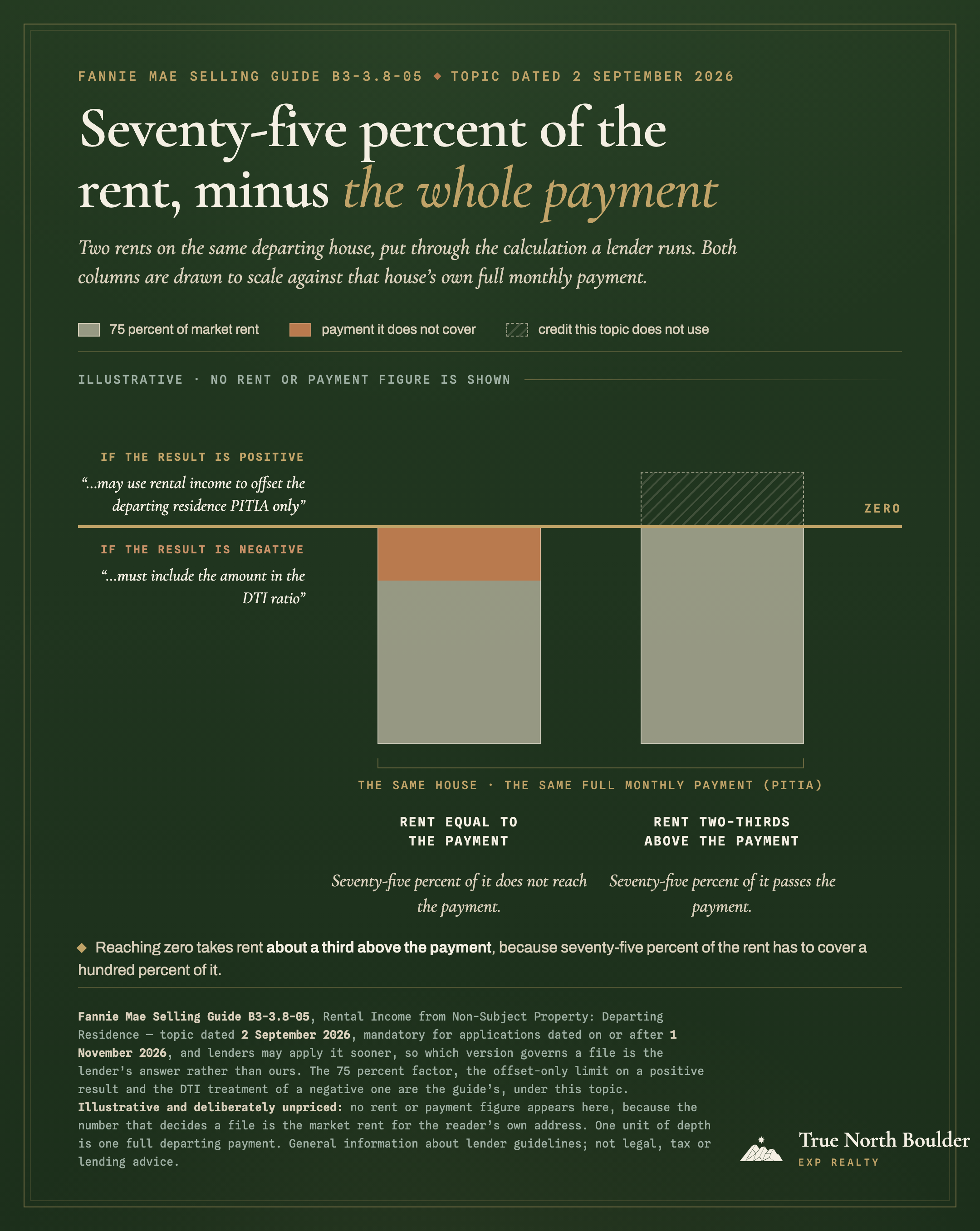
The guide sets out one calculation. The lender multiplies the monthly gross rent by 75 percent to reach net rental income, then subtracts the PITIA for the departing residence, meaning the full monthly obligation on the house you are leaving: principal, interest, taxes, insurance and any association dues. The result is what the guide calls adjusted monthly net rental income. One note on the I in that: run the subtraction on the insurance premium you'll have as a landlord, not the one you have today.
Two rules then attach to that number, and they aren't symmetrical. If it is positive, the guide permits the lender to use rental income to offset the departing residence PITIA only. If it is negative, the lender must include the amount in the debt-to-income ratio. Read them together and the shape is plain. The number can climb as far as zero and stops there. It can fall below zero as far as it likes.
| What you expected the rent to do | What the guide does with it |
|---|---|
| Count as income, so you qualify for more house | It doesn't. A positive result offsets the departing house's own payment and stops |
| Count in full | It counts at 75 percent of market rent, before the old payment is subtracted |
| Help if it is strong, be ignored if it is thin | A shortfall is not ignored. It goes straight into your debt-to-income ratio |
That 75 percent isn't a lender being cautious with you; it's a step in the calculation, applied to the rent before the payment comes off. Seventy-five percent of the rent has to cover 100 percent of the payment, so the rent has to run about a third above that payment before the calculation even reaches zero. That's why it lands short so often, even on a house that rents well.
And that multiplier isn't a budget, either. It's an allowance inside the lender's own arithmetic, not a reserve for your roof, your turnover, or the month the house sits empty between tenants. Those costs are yours, and they are not in this number.
Which reframes what you're actually buying with the decision. Our guide to reading your move-up equity position names the trap that catches owners who buy before the current home is under contract: the lender counts both mortgage payments against the debt-to-income ratio, as though you will carry two homes indefinitely. That trap is why this calculation matters. The standard way out of it is to sell, which routes the departing house down a different path in the guide entirely. That's the escape our guide to a HELOC, a cash-out refinance or a bridge loan leans on throughout, and it's the one route a keep-and-rent plan gives up. The departure-rent calculation is the only other route to making that payment stop counting, and the best it can do is exactly that. Keeping the house does not add borrowing power. It removes a subtraction, and only if the numbers clear.
The lease your underwriter is not allowed to read
The short version: The advice filling the first page of results on this question tells you to get a lease signed and hand it to your lender. For the home you are vacating, the guide forbids it in one line: lease agreements are not permitted for any departing residence. That topic is dated 2 September 2026 and is mandatory for applications from 1 December 2026. The lender documents market rent instead, from an appraisal, a Form 1007, or market-analysis tools with at least three comparable rentals.
This is the part worth slowing down for, because the advice in circulation isn't merely incomplete. It is the opposite of the rule.
Search the question and you'll be told that conventional guidelines count 75 percent of the gross rent shown on your signed lease. The percentage is right. The document is wrong, and it went wrong recently enough that the date matters. In the departing residence topic the guide prints a note in its own line: lease agreements are not permitted for any departing residence.
What the lender uses instead is market rent, evidenced one of three ways. A complete appraisal report that includes market rents. A Single-Family Comparable Rent Schedule, Form 1007, for the occupied unit. Or market-analysis tools, and where the lender uses those, the guide requires it to obtain at least three comparable rental properties, from within the same market area where possible. There is a precondition underneath all three: the lender must document a current housing payment before it uses any rental income from the departing residence in qualifying.
None of which makes your lease pointless, and it's worth being precise about that, because a tenant is still a tenant. The lease is the instrument that governs the tenancy, sets the term, and shapes your exit. It is simply not the underwriting evidence. A plan that waits on a signed tenant before talking to a lender has the sequence backwards, and the evidence your loan needs is an opinion of market rent for your address. You can start that conversation this week.
Two different documents are in play here, and the difference between them is who does the ordering. An opinion of market rent from a broker or a property manager costs nothing and takes days, and it's enough for you to run the subtraction and set a range. The version that goes in the file is ordered differently: the lender or its agent orders the appraisal or the rent schedule, not you, so a Form 1007 you commission yourself is generally not usable. Ask at pre-approval that the documented number be ordered then. If the pre-approval gets written on a loan officer's estimate and the documented rent only lands in underwriting, your earnest money is already in by the time the two disagree.
And if someone is already living there, the order matters more rather than less. The guide's rent schedule is written for the occupied unit, so an appraiser needs access, and once a tenancy exists that access is no longer entirely yours to give.
One honest caveat on all of it, and it has a date attached. The topic quoted here is dated September 2, 2026, the day Announcement SEL-2026-08 issued, and that announcement did more than renumber the chapter. It set out a new framework for departing residences built on market-supported rents, reserve requirements and PITIA offset limitations rather than lease agreements. It becomes mandatory for applications dated on or after December 1, 2026, and lenders are encouraged to apply it before then, which is why your lender's answer matters more than the calendar does. Which side of that date your own application falls on is a question for your lender, not a strategy to plan around. Rules of this kind are applied by the lender who is writing your loan, so the useful question isn't what a broker tells you the guide says. It's which version of it your lender is applying to your file, and whether your loan will be sold to an investor that follows it at all. Ask them in those words.
Six months of the old payment, in cash
The short version: This one is cash, not arithmetic. The guide requires six months of reserves covering the vacated property's payment when the borrower has less than 12 months of property management experience, and states that the six-month figure is in addition to any reserves required for multiple-financed properties. An owner who has never rented out a property doesn't have that history, which is the ordinary case in a first move-up.
This is a separate requirement from the calculation above, and the two are worth keeping apart. The twelve-month test plainly decides the reserve. Whether it also changes how the rent itself is treated is a question for your lender, because the general rental-income topic and the departing-residence topic do not read identically on it, and an owner who has managed a rental before is not in the same position as one who never has. If you've managed a rental, say so early and ask which of the two the underwriter is applying to your file.
The requirement reads plainly. The lender must verify the borrower has six months of reserves to cover the PITIA obligation for the vacated property when the borrower has less than 12 months of property management experience, and the guide adds that the six-month figure is calculated in addition to any reserves required for multiple-financed properties. Experience here is documented, not asserted: the guide looks for a tax return showing the property actually rented, a Schedule E supporting 365 fair rental days or a business return on Form 8825, which an owner renting out a property for the first time does not have.
Reserves are assets you document and do not spend, which is why this is the requirement that surprises people at the worst moment. It's the same money you had mentally allocated to the new down payment. The equity-position guide walks the distinction between cash-to-close and reserves, and why clearing one isn't qualifying on the other. What matters here is that they stack. Keeping the house adds a second reserve obligation on top of the first, on a house you no longer live in.
Keeping the house is why the next loan is the harder one
The short version: Keeping the house keeps your equity inside it, so the new loan is larger by exactly the amount you didn't take out. In Boulder County the line that matters sits at $879,750 for a one-unit home in 2026, and past it the loan is jumbo, which is not a Fannie Mae loan at all.
The rest of the move-up decision assumes a sale, because the sale is where the down payment comes from. Remove it and the down payment has to come from savings, and the loan on the new house grows to cover the difference.
If the plan was a line of credit on the departing house rather than savings, check its terms before you move, because those lines generally turn on the house being where you live. Our guide to a HELOC, a cash-out refinance or a bridge loan covers that instrument, and it assumes the balance is retired out of your sale proceeds at closing, which is exactly what never happens to an owner who isn't selling. Ask your lender whether a payment on a subordinate lien sits inside the PITIA this calculation subtracts.
Boulder County's one-unit conforming loan limit for 2026 is $879,750. Our guide to the equity position lays out what that threshold does to your down payment, and why the twenty-percent instinct is usually the wrong reflex in this band. The part that belongs here is narrower, and it is easy to miss. Keeping the house doesn't just move you along that menu of paths. It can remove the menu, because the equity that would have funded a larger down payment is still sitting in a house you didn't sell.
There is also a consequence past the line that has nothing to do with the down payment. A jumbo loan is not sold to Fannie Mae, so the rulebook this piece has just walked through is not the one governing it. Reserve expectations, how departure rent is treated, what evidence is acceptable: on a jumbo file those are the lender's own, and they vary. We're not going to tell you what they are, because there's no single authority publishing them. So an owner who researched the conventional rule and then landed on a jumbo loan has researched the wrong document, and the moment to find that out is when the price range is set.
Two of these three questions turn on the house you are moving to
The short version: Three questions, and they run on different clocks. Which office licenses your rental is about the parcel you are leaving, so you can settle it this week. Whether the city's temporary exemption is available, and whether you must name a local agent who can reach the property, both turn on where you move to, so they're filters to carry into the search rather than calls to make now. Those two point at the same fact, living outside Boulder County, but they use it differently. The exemption requires that it be temporary. The local-agent rule turns on where you are domiciled, and the city's page is a summary of the ordinance rather than the ordinance itself.
Boulder's licensing mechanism itself is covered in our guide to buying on University Hill, which walks what the license requires, the inspection, and the handoff clock when a licensed rental changes hands. Three questions sit outside that, and they only arise when you vacate a house you already own. Two of them turn on your next address.
| The owner's question | Where the answer comes from |
|---|---|
| Can I use the temporary rental exemption? | The city's temporary rental exemption affidavit requires all of five things, including that the unit is temporarily rented for no longer than 12 consecutive months in any 24-month period, that the owner is temporarily living outside of Boulder County, and that the owner intends to reoccupy. A move-up buyer typically fails two at once: no intention to reoccupy, and a move to Niwot or Gunbarrel never leaves Boulder County |
| Do I need someone local? | The city's licensing page states that a local agent is required of owners who do not reside in Boulder County, and that the agent must be able to respond to the property within 60 minutes. Move to Gunbarrel or Niwot and you have not left the county, so it does not arise. Move to Loveland or Berthoud and you have, so put the question to the City: the ordinance behind that page sets the operative test, and its terms are not identical to the page's summary of it |
| Which authority do I even ask? | The City of Boulder states its code requires all rental properties in Boulder to maintain a valid rental license. Boulder County's program covers short-term and vacation rentals in unincorporated Boulder County, meaning stays of fewer than 30 days, and the county states it does not issue licenses for the incorporated cities and towns. Two different offices, and the parcel decides which one |
The jurisdiction rule underneath the licensing question isn't intuitive. Inside an incorporated town's limits the town is the authority, whichever county the parcel sits in; the county is the authority only in unincorporated territory. One caution goes with that. What the county publishes is the scope of its short-term rental program, which is not the same statement as there being nothing to comply with. Ask the county about your parcel rather than reading the absence of a program as an answer.
The exemption and the local-agent questions turn on a different fact: which county you end up living in. That is where a Longmont move is genuinely ambiguous, because Longmont spans both Boulder and Weld counties. A Longmont address on its own doesn't tell you which side of the Boulder County line you've landed on, so it settles neither. The office to ask is the City of Boulder's rental licensing program, which administers both the exemption affidavit and the local-agent requirement, and the address it needs is the one you're moving to.
Becoming the landlord changes what you owe, and how you get out
The short version: Becoming a landlord starts a set of obligations, and the approval on the new house settles none of them. Colorado protects source of income as a housing class, including in advertising. Your note probably carries an occupancy clause, so ask your servicer about it. Your insurance won't be the policy you have now. And the tenancy you create governs how and when you can sell later. That's a partial list: Colorado's general landlord-tenant duties, from habitability to security deposits to notice and entry, attach the day a tenant moves in and aren't covered here.
Colorado is broader than federal law here. Source of income is a protected class in housing under the state's anti-discrimination act, which reaches refusing to rent or lease, the terms and conditions you set, and what appears in any advertisement. That last one catches people, because the advertisement is usually the first thing a new landlord writes.
You'll also find two carve-outs discussed online, and they're different from each other and narrower than they look. One concerns a landlord with three or fewer rental units. The other is voucher-specific rather than general: a landlord who owns five or fewer single family rental homes, and no more than five total rental units including those homes, is not required to accept federal housing choice vouchers for them.
Neither is a general exemption from source-of-income law. Each is written against particular obligations within it, and Colorado added new landlord duties in this area in 2025. Whether either one reaches you isn't something a guide can settle, and it doesn't turn on any single fact. It turns on the statutory terms applied to what you actually own, which means how many units you hold and in what form. It turns on whatever local ordinance governs the parcel you're renting, wherever that parcel sits. The City of Boulder is one example of that local layer and a live one: the city has had its own human rights ordinance since 1972, and states that it prohibits discrimination in housing on grounds including source of income. Take the question to a lawyer, or to the enforcing office, before you write a listing rather than after. Reading a carve-out too generously here doesn't produce a correction. It produces a discrimination claim.
A couple of these sit outside both the lender's file and the city's, and each is covered in depth elsewhere, so each gets a sentence here rather than arriving as a surprise. Your existing note very likely carries an owner-occupancy clause requiring you to live in the home, and the servicer who holds that note is the only party who can tell you what it does once you stop. Our guide to the Boulder move-up rate lock-in covers that clause alongside the rest of the keep-the-rate question. Moving out also starts a clock on the federal capital-gains exclusion, and the mechanism is what makes it bite here: continuing to own the house does nothing for that test, because the part of it that erodes is how recently you lived in the house rather than how long you've held it. Weigh it against the rate you're keeping, because for an owner who has been in the house a while it's usually the larger of the two numbers by some distance. Our guide to capital gains on a Colorado home sale runs that math, and it's a conversation to have with a CPA before the tenant moves in.
One more that nothing else on this page will catch. The insurance changes: a house with a tenant in it is generally written on a different policy from the one covering a house you live in, and it's generally not cheaper. That reaches past the premium, because insurance is the I in the PITIA this whole calculation subtracts. Get a landlord quote before you settle on a price range, and run the subtraction on that number rather than on the bill you pay today. While you have the carrier on the quote, ask whether Colorado's rebuild-coverage offer duty even reaches a house you do not live in: the statute defines the home it covers as a single-family home its owner uses as a primary residence.
The one people plan around least is the exit. A tenancy isn't only an income stream. It is a constraint on your own timing: once someone is living there under a lease, when you can list, what you can show and when you can deliver the property are governed by that arrangement and by Colorado's tenancy rules. Our guide to selling a tenant-occupied home in Colorado covers what that actually looks like. Read it before you sign the lease, not when you want out.
None of that is the whole list. Colorado's residential landlord-tenant law is its own body of rules, and habitability, security deposits, notice and entry all attach the day someone moves in, whatever your lender or your licensing office has told you. We're not going to summarize it here, because summarizing it badly is worse than routing it. Take it to a landlord-tenant attorney, or to a property manager who does this for a living, before the lease is signed rather than after the first dispute.
The order to run this in
The sequence matters more than any single answer, because the early ones are cheap now and expensive later.
FIRST, CHECK THAT YOU'RE ALLOWED TO RENT IT AT ALL
Two permissions sit above every number here, and both are one phone call. If the house is attached or sits under an association, check the covenants: some cap how many units can be rented and run a waiting list, which makes the answer a date rather than a yes. Your existing note very likely carries an occupancy clause, separately from anything the association says, and the servicer will say whether it still applies this far into the loan. None of the arithmetic below matters if either one says no.
GET AN OPINION OF MARKET RENT, NOT A TENANT
A broker's or property manager's opinion of rent for your address is free, quick, and enough for you to run the subtraction. The version that goes in the file is ordered by the lender, not by you, which is what the lender call below is for.
DO THE SUBTRACTION WHILE IT IS STILL HYPOTHETICAL
Seventy-five percent of that market rent, minus the full monthly payment on the house you are leaving. Positive means the old payment stops working against you. Negative means it works against you by the shortfall, and you want that answer before a house is involved.
ASK A LENDER TWO QUESTIONS BEFORE YOU SET A PRICE RANGE
Which version of the guide are you applying to my file, and will this loan be conventional or jumbo at the price I'm targeting. The second answer decides whether any of the first governs. If you don't have a lender yet, that call is this step, and it's where you ask for the documented rent to be ordered at pre-approval rather than in underwriting.
COUNT THE RESERVE SEPARATELY FROM THE DOWN PAYMENT
Six months of the old house's payment, documented and unspent, on top of whatever the new loan requires. If that money is currently the down payment, the plan needs revisiting now rather than in underwriting.
SETTLE ONE LICENSE QUESTION NOW, CARRY TWO INTO THE SEARCH
Which office governs the house you're leaving is answerable today, with one address. The other two turn in part on where you land, so they aren't a call to make this week. They're a filter to carry into the search, and the destination town usually settles them before any address does. Longmont is the exception: it spans two counties, so that one waits for a parcel.
TAKE THE TAX AND EXIT QUESTIONS TO PEOPLE WHO OWN THEM
The capital-gains clock to a CPA, and the tenancy you're about to create to your broker, because it sets the terms of the sale you may want in three years.
Almost none of this needs a listing, which is the good news in it. A month of arithmetic is cheaper than a rate you kept and a house you couldn't buy.
It's worth saying plainly what the subtraction is for. If there are two names on the deed, this is a decision people get genuinely stuck on, because holding a rate you can feel and holding a reason to move are both reasonable positions, which is exactly why talking about it doesn't settle it. The subtraction doesn't take a side. It's a number. It either clears or it doesn't, and that is a different thing to put on the table than an opinion.
And if it doesn't clear, that's an answer rather than a dead end. It means keeping the house is off the table and you're back to the choice between buying first and selling first. That choice has its own guide: buying before you sell in Boulder, and if the home you'd be selling is attached, selling it instead starts well before the listing does. Keeping the house was the third route around it, and the arithmetic on this page is what tells you whether that route is open.
Frequently asked
Does rent from my old house help me qualify for the new one in Colorado?+
Not in the way most plans assume. Under Fannie Mae's Selling Guide the lender multiplies the monthly gross market rent for the home you are vacating by 75 percent and subtracts that home's full monthly payment, including principal, interest, taxes, insurance and any association dues. If the result is positive, the guide permits the lender to use the rental income to offset the departing residence's payment only. Under that topic it doesn't become qualifying income that supports a larger loan on the new house. If the result is negative, the lender must include that shortfall in your debt-to-income ratio. An owner who has managed rental property before may sit under a different test, so ask your lender which one is being applied.
Can I use a signed lease to prove the rent to my lender?+
Not for the home you are leaving. Fannie Mae's Selling Guide states in the departing residence topic: Lease agreements are not permitted for any departing residence. That topic is dated 2 September 2026 and becomes mandatory for applications dated on or after 1 December 2026, and lenders may apply it sooner, so ask which version is being applied to your file. The lender documents market rent instead, using a complete appraisal report that includes market rents, a Single-Family Comparable Rent Schedule on Form 1007, or market-analysis tools, and where it uses those tools it must obtain at least three comparable rental properties, from the same market area where possible. The lender must also document your current housing payment before using any of that rental income. Sign the lease for the tenancy, which is what it governs. Just don't plan the loan file around it.
How much do I need in reserves if I rent out my old house?+
Fannie Mae's Selling Guide requires the lender to verify six months of reserves covering the vacated property's monthly payment when the borrower has less than 12 months of property management experience, and it states that this is in addition to any reserves required for multiple-financed properties. Reserves are liquid assets you document rather than spend, so this is the same money you were counting toward the new down payment. Your own lender may require more. Ask before you set a price range.
Do I need a rental license to rent out my Boulder house?+
It is settled parcel by parcel, and two in-band houses a few minutes apart can land under different authorities. The City of Boulder states that its Boulder Revised Code and Property Maintenance Code require all rental properties in Boulder to maintain a valid rental license. Boulder County's own licensing program covers short-term and vacation rentals in unincorporated Boulder County, meaning rental durations of fewer than 30 days, and the county states it does not issue licenses for the incorporated cities and towns. Niwot is unincorporated. Most residential Gunbarrel is too, but the City has annexed specific pockets, so it maps parcel by parcel and a Boulder mailing address settles nothing. Confirm the parcel with the authority that governs it before you advertise, and confirm that something applies before you conclude nothing does.
Does keeping the house as a rental make it harder to sell later?+
It changes who can buy it and when you can offer it. Once a tenancy exists, your ability to list, show and deliver the property is governed by that tenancy and by Colorado's residential tenancy rules, not solely by your own timing. That is a real cost of the decision and it belongs in the decision rather than after it. Our guide to selling a tenant-occupied home in Colorado walks the mechanics.
About the numbers here, and the one we will not print
The underwriting rules on this page are quoted from the Fannie Mae Selling Guide as published, in the topic dated September 2, 2026. That topic becomes mandatory for applications dated on or after December 1, 2026, and lenders may apply it before then, so which version governs your file is your lender's answer rather than ours. Conventional guidance is not universal guidance: a loan sold to a different investor, and any jumbo loan, is governed by a different document, and we've quoted only the one we read.
We are not printing a Boulder rent figure, and the reason is the rule itself rather than modesty about data. The number that decides your file is the market rent for your address, evidenced by an appraisal, a Form 1007, or at least three comparable rentals from your own market area. A town-level average is a different statistic, computed on a different set of homes, and it cannot tell you whether your calculation lands above or below zero. There is also no published rent series broken out for the $800,000 to $1.5 million band specifically, so any figure we quoted at that level would be a town average with a band's label on it. Not printing it doesn't leave you without a number. Ask a broker or a property manager what your address rents for: the opinion is free, and it's enough to see which side of zero you land on. The documented version is your lender's to order, so ask for it at pre-approval.
The bottom line
Rent from the house you are leaving is not income. At best it is an eraser: the guide lets it cancel that house's own payment and stops it there, while a shortfall counts against you without a limit. So the question this page answers is never whether the rent helps you buy more house, because in this calculation it can't. It's whether the rent clears the old payment, whether you can document six months of that payment in reserves you won't spend, and whether the loan you end up with is even governed by the rule you read.
Those are the tests for whether you can. Whether you should is a different question, and this page hasn't answered it: what the house returns against what it costs to own, what vacancy and repairs and an eventual sale do to that number, and what else that equity could be doing. The obligations named above aren't the full list either. Clearing them gets you a plan that funds, which isn't the same as a plan worth running.
Whether the rent clears is knowable now, months before there's an offer to lose.
The subtraction, the reserve it triggers, and which set of rules your next loan is written under are all cheaper to ask now than in underwriting. We'll run the first two with you, and make sure the third one reaches your lender in the words that get a real answer. If the answer turns out to be sell, that's a conversation worth having on paper too.
Daniel Hsieh is a licensed Colorado real estate broker with True North Boulder, brokered by eXp Realty. This is general information about lender guidelines, local licensing and Colorado housing law, not legal, tax or lending advice. Guidelines are summarized rather than quoted in full and are applied by your lender; confirm your own file, your parcel and your obligations with your lender, your broker, a CPA and an attorney.
Sources & notes
- The departure-rent rule: Fannie Mae Selling Guide B3-3.8-05, Rental Income from Non-Subject Property: Departing Residence, topic dated 09/02/2026. Eligibility of a vacated primary residence; documentation of monthly gross rental income (complete appraisal with market rents, Single-Family Comparable Rent Schedule Form 1007, or market-analysis tools requiring at least three comparable rental properties from the same market area where possible); the note that lease agreements are not permitted for any departing residence; the current-housing-payment precondition; the adjusted monthly net rental income calculation (monthly gross rent multiplied by 75%, less the departing residence PITIA) and its treatment (positive offsets the departing residence PITIA only, negative is included in the DTI ratio); and Additional Reserves (six months of reserves covering the vacated property's PITIA where the borrower has less than 12 months of property management experience, in addition to reserves required for multiple-financed properties).
- The chapter restructure: Fannie Mae Announcement SEL-2026-08, issue date September 02, 2026, which created the current B3-3.8-01 through B3-3.8-06 series and made the new departing-residence framework mandatory for applications dated on or after December 1, 2026 (the September 23, 2026 reissue moved it from November 1), with earlier adoption encouraged. Read from the reissued announcement (marked "Updated: Sept. 23, 2026"); cited without a link because the announcements index returns 404 to automated retrieval. Section numbers in older articles, including B3-3.1-08, refer to the superseded arrangement.
- Documenting property management experience: Fannie Mae Selling Guide B3-3.8-01, General Rental Income Information (09/02/2026): a signed individual return with Schedules 1 and E supporting 365 fair rental days, or a business return with Form 8825.
- The conventional-versus-jumbo boundary: Fannie Mae Selling Guide B3-6-06, Qualifying Impact of Other Real Estate Owned (09/02/2026), which routes a current principal residence converting to investment use into the B3-3.8-02 through B3-3.8-05 range rather than to B3-3.8-05 alone, a different path from a residence pending sale. Loan limit: Federal Housing Finance Agency, Conforming Loan Limit Values, one-unit limit for Boulder County, Colorado, calendar year 2026 ($879,750; announced November 25, 2025). Boulder is a designated high-cost county, so the national baseline is the wrong figure here. FHFA announces the following year's limits in late November. We state no jumbo requirement, because jumbo underwriting is set by each lender and no single authority publishes it. Freddie Mac's parallel rule is not cited: its Seller/Servicer Guide renders client-side and returned no readable text at any endpoint we tried, and every secondary carrying that text is a re-stater.
- Licensing: City of Boulder, Rental Housing Licensing, including the Rental License Exemption Affidavit for a temporary rental and the local agent requirement. The local-agent statements on this page follow the City's own licensing page, which is a primary for what the City requires. The underlying ordinance was reached only through a search index after the code host returned a 403, and it appears to condition the duty on neither the owner nor the operator being domiciled in Boulder County, a limb the City's summary does not carry. We therefore state what the page states and route the operative test to the City rather than asserting either document's text as complete. Boulder County Community Planning & Permitting, Short-Term and Vacation Rental Licensing. Jurisdictional rule:
docs/markets/boulder-northern-front-range.md. - Source of income: Colorado General Assembly, HB20-1332, adding source of income as a protected class under the Colorado Anti-Discrimination Act, C.R.S. 24-34-502, and covering advertisements; the act's carve-outs for a landlord with three or fewer rental units and, for federal housing choice vouchers, a landlord owning five or fewer single family rental homes and no more than 5 total rental units including those homes. Each carve-out is written against particular obligations within the section rather than exempting a landlord from it generally. City of Boulder, Human Rights Ordinance (1972), prohibiting housing discrimination on grounds including source of income. We do not state whether the city ordinance carries a small-landlord exemption; its text is a question for the City.
- Not legal, tax or lending advice. Lender guidelines are applied by the lender, change without notice, and do not govern every loan.