Off-Market and Delayed Marketing: Selling in Boulder County
Three options sellers ask for as quiet, three answers to one question: who can see the house. IRES has a seller form for one, the office exclusive: filed with the MLS, not disseminated to other brokers. A delayed marketing listing stays in the MLS. Page 4 of the contract decides the rest.
You would rather not put a sign up the week you list. Maybe the house isn't ready. Maybe nobody at work has been told. Maybe you want one quiet week to think before the street does. In Boulder County that's a real choice. It's narrower than the national coverage suggests, and most of it was settled on a page you have already signed.
Key takeaways
- Three named statuses, three different answers to one question: which channels carry the listing. An office exclusive holds it back from other brokers and the public, though the listing itself is still filed with the MLS. Delayed marketing holds back only public marketing through IDX and syndication, which covers brokerage sites as well as the portals. Coming Soon holds back nothing except the front door.
- IRES publishes a seller form for the first of those three, the Office Exclusive Listing Waiver, and it carries a blank for delaying publication until a date or condition you write in.
- Coming Soon is the loudest of the three, not the quietest: photos and videos are on the listing and it's shareable with anyone and any platform, while showings cannot occur, for up to seven days.
- Section 9.1 of the Colorado listing contract, on page 4, carries four Will/Will Not boxes and a blank line. They decide most of this, and the form records that you'd been advised before choosing.
- Market the house publicly and the rule speaks to one of the three: IRES requires Participants to distribute Office Exclusive Exempt listings to other Participants within one business day after public marketing. Yard signs are on the rule's own list. A delayed marketing listing is already in front of other brokers, so a sign has nothing to trigger, and Coming Soon is visible from the start and runs out on its own clock.
Can you sell a home in Boulder County without putting it on the MLS?
Yes. IRES publishes one seller form for it, the Office Exclusive Listing Waiver, and it withholds the house from other brokers and from the public, though the listing itself is still filed with the MLS and simply not disseminated. That is a narrower trade than the "delayed marketing" in the national coverage, which leaves the listing available to other brokers and holds it back only from IDX and syndication. And the rule that ends an exemption is written for one of the two: IRES requires Participants to distribute Office Exclusive Exempt listings to other Participants within one business day after the listing has been publicly marketed.
IRES covers this whole footprint. Boulder, Longmont, Loveland, Berthoud and Lyons all sit inside its service area, so there's one rulebook to read and the answer is the same in Niwot as it is in Berthoud. It isn't the only MLS on the Front Range, though, and much of what a search returns on this subject is REcolorado's rulebook, the Denver service, so check which one your listing is going to. The IRES rulebook is published. So is the waiver form, whose own footer reads Rev. 3/2023. Both are linked at the foot of this page, and you can read them without asking anyone's permission, which is the part of this sellers are rarely told.
Office exclusive, delayed marketing, Coming Soon: who can see the house?
IRES publishes no delayed marketing period. Across the three surfaces a seller can read from outside (the rulebook, the forms page and the Coming Soon policy) the category is named twice, never given a length, and carries no seller form. NAR leaves the number to each local MLS to set at its own discretion. That is what IRES publishes, not what the IRESis input screen offers your broker, so ask your broker what the system allows today.
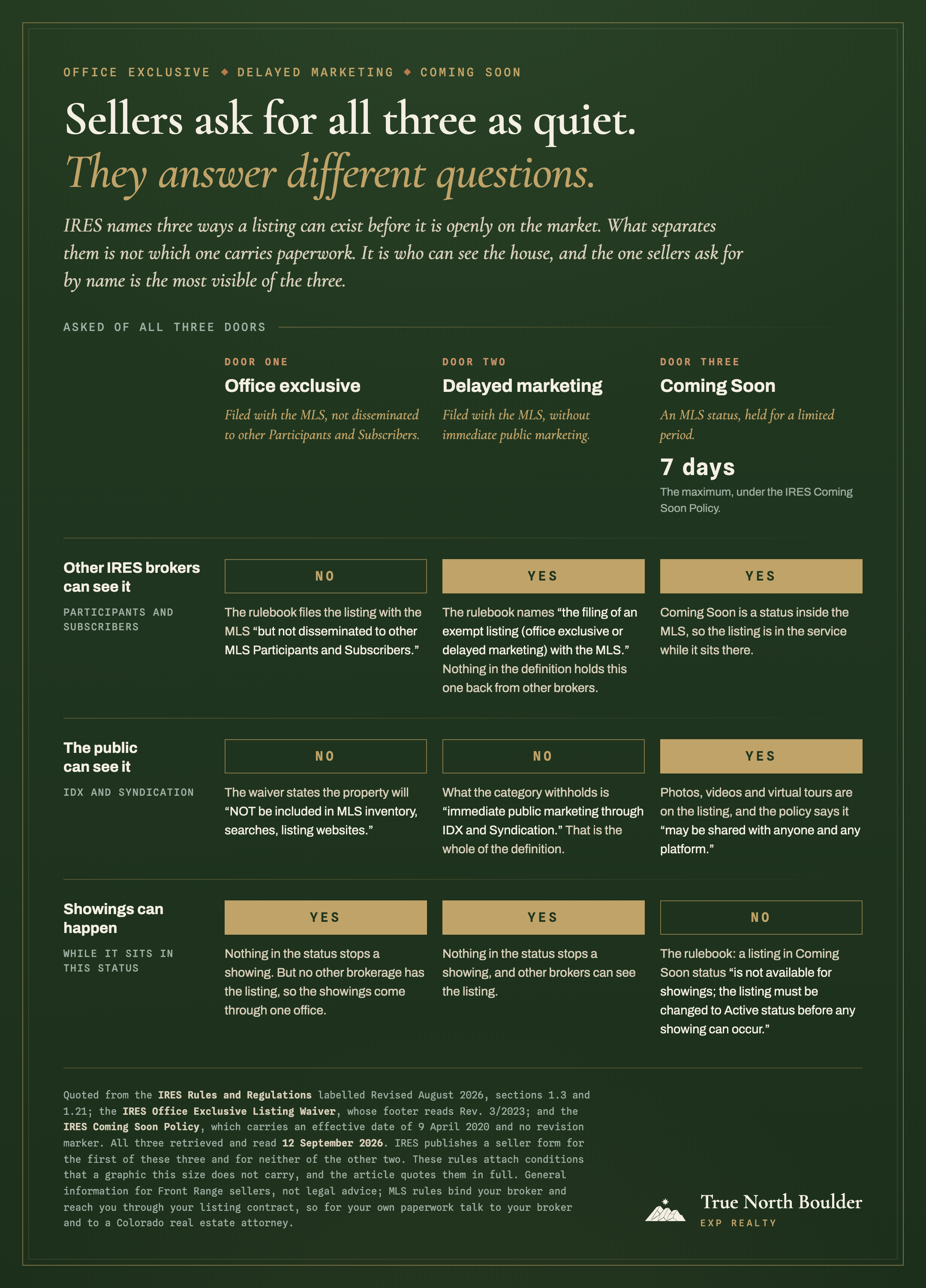
IRES names three ways a listing can exist before it's openly on the market, and sellers hear all three described as going quiet. They do different things, and the rulebook separates the first two in a single sentence, inside the paragraph setting out what a seller's signed exemption certification has to confirm.
An office exclusive is a listing where the seller has directed the broker "to not publicly market their property and to not disseminate it through the MLS to other MLS Participants and Subscribers." A delayed marketing listing is one that "will not have immediate public marketing through IDX and Syndication." Read those side by side and you have the whole of this page. One of them withholds your house from the trade. The other withholds it only from the public.
Neither of them keeps the paperwork away from IRES. The same section says an office exclusive "shall be filed with the MLS, subject to its local filing rules, but not disseminated to other MLS Participants and Subscribers," and the certification paragraph after it opens on "the filing of an exempt listing (office exclusive or delayed marketing) with the MLS." A record goes in either way; what you're choosing is who gets to see it.
The waiver form says what the first one costs, in a panel printed on the form itself: an office exclusive property will not be "Seen by over 7,000 local real estate professionals on the most widely used platform, the MLS," and will not be included in "MLS inventory, searches, listing websites." That isn't a softer version of holding back the portals. It's the other brokerages you're holding it back from, and it's the only one of the three IRES publishes a seller form for.
Coming Soon is the status sellers ask for by name, usually believing it's the discreet one. It's the opposite. Under the IRES Coming Soon policy, photos, videos and virtual tours are available on the listing, and "the listing may be shared with anyone and any platform." What it stops is the visit: showings cannot occur while a listing sits in Coming Soon, and it can stay there for up to seven days before moving to another status. Maximum broadcast, locked front door, one week.
Delayed marketing is the category the national coverage is about, and it's the one IRES says least about. The phrase appears exactly twice in the rulebook, both times inside that certification paragraph, with its effect described in a single clause. There is no period. There is no seller form on the forms page. The Coming Soon policy does not mention it. NAR's own policy leaves the length to each local MLS "in its unfettered discretion," which puts the number squarely in local hands, and a year after NAR's implementation deadline of 30 September 2025 passed, IRES publishes no number and no form for it.
Two boundaries belong with that publication finding, and both of them are limits on what we are claiming. The first is what it covers: all of the above describes what IRES publishes, on three surfaces we can read from outside. It does not describe what the IRESis input screen offers your broker on any given morning, because we can't see inside it and won't pretend otherwise. Ask your broker what the system actually allows today, and treat any answer that arrives without a rule behind it as a preference rather than a rule.
The second boundary is that blank on the waiver. It's real and it's useful, and it belongs to the office exclusive, not to delayed marketing: the line reads "I/We do NOT want my/our property listed in the IRES MLS system until _____ (Date or condition)." Filling it in turns an open-ended withholding into a bounded one, written on the form instead of left to a conversation you'll both remember differently. And what a date there delays is publication, not the filing: the form's own words are "NOT PUBLISH OR DELAY PUBLISHING." It does not hold your house on the MLS while the portals wait, which is what the coverage you've been reading is about.
Read the sentence printed directly beneath that blank, because the two are one construct: "And I/We WAIVE all benefits associated with publishing my/our listing on the MLS." The panel alongside spells out which benefits. And the certification block you sign carries an acknowledgement that your broker "has explained the advantages of the MLS and informed me/us of the serious considerations of limiting market exposure." Your listing contract opens its own marketing section with almost the same sentence, and you'd have signed that one first.
Which benefits, in plain words, because the form states them as an absence and a seller reading quickly can take the whole panel as boilerplate: the property will not be seen on the MLS by the over 7,000 local real estate professionals the form counts, and will not appear in MLS inventory, in MLS searches, or on the listing websites those feed. That is the machinery by which competing offers arrive. We are not going to put a number on what forgoing it costs, because nobody can price a buyer who never saw the house. Figures get published for this, and the honest limit on all of them is the same: an average drawn from other people's sales is not a measurement of yours. But it is what the signature moves, and a seller who wants the quiet week should choose it with that stated rather than implied.
One last thing about the date, and it's the difference between an instruction and a mechanism. Read the whole one-page form and nothing is attached to the date you write: no submission duty keyed to it, no consequence if it passes. One place a date can bind your broker is 9.3.1 of the listing contract, the specific-marketing-tasks blank in the table below. So the question isn't whether you can write "14 October" on the waiver. It's which document makes that date bind, and who acts on it.
NAR gives its own reason for offering any of this. Its policy says the options exist "while also supporting fair housing by providing buyers and their agents with equal access to important MLS property information."
One question is worth asking before any of this, because for a lot of sellers it settles the whole thing. Why do you want the quiet week? If the answer is that the house isn't ready, no status on this page is the answer. The three-business-day clock runs from your signatures, so a seller who needs a fortnight to paint needs no exemption, no waiver, no certification and no conversation about MLS rules. They need to sign on the 14th. The machinery above is for a narrower seller: one who wants to be actively selling while the house stays invisible.
The choice was made on page 4 of a contract you already signed
Whether or not you've signed yet, the answer is on the same page. If you haven't, it's the page you're about to sign, and this is the one moment when you decide rather than discover. If you have, it's already in your file, which is the more common way sellers arrive here. The Colorado Exclusive Right-To-Sell Listing Contract, form LC50, opens its marketing section by recording that the conversation has happened: Seller "has been advised by Broker of the advantages and disadvantages of various marketing methods, including advertising and the use of multiple listing services (MLS)," and then, "After having been so advised, Seller has chosen the following."
That sentence is something you told your broker, in writing. If you don't remember choosing, the form says you did, which is exactly why it's worth going and looking.
| Where it sits | What the form says | What it decides |
|---|---|---|
| 9.1.1 | "The Property ☐Will ☐Will Not be submitted to one or more MLS and ☐Will ☐Will Not be submitted to one or more property information exchanges." | Two separate choices in one sentence. The MLS and the exchanges are decided independently. |
| 9.1.2 | "Seller authorizes the use of electronic and all other marketing methods except: ______." | Your own carve-out line. A specific restriction belongs here in writing. |
| 9.1.3 | "Seller further authorizes use of the data by MLS and property information exchanges, if any." | Not a choice. There's no box here to tick or leave blank, which makes it the easiest line on the page to read straight past. |
| 9.1.4 | "The Property Address ☐Will ☐Will Not be displayed on the Internet." | The street number only. |
| 9.1.5 | "The Property Listing ☐Will ☐Will Not be displayed on the Internet." | The whole listing. |
| 9.3.1 | "The following specific marketing tasks will be performed by Broker: ______" | Blank. Where "no sign before the 14th" would live if you want it to bind. |
Four Will/Will Not boxes and a blank inside 9.1, plus the second blank at 9.3.1, all on page 4 of eleven. Go and look at yours before your next conversation about any of this.
There is one question the form does not answer, and we're not going to answer it for you. Section 9.1 prints no default for an unticked pair. Nothing on the page says what happens if nobody marked 9.1.1 or 9.1.5. The silence is worth reading as deliberate, because this contract knows how to write a consequence for an unchecked box. It does so at least six times elsewhere, including the provision that decides how your broker works with you: at 4.3.2, "in the event neither box is checked, Broker must work with Seller as a Transaction-Broker." Section 9.1 gets no such sentence. Colorado's purchase contract has its own rule about blanks in a different table, and that reasoning doesn't carry across to a different form. If your boxes are empty, that's a page to take to your broker before anything else happens, and one a Colorado real estate attorney should see if any public marketing has already started.
Hiding the address is not hiding the house
The two internet boxes look like a pair of dials for the same thing. They're not.
Mark Will Not at 9.1.4 alone and you have withheld the street number. The photographs, the price, the bedroom count, the square footage and the description are still there on the IDX feeds that carry the listing. A buyer sees your kitchen, your finishes and your asking price, and has to work slightly harder to learn which house it is. For most sellers who say they want privacy, that isn't what they meant.
The rule behind it is the IRES IDX section, which allows listings including property addresses in IDX displays "except where a seller has directed their listing broker to withhold their listing or the listing's property address from all display on the Internet." The two directions are separate, and the seller has to give one. Not every IDX site will carry your listing regardless, because the rules let a participant choose which listings to display by objective criteria such as location, list price or property type. Absence from one brokerage's website is not evidence that anything was withheld.
The MLS side of the same decision has a form of its own, reproduced in full inside the rulebook's Virtual Office Website section. That parent matters to you: the form sits under a heading about broker websites, so it is easy to read as somebody else's paperwork, and the signature at the bottom of it is yours.
Seller Opt-Out Form. "1. Please check either Option a or Option b … a. ☐ I have advised my broker or sales agent that I do not want the listed property to be displayed on the Internet. OR b. ☐ … I do not want the address of the listed property to be displayed on the Internet. 2. I understand and acknowledge that, if I have selected option a, consumers who conduct searches for listings on the Internet will not see information about the listed property … ___ Initials of seller"
Your listing contract offers two independent boxes; this form makes you pick one. The form itself says what option (a) does, in its item 2: consumers searching for listings on the internet "will not see information about the listed property." Option b is scoped to the address. The broker keeps the signed form for at least a year from signature "or one year from the date the listing goes off the market, whichever is greater."
Withholding a listing from display is a different job from getting one back down once it has been out there, and the second is harder than sellers expect. What a relist does and doesn't reset is the piece for that side of it.
Yard signs are on the list
The office exclusive is conditional, and the condition is one you can break by accident.
The rule, in full
IRES Clear Cooperation: "Within one (1) business day of marketing a property to the public, the listing broker must submit the listing to the MLS for cooperation with other MLS participants. Public marketing is engaging in any one or more of the following: flyers displayed in windows, yard signs, digital marketing on public facing websites, brokerage website displays (including IDX and VOW), digital communications marketing (email blasts), multi-brokerage listing sharing networks, applications available to the general public, cooperating with other brokerages, or any substantively similar activity."
The note printed directly under that rule closes the loop, and it opens by saying what the whole policy assumes: "Exclusive listing information for required property types must be filed and distributed to other MLS Participants for cooperation under the Clear Cooperation Policy." It then applies that "to listings filed under Section 1 and listings exempt from distribution under Section 1.3 of these MLS rules, and any other situation where the listing broker is publicly marketing an exclusive listing that is required to be filed with the service and is not currently available to other MLS Participants." That last clause reads like a catch-all, and it carries its own limiter on the end: it reaches a listing that is not currently available to other Participants. A delayed marketing listing is available to them, so a sign has nothing to trigger. Section 1.3 then says it from its own end, requiring Participants to distribute "Office Exclusive Exempt listings" to other Participants and Subscribers "within (1) one business day after the listing has been publicly marketed."
So the exemption isn't somewhere you go and stay. It holds while nothing is marketed, and it ends when something is. A sign in the front garden isn't a soft launch. It's item two on the rule's own list.
Two smaller rules point the same way. The listing contract makes your own advertising run through your broker first: "Seller agrees that any advertising of the Property by Seller (e.g., Internet, print, and signage) must first be approved by Broker." The MLS rules then allow only the listing broker's For Sale sign on the property at all. The enthusiastic homemade sign is covered twice over. What you may and may not say about buyer-broker compensation while marketing is a separate set of rules for sellers, and no status above changes it.
The waiver adds one more line worth reading slowly before you sign it, because it narrows the shelter further: "I/We understand that our Listing Broker is under a continuing duty to cooperate with other Brokers, whether or not the property is included in the MLS." An office exclusive holds your listing out of the MLS. It does not switch off your broker's obligation to deal with the brokers who come asking.
The MLS discipline here doesn't land on you. Section 7 authorises six measures, from a letter of warning through a fine not exceeding $15,000 to termination of MLS services, and every one of them runs against the participant or subscriber, not the seller. Your own exposure sits on the other document: the listing contract carries that approval clause, and a question about breaking it belongs there. That's simply why your broker will be careful about the sign, and why "let's put it up quietly for a weekend" gets a slower answer than you expect.
The portal rule changed. The MLS rule did not.
The story that put this topic in front of you was Zillow's listing access standard, introduced in April 2025. A home marketed publicly and not in the MLS within one business day would not appear on Zillow or Trulia for the life of the listing agreement, effective 30 June 2025. Then it moved. A replacement was announced on 17 March 2026, under which MLS submission became optional for Zillow's purposes.
So that is two versions of a portal's rule inside a year, and the second turns on the same question this page does. Zillow's own summary of it: "If listings are publicly marketed, they should be broadly accessible to buyers." Sellers, it adds, "can still choose truly private listings if they do not want their home to be publicly marketed at all."
The same announcement says plainly whose rules govern the choice: "While Zillow can set policies for how listings appear on our platform, we're not the rule-makers for the industry. Local MLSs establish the rules that govern listing marketing and distribution in each market, and agents and brokers are responsible for understanding and following those rules." The portal is telling you to go and read your MLS's rulebook, which is what this page has been telling you. That rulebook and your listing contract are both published, both dated on their own face, and both in reach tonight — which is more than the standard it replaced managed. Check the edition against the one you signed.
About this data: what we won't publish
No delayed-marketing day count. The twenty-one days in circulation this month belong to a Northwest MLS status launched on 4 September 2026, which is a Washington rule, allows showings and open houses, and requires every listing to be submitted to that MLS and accessible to its members, so it isn't an off-MLS status at all. IRES Coming Soon is seven days with showings forbidden. Same headline, opposite door. No price effect of selling off-market either: the three studies in circulation run in three directions, and they do not measure the same object. One is a portal's, one is an MLS and university pairing, and the third is measured on a brokerage's own phased marketing product rather than on an office exclusive or a delayed marketing listing. Every one of the three was published by a party with a position. Three measurements of three different objects don't average into a fourth. And nothing here describes what the IRESis system offers your broker, which is a screen we can't see.
Take the document, not the summary
The first three of these are only open to you before you sign. The last three work either way, and once you have signed they are what's left.
Ask what your brokerage's own policy is
Brokerage policy on off-MLS listings varies, and a brokerage can be stricter than its MLS. Get yours in plain words, and ask whether it's written down as a policy or held as a preference, because a house rule and an MLS rule sound identical when they're spoken aloud.
Put the three-business-day clock on your calendar
IRES requires listings delivered to the service within three business days of signatures, and the waiver has to be filed within the same three business days. The clock starts at your signatures, which makes the day you sign the simplest lever on this whole page.
Agree what counts as marketing, in writing
Signage, a neighbourhood email, a post in a private agent group. Write the restriction into 9.1.2 or 9.3.1 instead of leaving it as a shared understanding, because the one business day obligation runs from an act, not from an intention.
Find your listing contract and turn to page 4
Section 9.1 is the marketing section. Note which Will and Will Not boxes are ticked, what is written after "except" in 9.1.2, and whether 9.3.1 is blank. It's a short read, and it's most of the answer.
Ask for the Office Exclusive Listing Waiver by name
It's a one-page IRES form. Ask to read it before you decide anything: the line about your broker's continuing duty to cooperate, the sentence waiving the benefits of publication, and the blank for a date. Ask what an amendment to an executed contract would involve, and ask where each answer is written down.
Ask your broker what the MLS system actually offers today
Published rules and an input screen are different things. If the answer is that a delayed marketing status exists in IRESis, ask what period it allows and where that period is written down. Then ask the question almost nobody asks: when the exemption ends and the listing goes out to other brokers, what does the listing history show, and does the day count start at zero? An office exclusive can mean doing in advance what a relisting seller pays to undo afterwards, and the published rules don't answer it.
Once the channel is settled, the next decision is the one that actually governs your calendar: whether you sell first or buy first. That's a different problem from this one. Our guide to selling a move-up home in Boulder works the sequence through, and what an automated estimate can and cannot tell you is where to start on pricing.
For the Boulder end of the footprint, our guide to living in Boulder takes the wider view.
The bottom line
An office exclusive is a pause you can end by accident. It holds while nothing is marketed publicly, and once something is, IRES requires Participants to distribute Office Exclusive Exempt listings to other Participants within one business day. The version IRES publishes a seller form for holds your house back from other brokerages, not only from the portals. That's a real option, and it's the right one when that wider hold is the point rather than a cost you'd be absorbing along the way. It's simply narrower than the coverage implies, and you don't have to take anyone's word for that, including ours. Both documents are published, and both of them say so plainly.
The question the paperwork can't answer.
Read section 9.1 and the waiver yourself. Those two pages are yours and they are most of the answer. What neither tells you is what the IRESis system offers a listing today, and a broker can look that up in minutes. If you haven't signed yet, we'll also tell you plainly where we stand on listing a house off the MLS, before you pick anyone. If you have signed, the conversation is about what your existing contract already allows.
True North Boulder is a real-estate team with eXp Realty. This is general information about MLS rules and the Colorado listing contract for Front Range sellers, not legal, tax or financial advice; MLS rules bind your broker and reach you through your listing contract, so for your own paperwork talk to your broker and to a Colorado real-estate attorney.
Frequently asked
Can I sell my Boulder County home without putting it on the MLS?+
Yes. IRES publishes a form for it, the Office Exclusive Listing Waiver, which the owner signs to withhold the listing from the MLS. The rules are precise about what that means: the listing is still filed with the MLS and simply not disseminated to other Participants and Subscribers. The form states that the property will not be included in MLS inventory, searches or listing websites, and it carries a blank where you can instead direct your broker to delay publishing until a date or a condition you write in. Under the IRES rules a listing has to reach the service within three business days of the seller's signatures, and the waiver carries the same deadline on its own face. Whether it suits your sale is a conversation for your broker.
What is the difference between an office exclusive and a delayed marketing listing?+
The difference is who can see the house, and both listings are filed with the MLS; what changes is who it's shown to. The IRES rulebook draws the line in one sentence: an office exclusive is a listing the seller has directed the broker not to publicly market and not to disseminate through the MLS to other Participants and Subscribers, while a delayed marketing listing is one that will not have immediate public marketing through IDX and Syndication. So an office exclusive withholds the house from other brokers as well as from the public, while delayed marketing keeps it inside the MLS and holds back only the consumer sites.
Does IRES have a delayed marketing period?+
Not one it publishes. Across the three IRES surfaces a seller can read from outside, the category is named but never measured: the rulebook mentions it twice, always in the certification paragraph and never with a length attached; the forms page carries no seller form for it; the Coming Soon material is silent on it. NAR hands the length to each local MLS to set at its own discretion, and as of 12 September 2026 no length had been published here. That's a statement about what IRES publishes rather than about what the IRESis system offers a broker, so ask your broker what the system actually allows.
Does a Coming Soon listing stay off the internet?+
No, and it's the option sellers most often ask for by name while expecting the opposite. The IRES Coming Soon policy puts photos, videos and virtual tours on the listing and lets it be shared on any platform. What the status blocks is access to the house: no showings for as long as the listing holds it, and seven days at most before it has to move to another status. That's the loudest of the three options, with the door locked.
What happens if the marketing boxes in my listing contract are blank?+
The Colorado listing contract prints no default for them. Section 9.1 of the Exclusive Right-To-Sell Listing Contract offers Will and Will Not boxes for MLS submission, for submission to property information exchanges, for display of the property address on the internet and for display of the listing on the internet, and the form does not say what happens if a pair is left unticked. We're not going to tell you what an unticked box means on your own contract. Put the page itself in front of your broker, and get a Colorado real estate attorney onto it if the house has been marketed in any way already.
Does a yard sign end an office exclusive in Colorado?+
Under the IRES Clear Cooperation rule, within one business day of marketing a property to the public the listing broker must submit the listing to the MLS for cooperation with other Participants, and yard signs are named in the rule's own list of public marketing along with flyers in windows, digital marketing on public facing websites, email blasts and multi-brokerage listing sharing networks. A note under the rule applies it to listings exempt from distribution as office exclusives. The exemption is a pause rather than a place: it holds while nothing is marketed publicly, and public marketing starts the one business day obligation.
Sources & notes
- The MLS rulebook. IRES Rules and Regulations, the version published at iresmls.com and labelled Revised August 2026; retrieved and read in full 2026-09-12. Sections used: Section 1 (listings delivered "within 3 business days after all necessary signatures of seller(s) have been obtained"); Section 1.01 Clear Cooperation and its Note, quoted in full in the body; Section 1.3 Multiple Listing Options for Sellers, the office exclusive definition and the exemption certification paragraph (Amended 09/25); Section 1.21 Coming Soon Listings; Section 4.1 "For Sale" Signs (Revised 11/89); Section 7 discipline, whose six permitted forms run from a letter of warning through an "Appropriate, reasonable fine not to exceed $15,000" to termination, and which by its own chapeau apply to a participant or subscriber; Section 18.2.3 IDX display and Section 18.2.4 participant selection criteria (Amended 05/17 and 1/22); Section 19.6, which sits inside the Virtual Office Website section, for the Seller Opt-Out Form and the retention period.
- The listing contract. Colorado Real Estate Commission form LC50 Exclusive Right-To-Sell Listing Contract, Adoption Date October 7, 2025, Mandatory Use Date January 1, 2026, as printed on the copy read; retrieved with a browser user agent (a plain request returns 403) and read in full 2026-09-12. Section 9 and its subsections sit on page 4 of 11. Also used: Section 4.3.2, quoted for the way this contract writes a consequence for an unchecked box, and Section 10.2 on Seller advertising. The Commission renumbers these provisions between revisions, so confirm the version against your own contract.
- The waiver. IRES Office Exclusive Listing Waiver, whose own footer reads Rev. 3/2023; retrieved and read 2026-09-12. The revision column on the IRES forms page prints the same value against every row of that table, so it is a table-level stamp rather than a fact about any individual form; the footer and the file path both date this one to March 2023. Quoted lines: the three-business-day filing requirement for the form itself; "NOT PUBLISH OR DELAY PUBLISHING"; "until ______ (Date or condition)"; "And I/We WAIVE all benefits associated with publishing my/our listing on the MLS."; the acknowledgement that the listing broker "has explained the advantages of the MLS and informed me/us of the serious considerations of limiting market exposure"; the continuing-duty-to-cooperate acknowledgement; and the panel stating an office exclusive property will not be seen by over 7,000 local real estate professionals or included in MLS inventory, searches and listing websites. An older 2021 copy of the form is also still live; this is the 2023 one.
- Coming Soon. IRES Coming Soon policy and FAQ, carrying an effective date of April 9, 2020 and no revision marker, while the rulebook states the policy is updated by the MLS from time to time. Read 2026-09-12 for the seven-day maximum, the prohibition on showings, and the statement that a Coming Soon listing may be shared with anyone and any platform. Any figure from it is quoted as what the policy says on that date.
- The national framework. NAR, Multiple Listing Options for Sellers, effective 25 March 2025 with an implementation deadline of 30 September 2025, for the delayed marketing category, the "unfettered discretion" allocation of the period to each local MLS, and the quoted fair-housing rationale.
- The portal standard. Zillow, "Updating Zillow's Listing Access Standards for today's market", bylined on the page "Written by Zillow on March 17, 2026"; retrieved with a browser user agent (a plain request returns 403) and read 2026-09-12. Source for the April 2025 introduction, the "broadly accessible" test, the truly-private carve-out and the quoted passage on who makes the rules. The 30 June 2025 effective date of the original standard, its life-of-the-listing-agreement mechanic and the fact that MLS submission became optional for Zillow's purposes are from trade coverage at realestatenews.com dated 2026-03-19; we hold no permanent link for it. A second Zillow page on the same topic returns 403 to both a plain request and a browser user agent, which is a fact about that site's bot policy and not about the document.
- The twenty-one days. Northwest MLS, "Northwest MLS expands listing options", for the First Look status effective 4 September 2026; read 2026-09-12 and cited only to attribute the number to Washington. Every First Look listing must be submitted to that MLS and is accessible to its members, and showings and open houses are permitted at the seller's option, so it is not comparable to an IRES exemption.
- Deliberately not published: any delayed-marketing period for IRES, any dollar or percentage effect of selling off-market, and any description of what the IRESis input system offers a broker. The reasons are in the body.