When It Broke, and Who Knew: Defects in a Colorado Sale
Selling one Colorado house and buying the next? A defect's remedy turns first on two facts about time: whether it was there when the contract was signed or failed afterward, and who learned of it when. Of those, each side can set only its own learning date; nobody controls when anything fails.
Sell one Colorado house and buy the next in the same few weeks, and you're working the same contract form from both sides at once: a seller's duty on one address, a buyer's option on the other. A defect can turn up in either house, anywhere between the listing photos and the closing table. What happens to it is settled by two facts about time before anyone prices the repair: whether it was already there on the day the contract was signed or failed after, and who learned of it when.
This map leaves out casualty, such as fire or storm damage, which has a provision of its own, covered in our guide to owning two homes during a move, and a repair the buyer's lender requires after the appraisal, which follows the rules for lender-required repairs.
What if you find a problem after the inspection period?
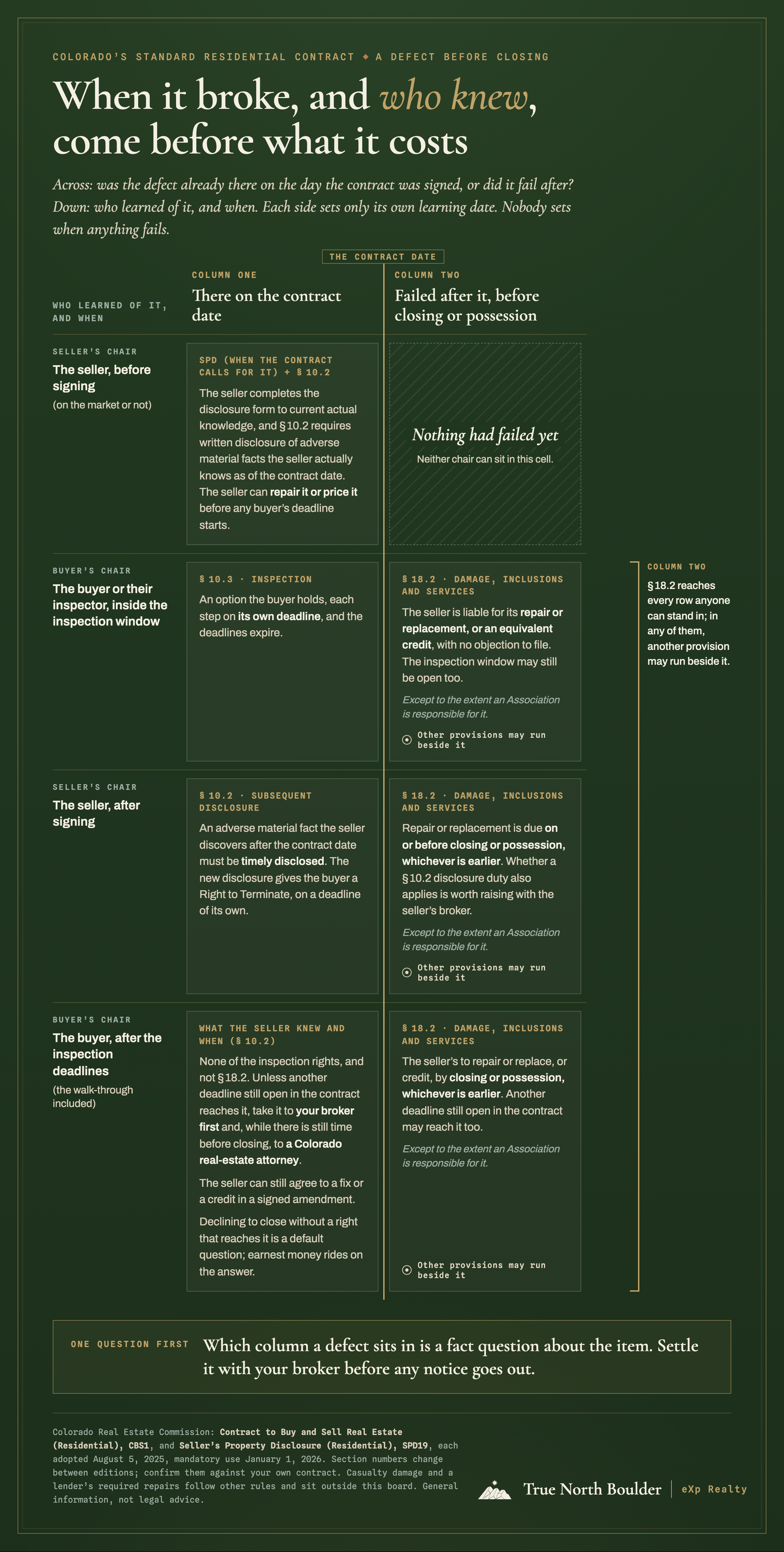
If you're the buyer and it surfaced after the inspection deadlines, two cells in the grid below apply. A problem that failed between the contract date and closing or possession, whichever is earlier, is the seller's to repair, replace or credit, except to the extent an Association is responsible for it. A problem that was there all along reaches none of the inspection rights, and unless another deadline still open in the contract reaches it, what is left turns on what the seller knew and when.
Colorado's standard contract sets one baseline, except where it provides otherwise: the property and inclusions "will be delivered in the condition existing as of the date of this Contract, ordinary wear and tear excepted." So the first question about a late find is when it came to be, and the second is who found out, and when. Cross the two and every defect in this map lands in one of these cells.
| Who learned of it, and when | Already there on the contract date | Failed after the contract date, before closing or possession |
|---|---|---|
| The seller, before signing (on the market or not) | The Seller's Property Disclosure, when the contract calls for it, which the seller completes to current actual knowledge; and §10.2, which requires written disclosure of adverse material facts "actually known by Seller as of the date of this Contract." The seller can repair it or price it before any buyer's deadline starts. | Nothing had failed yet. Neither chair can sit in this cell. |
| The buyer or their inspector, inside the inspection window | §10.3, Inspection. The buyer may terminate or deliver an Inspection Objection, each by its own deadline, and objecting gives up the inspection termination right. An objection with no written settlement ends the contract on the Inspection Resolution Deadline unless the seller receives the buyer's written withdrawal before then. Many settle as a credit or a price change written into an amendment rather than as a seller's repair. | §18.2, Damage, Inclusions and Services: the seller is liable for its repair or replacement, or an equivalent credit, except to the extent an Association is responsible for it, with no objection to file. The inspection right may still be open too. Which to lean on is the buyer's decision, made with their broker and the dates in hand. |
| The seller, after signing | §10.2 again: an adverse material fact the seller discovers after the contract date must be timely disclosed, and the new disclosure gives the buyer a Right to Terminate "on the earlier of Closing or five days after Buyer's receipt of the new disclosure." | §18.2, except to the extent an Association is responsible for it, with the repair or replacement due "on or before Closing or possession, whichever is earlier". Whether a §10.2 disclosure duty also applies is worth raising with the seller's broker. |
| The buyer, after the inspection deadlines (the walk-through included) | None of the inspection rights, and not §18.2, which needs something to fail or be damaged between the contract date and closing or possession, whichever is earlier. Unless another deadline still open in the contract reaches it, what is left turns on what the seller knew and when: take that to your broker first and, while there is still time before closing, to a Colorado real-estate attorney. The seller can still agree to a fix or a credit in a signed amendment. Declining to close without a right that reaches the defect is a default question, and the buyer's earnest money rides on the answer; the earnest-money guide covers it. | §18.2, except to the extent an Association is responsible for it. Unrepaired by closing or possession, whichever is earlier, the buyer "has the Right to Terminate under § 24.1., on or before Closing Date, or, at the option of Buyer, Buyer is entitled to a credit at Closing for the repair or replacement of such Inclusion or Service." Another deadline still open in the contract may reach it too. |
Read it down each column. The failed column is §18.2's, and our guide to something breaking before closing is about that provision, including how a credit lands on the settlement statement. §18.2 reaches every row of that column anyone can stand in, and it need not be the only provision there: §10.3 while the inspection window is still open, §10.2 if the seller learns of it, and any other deadline still open in the contract. Learn of the failure sooner and there's more time left before closing or possession for the repair to land in.
Down the left column the learning date changes the tool itself: the disclosure form and §10.2's first sentence, then §10.3, then §10.2's second sentence, then, past the inspection deadlines, what the seller knew and when.
The grid assumes you know which column you're in, and sometimes nobody does. A water heater that quits mid-contract may have been failing for months. Its repair records start the answer: take them to your broker before any deadline in your contract passes.
Where the right to walk away goes between signing and closing
Inside the inspection window, a condition the buyer finds unsatisfactory "in Buyer's sole subjective discretion" is reason enough to terminate or to object, each by its own deadline. Our guide to the ten contract deadlines that bite hardest covers those dates; your own contract's Dates and Deadlines table carries the rest.
Once the inspection deadlines pass, that reason is spent. The walk rights that remain are ones a named provision gives, each on its own date: on this map, §18.2 and §10.2, plus any deadline still open in your contract, which the Dates and Deadlines table in your own contract shows. Both sides can still agree in writing to end the contract, and anything beyond that is a question for a Colorado real-estate attorney. Either side can also propose a fix, a credit or a price change, and both can sign it into an amendment. What the contract no longer gives the buyer is an objection that ends the deal if the seller says no.
After closing, an election becomes a claim. Under §20.2.2, quoted in the same guide on something breaking before closing, a seller remains liable afterward for repairs the contract required; for a defect that was there all along, what's left usually turns on what the seller knew and when. What still holds anything for a buyer once the sale has closed is a different set of documents.
Selling one house and buying the next at once
Of the two facts the grid sorts by, the one you control on the house you're selling is when you find out. Find out before listing and the finding sits in the grid's top row, the row where no buyer holds a right over it yet; the pre-listing inspection guide makes the case for looking then. What you know is something the disclosure form asks about, with or without an inspection report, and whether a given item rises to an adverse material fact is one to settle with your broker or a Colorado real-estate attorney. The form is the seller's to complete, not the broker's.
On this map, signing changes two things for you as the seller. An adverse material fact you discover afterward has to be timely disclosed to your buyer, and that disclosure hands your buyer a walk right. And a Service that fails before your closing or possession, whichever comes first, is yours to repair, replace or credit, except to the extent an Association is responsible for it.
On the house you're buying, the learning dates you control are the inspection window, the walk-through, and the Seller's Property Disclosure Deadline, which you can propose in your offer so the form arrives before your inspector goes in. Booking the walk-through days ahead of closing rather than that morning moves one of those dates earlier. If you can't attend it yourself, our guide to something breaking before closing covers who to send.
So in one move you sit in the duty seat on one contract and the option seat on the other, often in overlapping weeks. The two seats are linked when your purchase depends on your sale: a walk right your buyer gains on the old house, from a disclosure made after signing or an unrepaired failure, can put the new one at risk too. Buying first unlinks them, at the price of carrying both homes at once, which starts with what your lender will confirm in writing.
Size and cost come last
Casualty and a lender's demand aside, a defect's size and cost decide how hard it is to fix, and they can bear on whether it rises to an adverse material fact the seller must disclose. They don't decide which column or row of the grid it lands in, or, on their own, what the contract lets either side do about it. The calendar settles that first: when the thing came to be, and who learned of it when. Of those two, the only one a party can set for itself is its own learning date. Nobody picks the week a water heater gives out, on the house you're leaving or the one you're buying.
This note describes how Colorado Real Estate Commission forms work in general. It is not legal, tax or financial advice, and it can't tell you which cell your own defect sits in. If real money rides on it, take it to a Colorado real-estate attorney, and early.
True North Boulder is a real-estate team with eXp Realty.
Frequently asked
What can I do if I find a problem after the inspection period in Colorado?+
In Colorado, start with when the problem came to be. Under Colorado's standard residential contract, an Inclusion or Service, such as heating or plumbing, that fails between the contract date and closing or possession, whichever is earlier, is the seller's to repair or replace, or to credit, except to the extent an Association is responsible for it, and there is no objection to file. A problem that was there all along reaches none of the inspection rights once the inspection deadlines in your contract have passed, and unless another deadline still open in your contract reaches it, what remains turns on what the seller knew and when. Your broker is the first call on that, and a Colorado real-estate attorney the second. If the seller discovers an adverse material fact after signing and discloses it, you have a Right to Terminate "on the earlier of Closing or five days after Buyer's receipt of the new disclosure." Whether your problem failed after the contract date or had been there for years is a fact question about the item, so settle that with your broker before any notice goes out.
Can I ask for repairs at the final walk-through?+
You can ask, and the seller can agree to a fix in a signed amendment. The walk-through itself is a right to verify that the property's physical condition "complies with this Contract", and the contract's standard, except where it provides otherwise, is the condition on the contract date, ordinary wear and tear excepted. A Service that has failed since you signed is the seller's to repair or replace by closing or possession, whichever is earlier, except to the extent an Association is responsible for it; if it isn't done, you may terminate on or before the Closing Date or take a credit at closing. A condition that was there all along and that you are only now seeing does not bring back the inspection objection; unless another deadline still open in your contract reaches it, what is left turns on what the seller knew and when, so take that to your broker first and, while there is still time before closing, to a Colorado real-estate attorney. Which of the two you're looking at is a fact question about the item, so pin that down before anything else. Our guide to something breaking before closing covers how to time and run that walk.
What does the contract ask of me as the seller while I'm also buying?+
On the Colorado house you're selling, four obligations bear on a defect. When the contract calls for it, you complete the Seller's Property Disclosure yourself, to your current actual knowledge; the form says it should be completed by the seller, not by the broker. You must disclose in writing any adverse material facts you actually know of as of the contract date. If you discover one after that date, you must timely disclose it, and that new disclosure gives your buyer a Right to Terminate on the earlier of closing or five days after they receive it. A disclosure that arrives with a proposed fix or credit gives your buyer something to weigh in those five days besides the exit; it isn't a reason to hold the disclosure back, which the contract says must be timely. And if an Inclusion or Service fails between the contract date and your closing or possession, whichever is earlier, you're liable for its repair or replacement, or an equivalent credit, except to the extent an Association is responsible for it. Moving out early doesn't end that window by itself; it runs to closing or possession, whichever is earlier, so keep the old house heated and its utilities on through your buyer's walk-through and on to closing. If buying your next house depends on this sale closing, a disclosure made after signing or an unrepaired failure gives your buyer a way out that puts your purchase at risk too. Whether something you found rises to an adverse material fact is for your broker or a Colorado real-estate attorney to help you weigh.
Sources
- Contract terms: CREC Contract to Buy and Sell (CBS1), mandatory January 1, 2026, §§ 10.1, 10.2, 10.3, 18, 20.2.2, 24.1; unchanged in the 2027 form set.
- Disclosure duty: CREC Seller's Property Disclosure (SPD19), mandatory January 1, 2026, same forms page.
- A broker's use of the forms: 4 CCR 725-1, chapter 7.