Rent to Answer Your Own Question, Not to Wait Out the Market
Most advice on renting first hands you a number of months. The right length is the time one question about your own situation takes to answer: whether the job holds, which blocks you'd live on, whether a second earner's job lands. After that, renting without shopping is a bet on rates and prices.
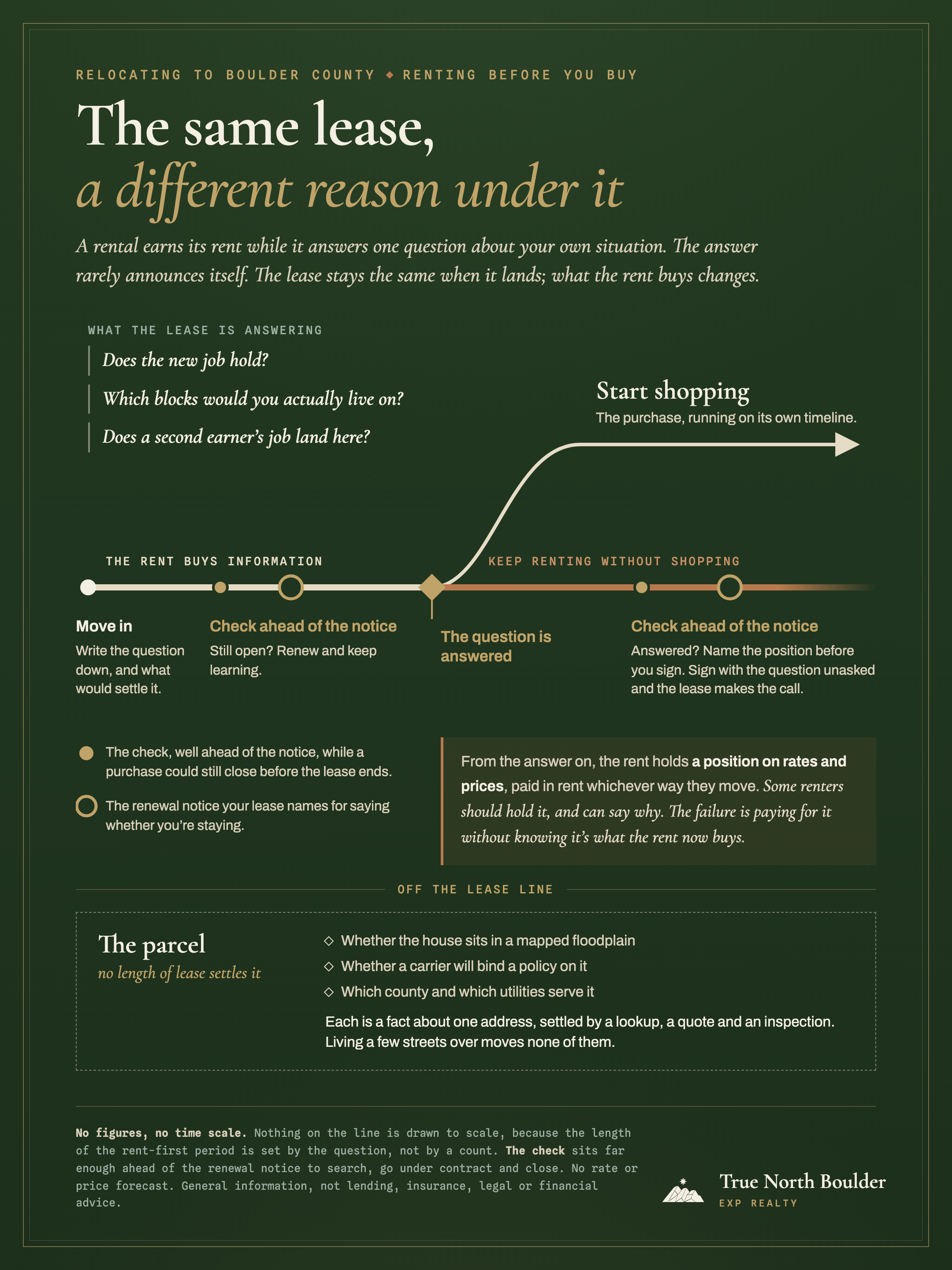
How long should you rent before buying in Boulder? We won't give you a number of months, because the right length is however long one question about your own situation takes to answer. Does the new job hold? Which blocks would you actually live on? Does a second earner's job land here? Write yours down when you move in. The month it's answered, a rental you keep without shopping stops buying you information and starts holding a position on rates and prices, paid in rent whichever way they move.
How long should you rent before buying in Boulder?
Rent for as long as one named question about your household takes to answer, whether that’s a job, a commute or a second paycheck, and not a month longer without shopping. No single count of months fits all three.
A year, six to twelve months, a break-even count: those are the usual answers, and they skip what the rent is actually buying. Renting first is worth whatever it lets you find out that a hotel room and a fly-in tour can't.
Our relocation guides each name a different question. A new federal hire rents through probation, because a lender may well count a probationer's paycheck, and if the job ends before probation does, the payment is still yours. Since 2025, keeping a probationer past that point has taken a certification from the agency, so the answer arrives as an act rather than a feeling. A Google transplant rents a season to learn which blocks are a bike ride from campus, and three to six months is enough for that question in a market balanced enough to let you ask it. Boulder leases commonly run a year, so a stay that short usually means corporate housing or a lease with an exit clause. And a household waiting on a second earner's job can't choose a commute that doesn't exist yet, which is why our relocation pillar waits for both jobs before the house.
Different questions, different lengths. The rule doesn't change.
If the question your lease is answering is which town, the employer table in our relocation guide narrows it to a row before the first renewal.
One reader this isn't for. If you sold first and you're renting while you shop, your rental is waiting on a listing, not learning about you, and the check on the destination town in our buy-before-you-sell guide is what governs your clock.
A lease can settle the job and the town, never the parcel
Renting answers the top of the relocation order: the job, the commute, the town. It can’t settle the facts that belong to one specific address, because those come from a lookup, a quote and an inspection, not from living nearby.
Living here answers three of the four decisions our relocation pillar puts in order: you learn whether the job holds by doing it, the commute by driving it on a weekday morning, the town by spending a winter in it.
The fourth, the parcel, doesn't work that way. Whether a house sits in a mapped floodplain, whether a carrier will bind a policy on it, which county and which utilities serve it: each is a fact about that address, and a year of living a few streets over moves none of them.
The South Boulder Creek flood project shows the trap. The City gives the build three to five years; the flood map changes only after that, when FEMA revises it at the City's request, with no date published. Even then, the new map lifts the federal rule behind a lender's flood-insurance demand only on the homes it redraws out of the zone, a lender may still require coverage on its own terms, and what the policy costs is set separately. A renter holding out to buy one of the homes it protects "once the map moves" is paying rent on two schedules, the City's and FEMA's, and controls neither.
What the rent pays for after the answer lands
Once your question is answered, a rental you keep without shopping holds a position on where rates and prices go next. You pay for that position in rent, and the rent is gone however they turn out.
People don't sit down and decide to bet on rates. The answer to your question rarely announces itself: the commute stops being a question on some Tuesday nobody marks. The lease does announce itself, with renewal terms on its own schedule. So the one moment built to force a decision is the landlord's, and by then the rental can be running on a different reason than the one you signed for.
From there the rent is buying something else. Rates can come down. What renting doesn't let you do is collect on a lower rate without also paying for every month it takes to arrive, and the relocating and cash buyers you'd be bidding against mostly aren't holding off to see where rates land. Prices can fall or rise too. The rent is spent regardless.
Some renters should hold that position, and can say why. The failure is paying for it without knowing it's what the rent now buys. A month spent shopping or waiting on a closing isn't part of it, and neither is a month with a preapproval in hand and a live search that hasn't found the house yet; in a thin price band or a winter market, that can be most of a lease. Those months are the purchase, running on its own timeline.
Before each renewal, ask what the rent is for
Write the question down
The question, and what would settle it: probation behind you, a winter of real commutes, a second job offer in hand.
Find your lease’s notice date
The date your lease names for telling the landlord whether you’re staying. It often falls well before the end date, and the renewal offer tends to come with a new rent. Put your own check far enough ahead of it to search, go under contract and close.
Get the lease to bend
Where you can, negotiate the month-to-month rollover or early-termination clause the NOAA guide recommends, so an early answer isn’t stuck behind a full lease.
Then ask the question again well ahead of that notice date, while a purchase could still close before the lease ends. If it's still open, renew and keep learning; that's what the rent is for. If it's answered and you'd still rather renew, name the position you're taking, rates or prices, before you sign for it. Sign the renewal with the question unasked and the lease has made the call for you.
The question sets the length. The calendar only tells you when to ask it.
The bottom line
A rental before you buy is worth what it teaches you about your own situation: the job, the commute, the town. Once that’s answered, keeping it without shopping is a position on rates and prices, paid in rent, and no lease settles the facts that belong to one specific house. Name the question when you move in, and check it with enough of the lease left to buy.
Frequently asked
Should I sign a 12-month lease if I might be ready to buy sooner?+
Usually, since a year is the common term here, but negotiate the way out before you sign: a month-to-month rollover or an early-termination clause, the same clause our NOAA guide recommends. Then find the date your lease names for giving notice, and check your question well before it.
Is it a mistake to keep renting until mortgage rates come down?+
Not if you choose it. Rates can come down, but every month you wait on them is a month of rent you don't get back, and the cash and relocating buyers in your price range mostly aren't waiting with you. Once your own question is answered, renting on without shopping is a position on rates and prices, paid for in rent either way. Hold it as a choice, or don't hold it.
What can't renting first tell me about a house?+
Anything that belongs to the address rather than the town. Living nearby teaches you the commute and the winter; it can't tell you what a flood lookup, an insurance quote or an inspection on one specific house will say, so there's no reason to rent longer waiting for those to become clear.
If you're renting now and can't name what the lease is for, that's worth a call well ahead of the notice date. We'll look at which question you're answering, whether it's settled already, and what's actually trading in your price band, so you know whether you'd be shopping or waiting. Sometimes the right move is another year of renting.
General information about renting before you buy, not lending, insurance, legal or financial advice. Run your own numbers past your lender before you decide.
True North Boulder is a real-estate team with eXp Realty.
Sources
- Flood project start and duration: City of Boulder announcement and project page, October 2026.
- Federal probation: OPM final rule, Federal Register 2025-11576, effective June 24, 2025.
- Lease lengths and relocation housing are practitioner observation, not measured statistics.