How to Compare Offers When Selling Your Home in Colorado
If your next purchase depends on selling this house, compare each offer with that purchase contract first. An offer fits if its Closing Date lands on or before your Conditional Sale Deadline; the gap from its last dated exit to that deadline is your margin if it fails there.
You've signed for the next house, and that purchase is waiting on this one to sell. Pick the wrong offer and this sale can fall apart after the date your purchase stopped depending on it, with the next house still under contract and no sale condition left to get you out. And while you weigh the offers, if the seller of the next house kept it on the market, a stronger offer there can force a choice: drop your sale condition or lose the house. For a move-up seller, then, knowing how to compare offers when selling your home in Colorado starts one step earlier than price and terms, with the Conditional Sale Deadline on the contract you've already signed for the next house: an offer fits only if its Closing Date falls on or before that deadline.
That date stays put from one offer to the next, which is what makes it useful. Hold each offer against it and the field sorts itself before you look at price. In September 2026, Boulder's single-family market had 4.3 months of supply; a year before, it had 5.4. Whether supply runs tight or loose, and whether you have one offer or several, the method works the same. Selling a move-up home in Boulder runs from the sequence decision through to listing. This guide picks up when the offers arrive. If your purchase isn't conditional on this sale, or you haven't signed it yet, skip to the last section, which reads offers against a different date.
What we won't print
How often Boulder listings, or homes in our price band, draw more than one offer. No source we use publishes that count, and the monthly reports don't break out the band. The comparison below doesn't need it, because each offer is measured against your contract rather than against the other offers.
Which date on your own contract do you compare offers against?
The Conditional Sale Deadline on your purchase contract, when that contract makes the purchase depend on this sale. It's the last day your seller can receive your notice ending the purchase because this house hasn't sold and closed. Once it passes with no notice received, that exit is waived, and every offer has to be read against it.
The provision is section 10.7 of the Colorado Real Estate Commission's standard purchase contract, headed Conditional Upon Sale of Property. It makes your purchase "conditional upon the sale and closing" of the house you already own, and gives you, as the buyer, a right to terminate "effective upon Seller's receipt of Buyer's Notice to Terminate on or before Conditional Sale Deadline if such property is not sold and closed by such deadline." The section is "for the sole benefit of Buyer," so the exit is yours; your seller can't invoke it.
The next sentence is why it's the date to measure every offer against: "If Seller does not receive Buyer's Notice to Terminate on or before Conditional Sale Deadline, Buyer waives any Right to Terminate under this provision." Section 24.1 adds that a notice delivered after the deadline "is ineffective and does not terminate this Contract." So nothing ends when the date passes. The purchase stays in place and the exit is gone. From that day on, section 10.7 no longer gives you a way out of the purchase if this sale falls through.
The deadline runs on your seller's receipt, not on when you act. A notice that reaches them the day after does nothing, so pin down with the broker on your purchase, well ahead of the date, how notice gets delivered under your contract. If the deadline lands on a weekend or holiday, read section 3.3.3 as well: the form moves it to the next weekday that isn't a holiday only when its "Will" box is checked. The date is also fixed by a signed contract. Section 25 says no change is binding "unless made in writing and signed by the parties," so moving it takes your seller's signature. The form for it is the Commission's Agreement to Amend/Extend Contract, and your seller can decline to sign.
Before you open an offer, then, find the Conditional Sale Deadline row in section 3.1 of your purchase contract, the Dates and Deadlines table, and write that date at the top of a page. Then read your purchase contract's Additional Provisions, section 30, and any addendum section 31 lists as part of it, before you trust that date. A seller who accepted a contingent offer often had a clause written there that keeps their house on the market; a stronger offer on it starts a short clock for you to give up your sale condition or lose the house. That clock can run out before your Conditional Sale Deadline, and it keeps running while you counter. If your purchase carries one, or an earlier date by which this house has to be under contract, that's the first date on your page, and your broker can tell you how yours reads. If the house you're buying is in another state, its contract may not use these names or section numbers, or work the way the Colorado form does; ask the agent on that purchase which date your sale has to clear, what happens if it doesn't, and how notice is delivered there.
How long can each buyer still back out?
Read each financed offer's dated exits: its loan, appraisal, inspection and insurance rows, and a sale condition of its own if it has one, then its Closing Date. The exits are the dates by which the deal can still end. The latest of them, set against your own Conditional Sale Deadline, shows how much room you'd have if the sale failed at that exit. Some exits run to Closing, and an offer's appraisal terms depend on its loan type, so the table doesn't show every way a sale can fail.
An offer on the Commission's form arrives with its own Dates and Deadlines table, and much of what can undo your sale sits in that table as a date. These are the rows a financed offer carries that this comparison reads; the form has others, such as title and survey, that work on the same pattern. On these offers the roles reverse: the form calls you Seller, and Buyer means whoever made the offer. Start with the table's last rows, the Acceptance Deadline Date and Time. Under section 27 the offer "will expire unless accepted in writing" and the buyer receives notice of your acceptance by then, so that's your clock for this comparison.
| Exit on the offer | Where in the contract | How it can end the sale | What to read on the offer |
|---|---|---|---|
| New Loan Terms | §5.2.1 | The buyer's notice, received on or before the deadline; the buyer judges the terms "in Buyer's sole subjective discretion" | The New Loan Terms Deadline |
| New Loan Availability | §5.2.2 | The buyer's notice, received on or before the deadline, if the loan's availability, after the lender's underwriting, isn't satisfactory to them (not a second chance to object to terms, appraisal or insurance) | The New Loan Availability Deadline |
| Appraisal | §6.2.1 | On a conventional or cash offer: if the appraisal comes in below the price or arrives late, the buyer may terminate by the Appraisal Objection Deadline or object instead; with an objection and no written settlement, the contract "will terminate on the Appraisal Resolution Deadline" unless the buyer withdraws. Other loan types carry their own appraisal terms | The Appraisal Objection and Appraisal Resolution Deadlines, and the loan type the offer names |
| Inspection | §10.3 | The buyer may terminate by the Inspection Termination Deadline, or object instead; with no written settlement the contract "will terminate on Inspection Resolution Deadline" unless withdrawn | The Inspection Termination, Objection and Resolution Deadlines |
| Property insurance | §10.5 | The buyer's notice, received on or before the deadline, on the availability, terms and conditions, or premium of insurance, in the buyer's "sole subjective discretion" | The Property Insurance Termination Deadline |
| The buyer's own sale | §10.7 | Only if the offer carries one; their notice if their home isn't sold and closed by their deadline | The offer's Conditional Sale Deadline, if any |
| Closing | §12.3 | Not an exit; the date the sale is scheduled to close, or "by mutual agreement at an earlier date" | The Closing Date |
| Earnest Money | §4.3, §20.1 | Not an exit; the form's remedy for you if the buyer fails to close | The Earnest Money amount |
Two of those rows end the contract on their own. If the buyer objects to the inspection, or on a conventional or cash offer to the appraisal, and you reach no written settlement by the Resolution Deadline, the form ends the contract on that date unless the buyer withdraws the objection. The other exits in the table need the buyer's written notice, received by you on or before the date. Either way, the date is what you're reading. That appraisal reading depends on the loan type the offer names, so ask your broker how a given offer's appraisal term works.
A blank row matters as much as a dated one. Under section 3.2, a deadline "left blank or completed with 'N/A', or the word 'Deleted'" means "the corresponding provision containing the deadline is deleted." That removes an exit from the buyer, and it removes everything else the provision carried, so check what a blank row took with it before you count it in an offer's favor.
Not every exit has a row. Lender property requirements run on a floating clock that starts when you receive them, which is its own read in what happens when a lender requires repairs before closing, and damage to the property before closing runs to the Closing Date rather than to a dated row. A buyer can also simply fail to close. So the last dated exit is the latest point the table shows, not a promise that nothing after it can go wrong.
That's why the offer's Earnest Money belongs in the comparison. It's printed in the offer's Price and Terms table, and if the buyer fails to close after their exits have passed, the standard form makes it your remedy: unless the box in section 20.1.1 is checked, section 20.1.2 calls it, outside two exceptions the form names, "SELLER'S ONLY REMEDY." Once your Conditional Sale Deadline has passed, section 10.7 no longer lets you out of your purchase if this sale fails, so for that stretch the deposit is what stands behind the sale. Under the form's default, where the section 20.1.1 box isn't checked, an offer with its exits stripped out and a small deposit is a buyer who can still walk away for the price of the deposit. Whether a buyer is in default is a question for your broker, and for a Colorado real-estate attorney if it's contested; under section 23 the holder releases the money on written instructions you both sign.
What a low appraisal on your sale does to your purchase sets the appraisal row against your own Conditional Sale Deadline. A buyer whose rate went up can also use the New Loan Terms row on your sale, which the guide to a rate rise while under contract covers.
Compare offers on what's printed on them, and on the lender letter that comes with them: the terms and the dates, and the money terms too. That means the Earnest Money, how much of the price is a new loan and how much is cash at closing, any Seller Concession and any payment to the buyer's brokerage the offer asks you to make (section 29.1), and how far the buyer's lender says the approval has actually gone. Who the buyer is isn't part of this comparison, and neither is the kind of income or assistance behind their money.
Does the offer close by your Conditional Sale Deadline?
For a Colorado move-up seller whose purchase depends on this sale, an offer fits only if its Closing Date falls on or before the Conditional Sale Deadline on your own purchase contract. If the Closing Date is later, the offer as written isn't scheduled to close by the date your purchase depends on. The days between its last dated exit and your deadline are the time you'd have to act if it failed at that exit.
This test comes before price, because the highest number on the table can sit on an offer whose Closing Date falls after your deadline. That isn't a dead offer. The contract allows closing "by mutual agreement at an earlier date," and your seller can agree in writing to move your deadline, so a late Closing Date is a problem to solve. You just can't count on either fix when you accept. An offer can also pass this test on paper and still leave you nothing to spare. A Closing Date that lands on your deadline, or a day or two before it, passes on paper with no room for the closing to move, and closings move for ordinary reasons, the buyer's lender getting its final loan paperwork out late among them. As far as your purchase is concerned, a sale that closes the day after your deadline hasn't closed by it. So read how many days sit between the offer's Closing Date and your deadline, not just which side of it the date falls on.
Find your deadline
The Conditional Sale Deadline on your purchase contract, as a date.
Check the offer's Closing Date
Is it on or before your deadline, and by how many days?
Find the offer's last dated exit
The latest of its loan, appraisal, inspection, insurance and sale-condition rows.
Count the days between
From that exit to your deadline. That's your margin if the sale fails at its last dated exit; remember that some exits run to Closing.
If the sale failed at that last dated exit, the margin is the time you'd have to decide about the purchase: end it by a notice your seller receives by your deadline, ask your seller for a written extension, which they may refuse, or let the right lapse and go ahead with the purchase. Which of those suits you is yours to weigh with your broker. The margin doesn't make that choice. It tells you whether you'll know the sale failed at that exit before you have to make it.
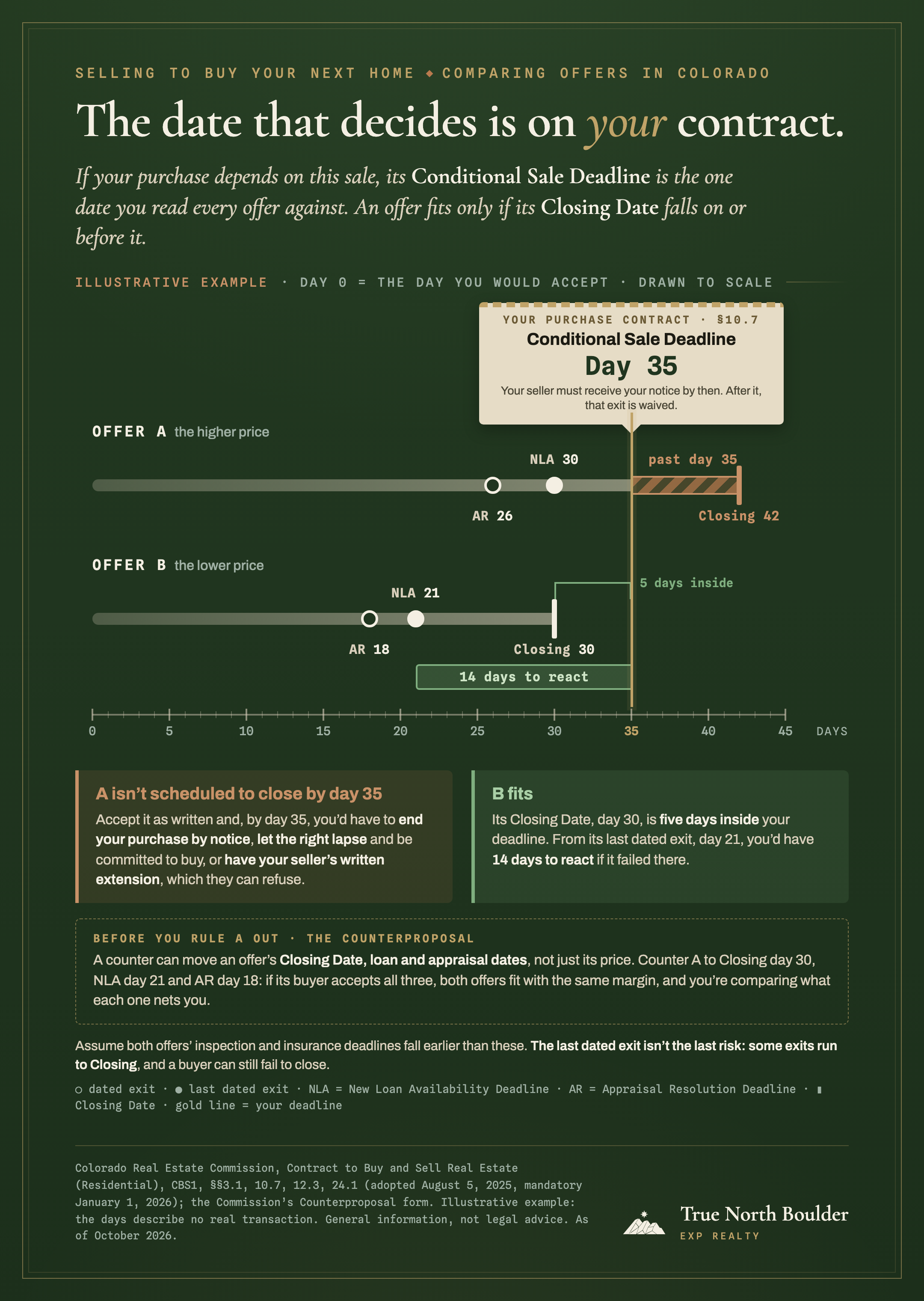
Day 0 is the day you would accept. Your purchase contract is signed and conditional on this sale, with a Conditional Sale Deadline on day 35. Offer A carries the higher price: New Loan Availability on day 30, Appraisal Resolution on day 26, Closing Date on day 42. Offer B is lower: New Loan Availability on day 21, Appraisal Resolution on day 18, Closing Date on day 30. Assume both offers' inspection and insurance deadlines fall earlier than these. Offer A isn't scheduled to close by day 35. Accept it as written and, by day 35, you'd have to end your purchase by notice, let the right lapse and be committed to buy, or have your seller's written extension. A's loan and appraisal exits would be behind it by then, so what you wouldn't know yet is whether it actually closes, with its Earnest Money the form's remedy for you if its buyer fails to close. That's a narrower question on day 35 than on day 0, and a short extension is an easier ask once a sale has cleared its loan deadline, though your seller can still refuse. Offer B is scheduled to close on day 30, five days inside your deadline, and its last dated loan exit, day 21, leaves 14 days to react.
Possession has its own row, separate from the Closing Date, and if the parties sign a Post-Closing Occupancy Agreement, the form says that agreement "will control Possession Date and Possession Time." For a seller with a purchase waiting, that row can matter as much as the Closing Date: an offer that closes well inside your deadline and lets you stay on until your purchase closes can cover the gap between the two closings, within whatever occupancy limit the buyer's own loan sets. If the dates leave you holding both houses for a stretch, what that overlap costs and how it's managed is covered separately.
Back in the example, price drops out of the comparison only for a moment. If Offer A's buyer will move their dates, you're back to choosing between two offers that both fit, and the Counterproposal, below, is how you ask.
Can a counter make a late offer fit?
A counter can move an offer's Closing Date, loan dates and appraisal dates as well as its price, because the Commission's Counterproposal form carries its own Dates and Deadlines table. When the strongest offer doesn't fit your deadline, a counter that re-dates it is how you find out whether it can.
A counter that touches only price leaves the dates that decide fit exactly where they were. The Counterproposal lets you change any row. Its notes say that an item left blank or marked "No Change" "means no change to the corresponding provision of the Contract," and an item marked "Deleted" deletes that provision. Each counter "supersedes and replaces any previous counterproposal," and once accepted, "the Contract, as amended by this Counterproposal, will become a contract between Seller and Buyer," provided acceptance comes in writing and "the offering party to this document receives notice of such acceptance on or before" the acceptance deadline written on it.
One trap is in the numbering. The Counterproposal's table doesn't number its rows the way the contract does, so the Conditional Sale Deadline and the Closing Date sit at different item numbers on the two forms. Name the row you're changing rather than relying on its number.
In the example, that means countering Offer A with a Closing Date on day 30, New Loan Availability on day 21 and Appraisal Resolution on day 18. If A's buyer accepts all three, both offers fit with the same margin and you're comparing what each one nets you after costs and concessions. If A's buyer moves the Closing Date and the loan date but not the appraisal date, A fits with 9 days of margin to B's 14, and that difference sits beside the price gap. If they won't move the dates, that is the answer about A. Whatever you counter, ask your broker what will be left to accept if it fails. And if your purchase carries a clause that ends once this house is under contract, every day spent countering is a day it stays live.
Slow down before countering two buyers at once. Nothing on the Counterproposal deals with counters going to several buyers at the same time, and under the acceptance terms quoted above each one becomes a contract once its buyer's written acceptance reaches you by its deadline; nothing on either one refers to the other. So ask your broker, before either counter goes out, how each will be worded so that no more than one can become a contract. The common alternative isn't a counter at all: with your go-ahead, your broker tells every buyer there are several offers and asks each for its best terms by a set time, which creates no contract until you accept one.
If your broker acts as your agent, your reasons for selling aren't theirs to share. Under C.R.S. 12-10-404(2), a broker acting as your agent may not disclose, without your informed consent, "that a seller... is willing to accept less than the asking price" or "what the motivating factors are for the party selling." If your broker is a transaction-broker instead, section 12-10-407(3) bars disclosing "what the motivating factors are for any party buying, selling, or leasing the property" without the informed consent of all parties. A purchase waiting on this sale is a reason for selling, so agree with your broker what, if anything, gets said about it; under the transaction-broker rule, saying it takes every party's consent.
What a contingent offer adds: a third contract
An offer conditional on its buyer selling their own home puts a third contract under yours. That buyer's Conditional Sale Deadline becomes one more exit on your sale, and how far along their sale is decides how live that exit is.
If an offer carries a sale condition of its own, it's the same section 10.7 you signed on your purchase, one link further down the chain. Your sale now depends on theirs, and their deadline is a row in the exit table like any other, so hold it against your own date the same way. Whether their house is merely listed or already under contract changes what that row is worth; how a home-sale contingency differs from a home-settlement one is explained from the buyer's chair.
Taking an offer like this, you may want the right to keep marketing the house, or a back-up buyer waiting. The standard contract carries neither a kick-out nor a back-up provision. Anything of that kind has to be written in by agreement, in Additional Provisions, section 30, or in an addendum that section 31 lists as part of the contract. The form opens section 30 by saying its provisions "have not been approved by the Colorado Real Estate Commission." The Commission's rules add that an additional provision that deletes or modifies part of a standard form "must result from negotiations or the instruction(s) of a party to the transaction." Your broker can tell you how one would be written; where it changes how the form works, that's a question for a Colorado real-estate attorney.
Offers that arrive after you've accepted one
In Colorado, your listing broker still has to present offers that arrive after you've accepted one. State law requires a seller's agent to present all offers in a timely manner whether or not the property is under contract, though the broker doesn't have to go looking for more.
The statute that sets a seller's agent's duties, C.R.S. 12-10-404, lists "Presenting all offers to and from the seller or landlord in a timely manner regardless of whether the property is subject to a contract for sale." The same section says "the broker shall not be obligated to seek additional offers to purchase the property while the property is subject to a contract for sale." If your broker works with you as a transaction-broker instead, section 12-10-407 carries the same duty, for "all offers and counteroffers."
So a later offer can still reach you, and receiving it doesn't end the contract you accepted. The standard form has no back-up provision, so whether a later buyer can wait behind the accepted one, and what becomes of their offer if your sale fails, depends on what's in Additional Provisions or in any addendum section 31 lists as part of the contract, and on how your broker sets up any second position, with a Colorado real-estate attorney where it changes how the form works. A later offer whose dates fit your deadline still tells you something: there's another buyer who could fit if the first sale came apart. Run it through the same steps you used on the first one, so that when you sit down with your broker and the accepted contract, you already know whether it would fit.
If your purchase has no sale condition, or isn't signed yet
If your purchase carries no sale condition, or you haven't signed it, there's no Conditional Sale Deadline to hold offers against. With no sale condition, read offers against the purchase's Closing Date and the money you need to close. If you haven't signed the purchase yet, the offer you accept can set the dates your purchase has to fit.
If the Conditional Sale Deadline row on your purchase was left blank or marked N/A, section 3.2 deletes the provision, and the standard form no longer makes the purchase conditional on this sale. That's the buy-first route, and the case for buying before you sell weighs it. The offers then get read against the purchase's Closing Date and the proceeds you're counting on to close.
If you haven't written the purchase yet, the sequence flips. The offer you accept sets the dates, and the Conditional Sale Deadline you then propose on the purchase needs room after that offer's Closing Date and its last dated exit; the seller of the next house can counter it. Before you write it, read what each Dates and Deadlines row means.
Listing with us? We'll read every offer against your deadline.
Each offer's Closing Date and dated exits, set beside the Conditional Sale Deadline in your purchase contract, with a note on where a counter could make one fit. If another broker already has your listing, they're the one to take this page to.
True North Boulder is a real-estate team with eXp Realty. This is general information, not legal, tax, or financial advice. Your broker or a Colorado real-estate attorney can tell you how it applies to your two contracts before you act.
Frequently asked
How do I compare offers when I'm selling one home and buying another in Colorado?+
Start with your purchase contract, not the offers. If it's conditional on this sale, find its Conditional Sale Deadline. Under Colorado's standard contract you can end the purchase if this house isn't sold and closed by then, but only by written notice your seller receives on or before that date. An offer fits if its Closing Date falls on or before your deadline. Then count the days between its last dated exit and your deadline, and among the offers that fit, weigh what each leaves you, net of what it asks you to pay, against that margin.
What if the highest offer closes after my Conditional Sale Deadline?+
As written, it isn't scheduled to close by the date your purchase depends on, so taking it means deciding about your purchase before you know whether the sale closes. You can counter it with an earlier Closing Date and earlier loan and appraisal dates on the Commission's Counterproposal form, or ask your seller to extend your deadline in writing, which your seller can refuse. Your broker can tell you which fits your contracts.
Can I counter more than one buyer at once in Colorado?+
The Commission's Counterproposal form has no language for countering several buyers at the same time, and we found no Commission position statement on multiple offers. Before more than one counter goes out, ask your broker how each will be written so that no more than one can become a contract.
Does my agent have to show me offers after I've accepted one?+
Yes. Colorado law requires a broker acting as the seller's agent to present all offers 'in a timely manner regardless of whether the property is subject to a contract for sale,' and a transaction-broker has the same duty for offers and counteroffers. The broker isn't required to look for new offers while you're under contract, and a later offer arriving doesn't end the contract you accepted.
Should I accept a contingent offer if my own purchase depends on this sale?+
Read it the way you'd read any offer, with one more row: the buyer's own Conditional Sale Deadline. Your sale then depends on theirs, so check where their deadline falls against yours, and whether their home is only listed or already under contract. A right to keep marketing, or a back-up buyer, isn't on the standard form; it would have to be agreed and written in, in Additional Provisions or in an addendum made part of the contract, worded with your broker and, where it changes how the form works, a Colorado real-estate attorney.
The bottom line
If your purchase depends on this sale, compare each offer with your own contract before you compare the offers with each other: hold it against your own Conditional Sale Deadline before you weigh the price. An offer that isn't scheduled to close by that date needs new dates first, and the Counterproposal is the form you use to ask for them. Among the offers that fit, you're weighing each one's price, net of what it asks you to pay, against the margin it leaves, and that weighing is yours.
Sources
- Contract terms: CREC Contract to Buy and Sell (CBS1), mandatory January 1, 2026, §§ 3 to 6, 10, 12, 17, 20, 23 to 25, 27, 29 to 31.
- Counterproposal and Agreement to Amend/Extend Contract: CREC forms, same page.
- Broker duties to present offers and keep confidences: C.R.S. 12-10-404 and 12-10-407, 2026 Colorado Real Estate Manual, Chapter 1.
- Additional Provisions: 4 CCR 725-1, Rule 7.3.A, Manual, Chapter 2.
- Commission position statements: Manual, Chapter 3.
- Months of supply: CAR Local Market Update, Boulder (IRES data), single-family, September 2026 and 2025.
- The worked example is illustrative and describes no real transaction.