Does a Builder Warranty Transfer to a New Owner in Colorado?
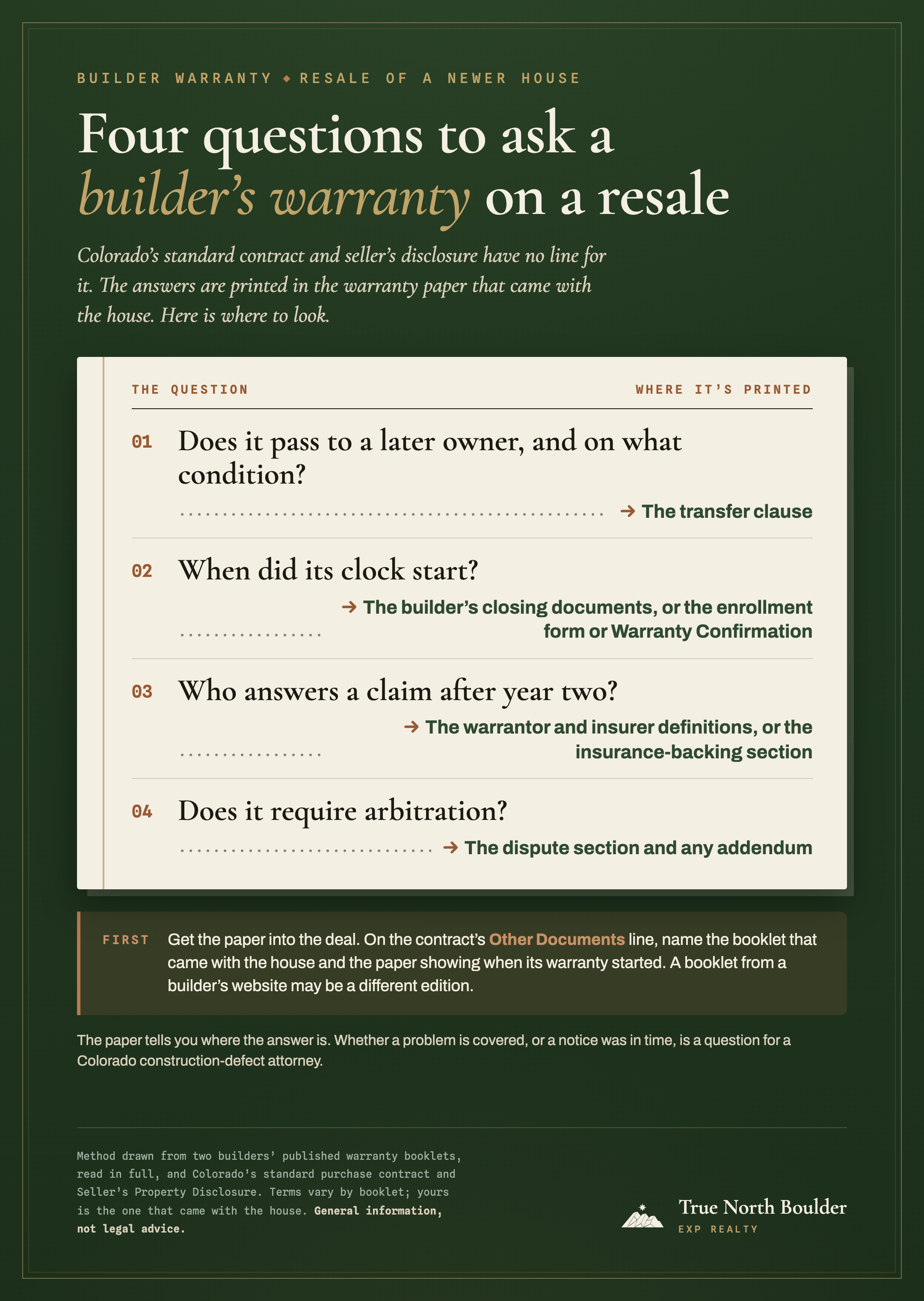
Part of a builder's warranty can pass to the next owner of a newer Colorado house, on the booklet's terms and on a clock that started at the builder's sale. Colorado's standard contract won't hand you that booklet by default, so name it on the Other Documents line and date that section's deadlines.
A newer house can still carry part of its builder's warranty, and the booklet that came with the house decides whether that coverage transfers to a new owner. Colorado's standard contract and disclosure form have no line for the builder's warranty, and neither asks for the booklet. That request is yours to write in.
If the listing says the house is still under builder warranty, ask which part. After year two, what's left in both booklets we read is mostly a structural promise, and outside PulteGroup's FHA/VA addendum it answers only damage serious enough to make the home unsafe. The bad way to learn that is after closing, when a crack shows up and the booklet's deadline has already gone by.
This page is for you if you're buying a house its builder first sold within the last ten years, in a newer subdivision, in Berthoud or anywhere else in the corridor, as its second owner or a later one. If you haven't bought a home in Colorado before, our Boulder County buyer's guide walks through the whole process in seven steps.
Will the Colorado contract get you the builder's warranty?
Not by default. The contract's due-diligence list (§10.6.1) names leases, leased and encumbered items, a solar plan and a septic permit, and no warranty. The seller's disclosure asks whether a warranty transfers only about the roof. The builder's booklet enters the deal when you name it on the contract's Other Documents line, in a contract whose Due Diligence Documents deadlines are dated.
The Seller's Property Disclosure, in the version brokers have had to use since January 1, 2026, asks about one warranty: row B.3, "Roof is under warranty," then "Date of warranty expiration" and "Warranty is transferable," with boxes for Yes, No and Unknown. There's no row for a builder's, structural or home warranty.
The Contract to Buy and Sell Real Estate is no different. Its §10.6.1 lists the Due Diligence Documents the seller agrees to deliver: occupancy agreements, leased items documents, encumbered inclusions documents, a solar power plan and a septic use permit. A sixth item reads "Other Documents. Other documents and information:" over blank lines. The clause headed Home Warranty, at §2.5.4, concerns "pre-owned home warranty programs that may be purchased," a service plan someone buys, not the limited warranty a builder issued with the house. (Buying from the builder itself is a different contract altogether, and our guide to buying new construction in Colorado starts there.)
A few other rows are worth reading closely. R.7 asks about "Any award or payment of money in lieu of repairs for defective building products or poor construction," and R.8 about "Any release signed regarding defective products or poor construction that would limit a future owner from making a claim." R.1 and R.3 ask for engineering reports and structural plans "in possession of Seller." If you're the seller answering those rows, our guide to the seller's property disclosure is written for you.
So the dependable way to get the booklet into the deal is to write it in. On the Other Documents line, name the warranty booklet that came with the house, with any state addenda; the paper showing when the warranty started (in PulteGroup's books, the builder's closing documents; in RWC's, the Application for Enrollment, form #316, or the Warranty Confirmation and its Validation Number); any written warranty requests and replies; and any release signed when a repair was made or paid for. Named there, and with the contract's due-diligence deadlines dated, they're Due Diligence Documents, and the contract lets you object or terminate if one is "not supplied." Expect gaps if the seller bought the house as a resale: they may never have been given the booklet, and as the current owner of the house they're the one best placed to ask the builder or administrator for a copy and for the date the warranty started. If you're past the offer and the booklet isn't on that line, the seller can still hand it over; making it a contract term now takes a change in writing you both sign. What keeps that line working, and what quietly cancels it, is in our due-diligence documents guide.
Don't swap in a booklet from the builder's website. PulteGroup's warranty book whose file is dated March 2020 (filename 032720F) and its August 2024 book word the transfer sentence differently. The edition that matters is the one that came with the house. RWC's cover tells a buyer without internet access to "contact RWC to obtain your Limited Warranty book and Warranty Confirmation," but it's written to the first buyer, and it says nothing about whether RWC will supply a later owner.
Here are two dated booklets side by side. Treat them as examples until you have your house's own edition. RWC's form #319 is revision 7/25, so on a house first sold before that revision it shows how an RWC booklet is built, not what your house's revision says.
| Question | PulteGroup book, file dated March 2020 (032720F) | RWC form #319, Rev. 7/25 (as posted by D.R. Horton) | Where to look in the house's own paper |
|---|---|---|---|
| Passes to a later owner? | Yes, to owners who take title within the coverage period and "use the home for their residence only" | Yes, automatically during the ten-year term; a foreclosure voids it | The transfer clause |
| Clock starts | The closing date (the 2024 book and the HUD addendum tie it to the builder's sale to the first buyer) | The Effective Date Of Warranty on the enrollment form or Warranty Confirmation | The builder's closing documents; form #316; the Warranty Confirmation |
| Tiers | 1, 2, 5 and 10 years | 1, 2 and 10 years | The coverage section |
| Warrantor after year two | The builder, with insurance behind it in certain situations required by HUD, VA or other law | An insurer, through RWC as administrator; $500 per request in years 3 to 10 | The warrantor and insurer definitions, or the insurance-backing section and any HUD addendum |
| Arbitration | Binding, under the Federal Arbitration Act; small-claims court excepted; not required for a home with original FHA or VA financing | Binding, under the Federal Arbitration Act; the requester pays the fees first | The dispute section and any addendum |
Does the warranty transfer to you, and on what conditions?
Yes, on conditions, in both booklets we read: coverage passes to a later owner who takes title within the coverage period. PulteGroup's March 2020 file adds, in its transfer sentence, that the owner must use the home as a residence; RWC's form #319 says a foreclosure voids it. Neither, in its full text, asks a later owner to register or pay a fee to take it over.
PulteGroup's 2020 file extends the warranty "to all subsequent owners who take title within the Limited Warranty period identified in the Performance Standards, and use the home for their residence only." The August 2024 book's transfer sentence drops the residence condition, though all three booklets we read separately exclude loss from non-residential use. RWC's form: "This Limited Warranty is automatically transferred to subsequent Owners during the ten-year term of this Limited Warranty, except in the case of a foreclosure that voids the warranty as provided in Section II.A.6."
What passes is the coverage as the first owner left it. PulteGroup's book excludes damage "to the extent it is caused or made worse by" improper maintenance, grading changes, or "Changes, alterations, or additions made to the home by anyone other than the Builder or its agents or subcontractors after the Limited Warranty commencement date." RWC's form excludes loss "resulting from, or made worse by" grading changes "by anyone except your Builder or its employees, agents or subcontractors" and "modifications or additions to the Home, or property under or around the Home, made after the Effective Date Of Warranty (other than changes made in order to meet the obligations of this Limited Warranty)." A basement finished after the warranty began, or a side yard regraded for a patio, is that kind of work; what's excluded is the damage it caused or made worse.
Two more terms matter to a later owner: repairs and releases. Both booklets tie payment for a repair to the warranty process. PulteGroup's won't pay for one made "without first notifying us of the problem and allowing us to investigate and repair it," except an emergency repair "to protect the safety of occupants of your home or to prevent imminent serious damage to your home," which still needs notice "as soon as possible." RWC says "Costs incurred for unauthorized repairs to warranted items are not reimbursable," and it excludes loss from "your failure to minimize or prevent such loss or damage in a timely manner."
RWC also requires a full and unconditional release, in recordable form, before it pays for a repair and again when one is completed; PulteGroup's 2020 file requires one only where its insurer resolves a claim because the builder couldn't. Disclosure row R.8 asks the seller about a signed release "that would limit a future owner from making a claim," and whether a release a prior owner signed for a warranty repair is that kind, or binds you, is for a Colorado construction-defect attorney to answer.
When did the warranty's clock start?
At the builder's sale to the first owner, not yours. PulteGroup's books run each tier from the builder's closing date; RWC's from the Effective Date printed on the enrollment form or Warranty Confirmation. Both booklets ask for notice promptly and set an outer limit 30 days after a coverage period ends; RWC adds that, in years one and two, the builder must have been told during the coverage period itself.
PulteGroup's 2020 file sets four tiers: one year for materials and workmanship, two for plumbing, electrical and mechanical systems, five for "various types of water infiltration and internal leaks," and ten for structure, each "after the closing date." The August 2024 book says whose closing: "Except as provided in Section 7.2 below for building common elements or as Builder and the initial purchaser of the home may otherwise agree, this Limited Warranty commences on the 'closing date', which is the date the Builder closed the sale of the home to the initial purchaser." RWC's tiers run one year, two years for specified systems and ten for Major Structural Defects, from an Effective Date set on the enrollment form "signed at closing by you, the Purchaser, and your Builder," or on the Warranty Confirmation where the builder enrolls electronically.
Take a made-up date. A house its builder first closed in mid-2019 lost its two-year systems coverage in mid-2021, and its ten-year structural tier runs to mid-2029. Your own closing moves neither date. A system that fails between contract and closing falls under a separate provision of the contract, covered in our guide to what happens when something breaks before closing.
Don't sit on a problem, either. The booklets want notice early: PulteGroup's says to contact the builder "as soon as possible" and excludes damage made worse by "Failure by the Homeowner to give timely notice to the Builder of any defects"; its outer limit is "Except as otherwise required by law, all Limited Warranty claims must be received by us no later than 30 days after the expiration of the applicable warranty coverage period. Please note this provision does not extend the Limited Warranty coverage period." An arbitration request must reach the AAA no later than 90 days after the period ends. RWC wants structural notice "within a reasonable time after the situation arises," and requests "emailed or postmarked more than thirty (30) days after the expiration of the term of this Limited Warranty will not be honored." For years one and two you "must provide evidence that you notified the Builder of the warranted Defect during the applicable coverage period (not during the thirty (30) day period)." The 30 days extends neither booklet's coverage period: it's a final cutoff for getting the request in, not a grace period.
Until closing, the owner the booklet is talking to is the seller. If your inspection turns up something that could be structural, or a tier ends while you're under contract, your Inspection Objection can name the condition, and the written settlement of it can have the seller submit a warranty request under the booklet's procedure and pass you a copy of the request and the reply. For that, you need the booklet before your Inspection Objection Deadline, so ask for a Due Diligence Documents Delivery Deadline that comes earlier. Under RWC's form after year two, that request costs $500, so agree which of you covers it. If the request turns into an RWC repair before closing, the release described above comes with it. A warranty visit won't always fit inside your deadlines; if it comes back in time, the warrantor's answer is in your hands while your contract still gives you choices.
Who answers a claim after year two?
It depends on the booklet. RWC's form #319 makes the builder the warrantor in years one and two and an insurer in years three to ten, through the administrator, at $500 a request. PulteGroup's March 2020 file names the builder as warrantor for every tier, with an insurance policy behind it "In certain situations as required by HUD, VA, or other laws or regulations."
RWC's warrantor is "Your Builder in Years 1 and 2; the Insurer in Years 3 through 10 and in Years 1 and 2 if your Builder defaults." The form names that insurer, "Western Pacific Mutual Insurance Company, A Risk Retention Group," and says "RWC is neither Warrantor nor Insurer"; it's the administrator. A request costs $500 in years three to ten, or $250 in years one and two if the builder defaults, and the written notice must include the "Validation # and Effective Date Of Warranty," a "copy of any written notice to your Builder," and "A copy of each and every report you have obtained from any inspector or engineer." Your own pre-purchase inspection report is one of those, so keep it, and know the limits of what an inspection here can reach.
PulteGroup's 2020 file keeps the builder as warrantor throughout, and its HUD addendum names the insurer behind it as "a member of the Zurich-American Insurance Group."
Does the booklet require arbitration?
Both booklets we read send disputes to binding arbitration under the Federal Arbitration Act. PulteGroup's March 2020 file lets either party take a claim to small-claims court instead, where it fits that court's limits, and doesn't require arbitration for a home with original FHA or VA financing. That file's Colorado addendum also points other defect claims to the builder's original purchase agreement, which a second owner never signed. Whether any of that binds a later owner is for a Colorado construction-defect attorney to say.
PulteGroup's 2020 file sends "any unresolved claim or dispute concerning your home or this Limited Warranty" to "binding arbitration, except that either party may bring any claim to a small-claims court if the claim is within the small-claims court's geographic and monetary jurisdiction," and says what that means: "Binding arbitration means that we each give up the right to go to court or jury to assert or defend rights (except for matters that may be taken to small-claims court)." The 2020 file's Colorado addendum makes "The Limitation of Liability set forth as Section 3 of Article II of the Home Protection Plan" applicable "only to claims asserting a breach of the Limited Warranty," and puts other defect claims under the state's Construction Defect Action Reform Act and "the requirement to arbitrate claims as provided in Section 11 of the Purchase Agreement," which is the first buyer's contract with the builder.
The 2020 file's HUD addendum changes the booklet for one kind of house: "The Homeowner of a home with original FHA/VA financing is not required to submit disputes related to or arising out of this Limited Warranty to the Binding Arbitration procedure available here," though a homeowner who "elects to pursue the dispute to a final resolution, including judicial resolution of disputes," can't then bring the same dispute through that arbitration, and Colorado basement floor slab coverage runs "from the first through the fourth year." So the first buyer's loan is one of the facts that changes what this booklet says. Ask the seller; one who bought the house as a resale may not know either. The August 2024 book's Colorado Addendum keeps claims "subject to binding arbitration procedures found herein or as provided in your home purchase agreement, if any."
RWC's arbitration "is governed by the procedures of the Federal Arbitration Act." The request goes to the administrator within 30 days after the warranty period ends, or within 30 days of RWC's notice of an unresolved issue if that notice arrives later, "you must pay the arbitration fees before the matter is submitted," and "The decision of the Arbitrator shall be final and binding upon all parties."
About these booklets
We read two builders' published warranty documents in full, PulteGroup's (files dated March 2020 and August 2024) and the RWC form #319 that D.R. Horton posts, and no other builder's booklet. Others vary, and we don't state Colorado terms for any booklet we haven't read. We don't say which builder built where. Your booklet is the one that came with your house.
What Colorado's defect statute adds
Colorado's limit on suing a builder has two parts. A claim must be brought within two years of when "the claimant or the claimant's predecessor in interest" discovered, or with reasonable diligence should have discovered, the defect's physical manifestations. And it can't be brought later than six years after the house's substantial completion, except that a claim arising in year five or six gets two years from when it arose. A booklet's clock and the statute's start from different dates, and which governs a given problem is a lawyer's call.
Under C.R.S. 13-80-104 a claim arises when the claimant or a predecessor in interest "discovers or in the exercise of reasonable diligence should have discovered the physical manifestations of a defect." The six-year limit runs from "substantial completion," which the statute doesn't define, so don't read it as your closing date or the certificate of occupancy. The defect-claim law's "claimant" is a person "who asserts a claim against a construction professional that alleges a defect in the construction of an improvement to real property"; a claimant must send written notice "No later than seventy-five days before filing an action against a construction professional" (a period that predates the 2025 amendments), and a notice of claim sent under section 13-20-803.5 in time pauses the limit "until sixty days after the completion of the notice of claim process described in section 13-20-803.5."
Then C.R.S. 13-20-807 sets the warranty apart: "The provisions of this part 8 shall not be deemed to require a claimant who is the beneficiary of an express warranty to comply with the notice provisions of section 13-20-803.5 to request ordinary warranty service in accordance with the terms of such warranty. A claimant who requires warranty service shall comply with the provisions of such warranty."
What's still running by year four, and what it takes to use it
A structural promise, mostly. After year two, both booklets we read cut the coverage back to structural damage that makes the home unsafe (PulteGroup's HUD addendum is broader for a home with original FHA or VA financing), plus certain water leaks to year five in PulteGroup's. Using it means the booklet's procedure: notice to the party that booklet names (in writing, under RWC's form), inside the window, and before any repair other than an emergency repair PulteGroup's books allow. Colorado's statute says a claimant who wants warranty service must follow that booklet.
The structural tier is narrower than its name. PulteGroup's book requires no action "unless there is actual physical damage that diminishes the ability of the Structural Element to perform its load-bearing function such that the home is unsafe." An RWC Major Structural Defect must affect "its load-bearing function to the degree that it materially affects the physical safety of the occupants of the Home," and drywall, flooring and subflooring, siding, shingles and sheathing, the heating, plumbing and electrical systems, and doors and windows are "deemed not to have Major Structural Defect potential." RWC's letter to the first buyer says it in a line: "For the remaining eight years, your Warranty applies to Major Structural Defects as defined in this book."
So the first request follows the booklet. That means notice to the builder or administrator it names (in writing, for RWC), with the start date and any validation number, before anyone repairs the defect, unless it's an emergency repair of the kind PulteGroup's books reimburse. Whether a particular crack is covered, or a notice was in time, belongs with a Colorado construction-defect attorney once the builder or administrator answers, or sooner if a booklet cutoff, or either part of the statute's limit, is close. And because that procedure sits in a booklet the Commission's forms don't ask for, the Other Documents line comes first.
Frequently asked
Does a builder's warranty transfer to the next owner in Colorado?+
In both booklets we read, yes, on conditions: coverage passes to a later owner who takes title within the coverage period. PulteGroup's March 2020 file adds residence use in its transfer sentence, RWC's form says a foreclosure voids it, and neither, in its full text, asks a later owner to register or pay a fee. All three documents we read, including PulteGroup's August 2024 book, separately exclude loss from non-residential use. The Colorado statutes we read and the Commission's forms don't decide it; the edition that came with the house does.
Will the Colorado contract or disclosure give me the builder's warranty?+
Not by default. The Due Diligence Documents list in the standard contract (§10.6.1) names no warranty, and the Seller's Property Disclosure asks whether a warranty transfers only for the roof. If you want the booklet in the deal as a contract term, name it, with its start-date paper, on the contract's Other Documents line, and check that the contract's Due Diligence Documents deadlines carry dates: under §3.2, a deadline left blank deletes the provision that contains it.
When does a transferred builder's warranty end?+
It's counted from the builder's closing date on its sale to the first owner (PulteGroup) or from the Effective Date on the enrollment form or Warranty Confirmation (RWC), not from your purchase. Both booklets want notice promptly, and each sets an outer limit 30 days after a coverage period (PulteGroup) or the warranty's term (RWC, years three to ten) ends. That's a final cutoff, not a grace period.
Who handles a structural claim after year two?+
It depends on the booklet. In RWC's form #319, the warrantor in years three to ten is an insurer, reached through RWC as administrator, at a $500 warranty service fee per request. In PulteGroup's March 2020 file, the builder stays the warrantor, with an insurance policy behind it in certain situations as required by HUD, VA or other laws or regulations.
Is a builder's warranty the same as a home warranty?+
No. The contract's Home Warranty clause, §2.5.4, refers to "pre-owned home warranty programs that may be purchased," a service plan someone buys. A builder's limited warranty is a different document, issued with the house when it was new.
Am I bound by the builder's arbitration clause?+
Both booklets we read provide for binding arbitration under the Federal Arbitration Act, except that PulteGroup's 2020 book lets either party take a claim within small-claims limits to that court, and doesn't require arbitration for a home with original FHA or VA financing. That book's Colorado addendum also points other defect claims to a purchase agreement a later owner never signed. Whether any of that binds you is a question for a Colorado construction-defect attorney.
This page describes two published warranty booklets, the Commission's forms and Colorado statutes. It's general information, not legal advice.
Writing an offer on a newer house? We can help you decide what to name on the Other Documents line in your contract's due-diligence list and, once the booklet arrives, set its printed start date beside your deadlines.
Daniel Hsieh is a licensed Colorado real estate broker with True North Boulder, brokered by eXp Realty.
Sources
- Contract and disclosure terms: CREC Contract to Buy and Sell (CBS1) and Seller's Property Disclosure, mandatory January 1, 2026; CBS1 §§ 2.5.4, 10.6.1, 10.6.2.
- Pulte warranty: National Warranty Book, March 2020 file and August 2024 file.
- Residential Warranty Company Limited Warranty, WPMIC #319 Rev. 7/25, as posted by D.R. Horton.
- Other builders' terms: KB Home warranty page (updated June 9, 2026) and Lennar warranty page.
- Time limits and void waivers: C.R.S. §§ 13-80-102, 13-80-104, 13-20-802.5, 13-20-803.5, 13-20-805 to 807, Colorado Revised Statutes 2026, Title 13.
- We have no business relationship with any builder or warranty company named here: no referral, compensation or marketing agreement. Naming one is not a recommendation.