Living in Berthoud, Colorado? The Mill Levy Decides
Most new builds in Berthoud's move-up band sit inside a metro district, and its debt mill levy — not the sticker — decides the deal. But it turns on the parcel's tax area, not the age of the street: four in ten Berthoud parcels pay no district mill.
There's a model home at the end of a new street in Berthoud, and the number on the counter is the price. It's a fair price. It is also not the number that will decide whether this house is a good buy. That number is on the property-tax bill, and on a new build in one of Berthoud's metro districts it can nearly double what a comparable Berthoud home pays, run for the next twenty or thirty years, and, unlike the price on the counter, it cannot be negotiated by anyone, ever. Berthoud is where a corridor move-up dollar buys the most new house, and most of that new house sits inside a metropolitan district. Not all of it, though, and that is the part nobody tells you: about four in ten parcels in this town pay no district mill at all, and they are not only the old grid. So before you fall for the floor plan, you look up the parcel's tax area, read the service plan, and re-run your loan qualification with the actual mill in it. That is the whole game in this town, and almost no one tells you before you're under contract.
In Berthoud, the mill levy is a tax-area fact, not a new-build fact
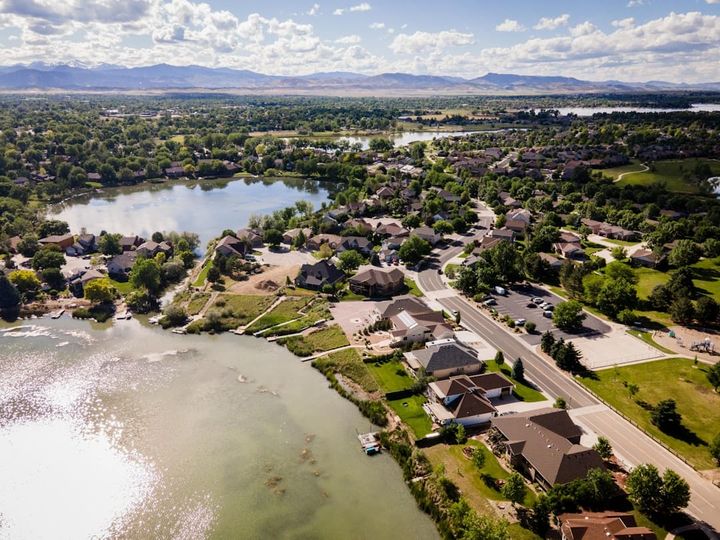
Berthoud is a small, fast-growing town on US-287 between Loveland (about 7 miles) and Longmont (about 11 miles), mostly in Larimer County with a sliver in Weld. Its schools are Thompson R2-J, the same district as Loveland. It's known as the "Garden Spot," but for a move-up buyer the defining fact is that it's a new-construction town: much of the housing your dollar reaches was built in the last decade or is going up now, and most of it sits inside a metro district. That last fact is the one this whole guide is about.
Start with where Berthoud is and what it is, because the answer engines tend to file it under "Loveland suburb" and leave it there. Berthoud is its own town on US-287, roughly seven miles south of Loveland and eleven north of Longmont, about twenty-one miles from Fort Collins and just over forty from Denver. It sits mostly in Larimer County, but the town line crosses into Weld, so a small number of addresses are billed by a different county. Schools are Thompson School District R2-J, headquartered in Loveland, which means if you're comparing districts across the corridor this is the same one Loveland uses, not Boulder Valley and not St. Vrain. It calls itself the Garden Spot of Colorado, the Little Thompson River runs through it, and its most recognizable address is TPC Colorado at Heron Lakes, a tour-caliber golf community that anchors a lot of the new building on the north side of town (and carries a third cost most buyers miss, a private-club membership separate from the deed).
Fast facts · Berthoud
Sources: US Census, Town of Berthoud, CAR · as of February 2026
What makes Berthoud different from its neighbors, though, is not the golf. It's that Berthoud is where the corridor still builds at scale. Roughly a third of the town's homes went up in the 2010s alone, the town approved thousands of new residential lots over the last decade, and much of the move-up product a buyer shops in the $800,000-to-$1.2 million range is brand-new construction in a master-planned community. If you're relocating and you want a new house with a foothills view for a corridor price, Berthoud is often where the math sends you, and what a move-up budget buys from Boulder down through the corridor puts the towns side by side. Each corridor town has its own guide too, from Boulder to Longmont. Before you get attached, one piece of ordinary Colorado diligence: Larimer County's average indoor radon runs above the EPA's 4.0 pCi/L action level, so budget a radon test and likely a mitigation system on anything you seriously consider. That's the cheap homework. The expensive homework is the tax buried in the new house, and it deserves its own section.
The tax you won't see on the listing
Most new Berthoud communities are financed through a metropolitan district, a local taxing authority that borrows to build the roads, water, and parks, then repays the bonds through a debt mill levy on your property taxes. At Heron Lakes and TPC Colorado, the county's certified 2025 record puts that levy at 79.180 mills, on top of the 95.456 mills a non-district Berthoud home pays to the county, schools, town, fire, health, library, water and pest control — 174.636 in total, about 1.83 times the base. Where several Berthoud-Heritage districts overlap one parcel, the district mills reach roughly 193 to 194 and the total approaches 290, about 3.04 times. The levy is a property of the parcel's tax area, so it is looked up, never assumed.
Here's the part the model home won't mention. When a developer builds a new community in Colorado, the roads, the water lines, the parks, and the trails cost money up front, and rather than fold all of that into the sticker price, the developer forms a metropolitan district. The district sells bonds to pay for the infrastructure, and then it repays those bonds with a debt mill levy charged to the homeowners, year after year, until the bonds are retired. It's a legitimate and common way to finance growth. It's also a second property-tax bill sitting inside the first, and it's the single biggest variable in what a Berthoud new build actually costs to own.
The numbers are worth seeing laid out, because the scale surprises people. Every Berthoud homeowner pays into the same base stack: the county, the school district, the town, the fire district, the library. In a metro district, you pay all of that plus the district's own levy on top.

Read that bottom stretch again. At Heron Lakes and TPC Colorado, the county's certified record puts the district levy at 79.180 mills on top of a 95.456-mill base, for 174.636 total — about 1.83 times what a non-district Berthoud home pays. That is a second property tax very nearly the size of the county, the schools, the town, the fire district and the library put together. And it is not the ceiling. Where several Berthoud-Heritage districts overlap the same parcel, the district mills alone reach roughly 193 to 194, for a total near 290 mills, about 3.04 times the base. Which is the real lesson: this is not a single number you can carry around town. It is a tax area, and it is checked per parcel. And that levy has two parts worth separating: a debt mill, which repays the infrastructure bonds and is the big one, and a smaller operating mill, which funds the ongoing maintenance the district handles. The debt mill is temporary in theory, in that it's supposed to step down as the bonds are paid off, but "temporary" here means decades, and the service plan sets a maximum the district is allowed to charge that can be higher than what it charges today. That last point matters: today's rate is not necessarily the ceiling. A district charging below its cap can legally ramp toward it. So the number you want is the authorized maximum in the service plan, not this year's levy. Thanks to a 2024 state transparency law, the district now has to disclose that maximum.
There's a reason a district would ramp toward that cap. The bonds were sized on an assumed pace of homes getting built and sold, and Berthoud is the slowest-selling market in the corridor. Buy an early phase and you're paying the full debt mill today for parks, trails, and later phases the developer still has to deliver, and if the buildout stalls, the homeowners already there carry the load. Colorado has seen a rising run of metro-district technical defaults as growth cooled, so this isn't hypothetical. Before you buy, ask where the community sits in its buildout, whether the amenities are in the ground or still on a plan, and how the district's debt looks. A nearly built-out district is a very different risk than one selling its first phase.
The one number in the whole deal you can't negotiate
On a new build you can negotiate the price, the interest rate, the upgrades, and the closing costs. You cannot negotiate the metro-district debt levy. It's set to repay bonds and it runs with the house for decades, no matter who owns it. Worse, your lender escrows the full mill, so a district home's higher tax bill directly lowers how much house you qualify for. The mill doesn't just add to your monthly payment, it moves your price ceiling down.
This is where a metro district stops being a line item and starts being the deal. In a new-construction purchase, almost everything is negotiable if you know to ask: builders in a slower market will buy down your rate, credit your closing costs, and throw in upgrades. The one thing on the table that no one can move is the district levy. It isn't the builder's to waive, it isn't the seller's in a resale, and it doesn't expire when you sell, it simply follows the house until the bonds are gone. You are buying it whether you notice it or not.
The honest take
The metro district's debt mill is the one number in a new-build deal nobody can negotiate: not the builder, not the seller, not you. And because your lender escrows it, it doesn't just add to your payment; it quietly lowers how much house you qualify for in the first place.
And it does more than raise your tax bill. Your lender calculates what you qualify for using your full monthly payment, taxes included, and it escrows those taxes. So two identical $900,000 houses, one in a district and one not, do not qualify the same buyer for the same loan. The district home's higher mill levy eats into your debt-to-income room and pushes your real price ceiling down. One more line to pull while you're at it: most district communities also carry an HOA on top of the mill, so your true monthly is the mortgage plus the full mill plus HOA dues. Get all three before you hold a new build up against a resale, or you'll under-count what it actually costs to own. That's why the honest first step in Berthoud isn't shopping floor plans, it's pulling the district and the service plan for any home you're serious about, finding the current levy and the authorized maximum, and re-running your qualification with the full mill in it. Do that before you tour, and the model home stops being able to surprise you.
Why you can't trust the "Berthoud median"
Berthoud is a small market where a lot of what sells is new construction, so the median home price moves on which houses happened to close, not on whether values went up or down. In December 2025 the single-family median was about $615,000 while the average was about $730,000, a wide gap that reflects new builds pulling the top up. With only around 17 sales that month, a handful of builder closings can swing the median tens of thousands of dollars. Treat it as a rough level, low-to-mid $600,000s, never as a precise value or a growth rate.
If you've been reading price stats on Berthoud, this is the correction that saves you from a bad conclusion. A town median is only as stable as the number of sales behind it, and Berthoud is a thin, build-heavy market. In December 2025, the single-family median sat around $615,000, but the average was closer to $730,000. That roughly $115,000 gap between median and average isn't noise, it's the signature of a market where new construction is dragging the top end up, so the two measures pull apart. And with only about seventeen homes selling that month, the median is essentially the ninth sale. If three of those nine happen to be new builds in Heron Lakes, the median jumps. If they're older homes near downtown, it drops. Nothing about values changed. The mix did.
About this data, and the number we won't publish
We'll give you the level, low-to-mid $600,000s for a single-family home as of late 2025, with the caveat that it's a small sample. What we won't publish is a Berthoud appreciation rate, a "prices are up X percent" figure on the town median. In a market this small and this new-build-heavy, that number is meaningless: depending on which months and which basis you pick, the same season can read sharply up or sharply down, because the median is tracking construction mix, not value. Anyone quoting you a confident Berthoud growth rate off the town median is selling you a mirage. If you want a real read on whether values are rising, the honest tool is a repeat-sales index like the FHFA House Price Index, which tracks the same homes over time, not a small-town median. So we publish the rough level and the reason for the imprecision, and skip the confident growth rate the construction mix can't support.
The most negotiable house in the corridor
Here's the upside. Berthoud is the slowest-moving market in the corridor, with homes sitting around 90 days, and builders carry standing inventory they need to move. That hands you real leverage on price, rate buydowns, closing credits, and upgrades. The trap is doing that dance without your own agent, on the builder's contract, with the builder's lender. Bring your own agent to the first visit, read the builder's contract closely, and price the incentives with an independent loan estimate.
The flip side of a new-build town where the median is a moving target is that you, the buyer, have more leverage here than almost anywhere else in the corridor. Berthoud homes were taking around ninety days to sell as of late 2025, and builders sitting on finished spec inventory have real motivation to make a deal before quarter-end. That's leverage on everything except the mill. Use it. But use it with your eyes open, because a new-construction purchase is where relocating buyers most often get quietly outmatched, and it comes down to a few specifics.
Bring your own agent, and bring them to the very first visit. The friendly person in the model home is a representative of the builder, and their job is to sell the builder's houses on the builder's terms, not to look out for you. Many builders also require your agent to register you on that first visit, and if you wander in alone and come back later with an agent, the builder can refuse to work with them. Under the buyer-agency rules in place since 2024 you'll sign a written, negotiable agreement with your agent before touring anyway, so line that up first. Then let your agent do the three things that protect you here: read the builder's contract, which is the builder's own document and not the standard Colorado Contract to Buy and Sell that most resales use, so the default protections you'd expect around earnest money, appraisal, inspection, and completion may simply not be there. Price the incentives honestly, because a builder's rate buydown or closing credit is usually tied to using the builder's preferred lender and title company, and the only way to know if the deal is real is to pull an independent loan estimate and compare. And in a slower market, push for a permanent price reduction or a lasting closing credit over a temporary "teaser" rate buydown that evaporates in a year or two. Expect the builder to steer you toward credits over a price cut, for the same reason they keep the sticker high, so hold out for whichever actually lowers your long-run cost. One more caution particular to a build-heavy town: watch the appraisal, because builders tend to hold their sticker prices and give concessions "below the line" to keep recorded comps high, which means a home can appraise under contract. On a resale you'd walk on a low appraisal; the builder's contract may not give you that out, so confirm whether a low appraisal is even a way out, and if it isn't, keep cash ready to cover the gap. Here's that whole play in one place, in the order that keeps the model home from surprising you.
Before you fall for a lot
Pull the metro district and read its service plan
For the specific lot, find the current debt mill and the authorized maximum in the service plan. Then check whether that maximum is Gallagher-adjusted, because the printed cap is not always the operative one. A district charging below its cap can legally ramp toward it; a district already at its adjusted cap has a different risk profile entirely.
Re-run your qualification on the full mill
Your lender escrows the whole levy, so a district home qualifies you for less than a non-district one. Re-run the numbers with the full mill and the community's HOA dues in them before you shop, not after.
Weigh the buildout phase and the district's debt health
Ask where the community sits in its buildout, whether the amenities are in the ground or still on a plan, and how the district's debt looks. A nearly built-out district is a very different risk than one selling its first phase.
The rest of a builder deal is not Berthoud-specific and it is not small: the model-home agent works for the builder, the contract is the builder's own document rather than the Commission form, and a rate buydown is usually tied to their lender. We work through all of it in buying new construction in Colorado.
If you're on the other side of this, selling a Berthoud move-up home rather than buying one, understand who you're really competing with: the builder's sales trailer down the street, which can buy down a buyer's rate and hand over a fresh warranty in ways you can't match. So don't try. Compete on what the builder can't give, a finished and landscaped yard instead of a dirt lot, upgrades already paid for rather than financed at builder markup, immediate possession instead of a six-month build, and, if your home sits in an older district whose debt levy has stepped down or in a non-district pocket, a lower total mill levy, which a sharp buyer comparing monthly payments will notice. Price to the builder's net after their concessions, not their sticker, and put your total mill levy on the table up front.
This guide is for you if
- You're relocating to Northern Colorado and Berthoud keeps coming up as where a new house with a view fits a corridor budget.
- You're in the $800K-$1.2M move-up band, looking at new construction, and no one has yet explained the metro-district levy that comes with it.
- You're trying to compare a Berthoud new build against a resale elsewhere in the corridor and want the total monthly cost, mill levy included, not just the sticker.
- You already own in Berthoud, you're trading up, and you need to sell against the builder down the street.
Price the district before you fall for the finishes
Before you tour a Berthoud community, the first number to pull is the metro-district mill, not the sticker: we'll find the current levy and the authorized maximum in the service plan, and tell you what the full tax bill does to your qualification, before you fall for a floor plan. That's a short head start from anywhere, and it's the right first step whether or not we ever work together, because in Berthoud the district decides more about the true cost than the sticker does.
The reason to do this first, rather than after you've picked a lot, is that the metro-district levy sets the real cost and it's the one thing you can't change once you're in. A price you can negotiate. A rate you can buy down. A district's debt mill you inherit and carry for decades. So before you drive out or fly in, get the district pulled before the floor plan: we'll read the service plan for the current levy and the authorized maximum, and show you what the full mill does to what you qualify for. If it's the right house, we'll help you build the offer around the tax instead of getting surprised by it, and we'll use the slow market to get you everything that actually is negotiable.
None of that requires hiring us. But if you'd rather have a broker who pulls a subdivision's metro-district debt before anyone walks you past the finishes, that's what we do, as a team under eXp Realty. You'd sign a buyer-agency agreement before we tour, and both its terms and its fee are yours to negotiate; what that fee buys you first here is the mill pulled and priced on the specific subdivision, so the debt is a number in your offer instead of a surprise on your tax bill. We start where the true cost of a Berthoud new build begins: with the debt mill and its ramp, the line that never makes the listing. The current town numbers live in our monthly Berthoud market report.
The bottom line
Berthoud is where a corridor move-up dollar buys the most new house, and most of that new house sits inside a metro district — though about four in ten parcels in town do not, and they are not only the historic core. The number that decides the deal isn't the price on the model-home counter, it's the district's debt mill levy, which can push your total tax rate toward double a non-district home's, runs for decades, follows the house, and is the one cost in the entire transaction that no one can negotiate. Because your lender escrows it, it also lowers how much house you qualify for. So pull the district and the service plan before you tour, re-run your qualification with the full mill in it, and use the corridor's slowest market to win on everything that is negotiable. Treat the "Berthoud median" as a rough level, not a value. A new build here can be a genuinely good buy; just make the district's debt mill the first number you run, not the last one you find out about.
Sources & data notes
- Corrected 2026-08-15. Mill levies now come from the county's own certified record rather than from a single district budget: Larimer County Tax Area by Tax Authority 2025 (Larimer County Assessor, run-dated 2025-12-22; tax year 2025, payable 2026), cross-checked against the county parcel service for the tax area of specific addresses. Base, non-district Berthoud (tax area 2400): 95.456 mills across eight authorities — Thompson R2-J 44.836, Larimer County 22.496, Town of Berthoud 9.538, Berthoud Fire 13.342, Thompson Valley Health 1.745, library 2.357, Northern Colorado Water 1.000, pest control 0.142. Heron Lakes / TPC Colorado parcels (tax area 2403): 79.180 district mills, 174.636 total (~1.83×). Where several Berthoud-Heritage districts overlap the same parcel, district mills reach ~193–194, for a total near 290 (~3.04×). ⚠️ A prior version of this guide attributed 82.698 mills (Berthoud-Heritage Metropolitan District No. 6, 2026 Final Budget) to the district serving Heron Lakes / TPC. That figure is correct for No. 6, but the county's parcel record assigns Heron Lakes addresses to a different tax area, so the attribution was wrong and has been removed. We now name tax areas, which is what the assessor actually keys on. Verify any parcel with the Larimer County Assessor and the Town of Berthoud metro-district information. What a metro district is, and the debt-vs-operating split: Berthoud-Heritage Metropolitan District.
- About four in ten Berthoud parcels pay NO district mill. Tax area 2400 alone holds about 3,187 of roughly 8,006 town parcels, and it is not only the historic grid — it includes modern subdivision streets, with district-free sales in the move-up band reaching about $1.47M (Larimer County sales records, 2022–2026). So the district levy is a tax-area fact, not a neighborhood-age fact, and it is checked per parcel rather than inferred from how new the street looks. ⚠️ Not verified, and deliberately not dollarized here: the 2025 residential assessment rate. A mill levy converts to dollars only through that rate, so we publish mills and the multiple rather than an annual figure we could not stand behind.
- Metro-district transparency: Colorado HB24-1302 (signed and effective June 3, 2024) requires each taxing authority to disclose its levy, prior-year levy and revenue, and the maximum levy allowed without further voter approval. Service-plan maximum levies and developer-bond terms: SB23-110 (2023). Metro-district financial-stress trend (technical defaults): The Bond Buyer (Dec 2024).
- Market level: Berthoud single-family, sold, December 2025: median ≈ $615,000, average ≈ $729,953, about 17 sales, ~90 days on market, from the CAR Local Market Update (IRES data, via LBAR). We do not publish a Berthoud median year-over-year or appreciation rate: at ~17 sales/month the median tracks construction mix, not value (see the data note). For appreciation, use a repeat-sales index such as the FHFA House Price Index.
- New-construction share and growth: roughly a third of Berthoud homes were built 2010-2019 (U.S. Census ACS, Year Structure Built), with continued building since; the Town issued 500+ single-family permits in 2018 and its 2021 Comprehensive Plan cited 6,000+ approved residential lots in various stages. Population 10,332 and the two-county split (Larimer 10,071 / Weld 261) are from the 2020 U.S. Census.
- Orientation: Berthoud sits on US-287 between Loveland (~7 mi) and Longmont (~11 mi), ~21 mi south of Fort Collins; schools are Thompson School District R2-J. TPC Colorado at Heron Lakes is the town's flagship golf/new-build community. Larimer County's average indoor radon runs above the EPA 4.0 pCi/L action level — Larimer County Health.
- New-construction buyer mechanics (the builder's rep represents the builder; agent registration on the first visit; incentives tied to the preferred lender/title; builder contracts differ from the CREC standard form) are general Colorado/industry practice; the buyer-agency written-agreement requirement has been in effect since August 2024 (NAR settlement practice changes). Confirm contract specifics with your own broker and counsel. Property-tax mechanics and qualification effects here are general information, not tax or lending advice: confirm the parcel’s tax area with the Larimer County Assessor and the payment effect with your own lender and tax adviser.
Frequently asked
Is Berthoud in Larimer or Weld County?+
Mostly Larimer, but the town crosses the line into Weld. At the 2020 census, 10,071 Berthoud residents were in Larimer County and 261 were in Weld, so a small share of addresses sit in Weld. It matters for which county assessor bills you and reads your metro-district levy, so confirm the county on any specific parcel. Berthoud sits on US-287 between Loveland and Longmont, and its schools are Thompson School District R2-J, the same district as Loveland.
What is a metro district and how much does it add to my taxes in Berthoud?+
A metropolitan district is a taxing authority that finances a new community's roads, water, and parks with bonds, then repays them through a debt mill levy on your property tax, on top of the county, school, town, fire, health, library, water and pest-control mills a Berthoud home already pays. Those base authorities total 95.456 mills on the county's certified 2025 record. At Heron Lakes and TPC Colorado the district adds 79.180 mills, for 174.636 in total, about 1.83 times the base — roughly as much again as every other authority combined. Where several Berthoud-Heritage districts overlap one parcel, district mills reach about 193 to 194 and the total nears 290, roughly 3.04 times. The figure is set by the parcel's tax area rather than by the subdivision's name or age, so look up the specific parcel with the Larimer County Assessor and read the service plan for the authorized maximum, which can sit above what the district charges today.
Can I negotiate or avoid the metro-district tax?+
No. You can negotiate price, interest rate, upgrades, and closing costs on a new build, but you cannot negotiate a metro district's debt levy, which is set to repay bonds and typically runs for decades until they're retired. You can only avoid it by buying a home that isn't in a district — and those are more common than buyers assume: on the county's certified record about four in ten Berthoud parcels carry no district mill, including modern subdivision streets, with sales in the move-up band reaching about $1.47M in county records. They are simply not where people look, because buyers shop by how new the street is rather than by tax area. The realistic move isn't to avoid the levy but to price it, and to re-run your loan qualification with the full mill included.
Why can't I trust the 'Berthoud median' home price?+
Because Berthoud is a small, build-heavy market, so the median moves on which new homes happened to close, not on whether values rose or fell. In December 2025 the single-family median was about $615,000 while the average was about $730,000, a gap that reflects new construction pulling the top of the market up. With only around 17 sales that month, one cluster of builder closings can swing the median tens of thousands of dollars. Use the median as a rough level (low-to-mid $600,000s), not as a precise value or an appreciation rate.
Do I need my own agent to buy a new-construction home in Berthoud?+
Yes, and you should bring one to your first visit. The agent in the builder's model home works for the builder, not for you, and many builders require your agent to register you on that first visit or they may decline to work with the agent later. Under the buyer-agency rules in effect since 2024, you'll sign a written, negotiable agreement with your agent before touring anyway. Your own agent reads the builder's contract, which is not the standard state form, and prices the metro-district levy before you get attached to a floor plan.