Your List Price Is Graded Twice
You set one number and it gets read against the same sold comparables twice, weeks apart, by two people Colorado will not let be the same person. Only the second reading works to a written method, and the seller cannot commission it, choose who performs it, or claim a right to read it.
Weeks after you set your list price, an appraiser you did not hire reads it against the same sold comparables your broker used. That looks like two goes at one exercise. It isn't. Colorado drew the line between those readers deliberately, and a mortgage investor's rulebook stops anyone on your side from crossing it.
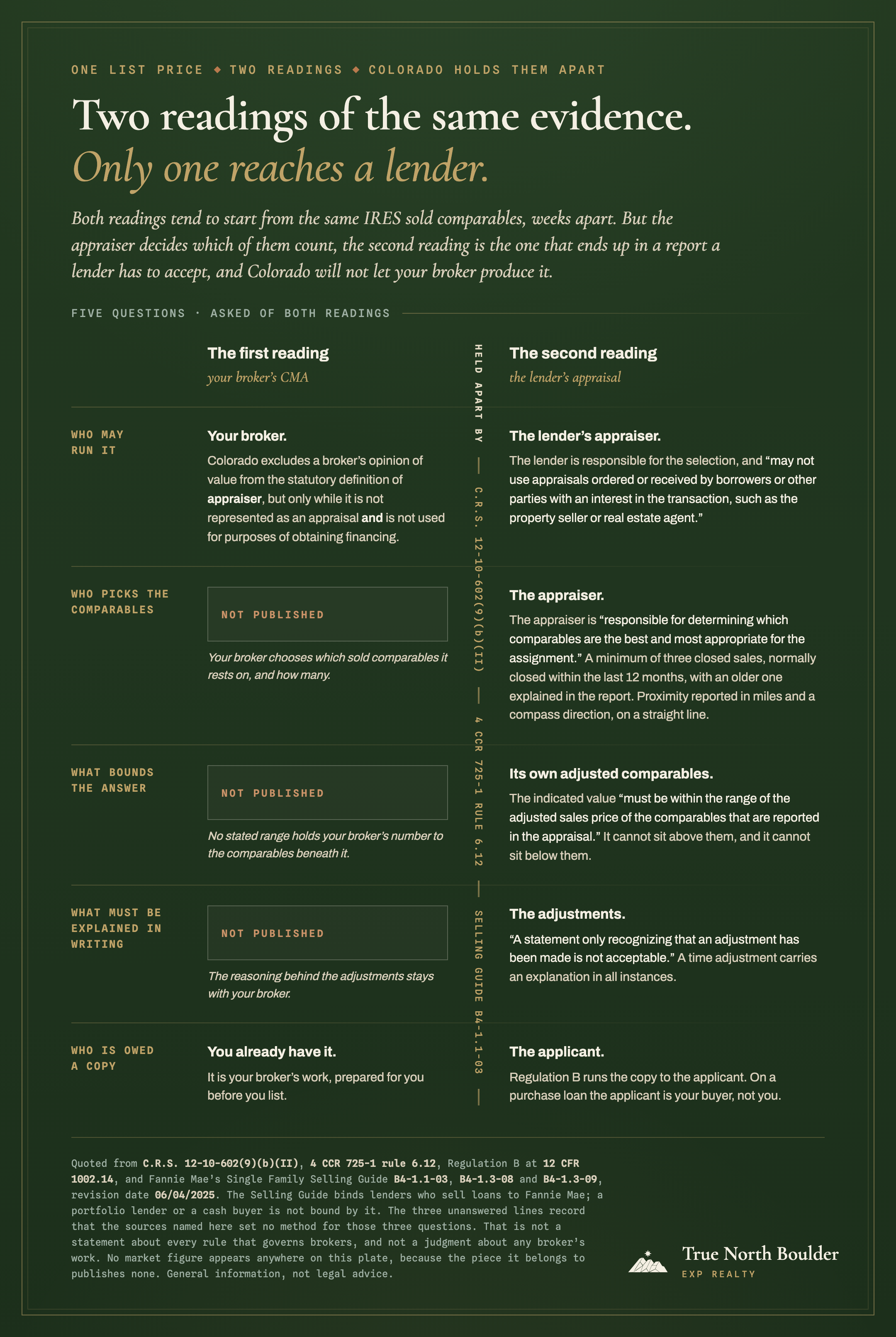
Usually yes on the source and no on the selection: both readings tend to start from the same IRES sold comparables, but only the appraiser decides which of them count. The shared starting point is the least interesting part of the answer; what differs after it is the method, because C.R.S. 12-10-602(9)(b)(II) keeps a Colorado broker’s opinion of value outside the statutory definition of “appraiser” only while it is not represented as an appraisal and is not used for purposes of obtaining financing. And sometimes there is no second reading at all, because not every loan requires an appraisal.
Colorado will not let the second reader be the first
The first reading is your broker's comparative market analysis, an opinion of value built from sold comparables.
The second reading is the one the loan depends on, and Colorado will not let your broker produce it. The state's appraiser statute lists nine exclusions from the definition of "appraiser," and second on that list is a licensed broker "who provides an opinion of value that is not represented as an appraisal and is not used for purposes of obtaining financing."
Two conditions, joined by an and: break either and the exclusion stops applying. And what it defines is a person, not a document, so the line runs around who the appraiser is rather than what your CMA is called.
The drafting says the rest, and it's one entry further down the list. That entry excuses a certified public accountant on one condition: that they not represent an opinion of value as an appraisal. Your broker's exclusion carries two conditions, and the financing one is unique to it.
The Commission that licenses brokers turns it into its own instruction: "Pursuant to section 12-10-602(9)(b)(II), C.R.S, Brokers are prohibited from completing CMAs or BPOs that are used for the purpose of obtaining financing." The statute defines; the rule enforces.
That second condition isn't an accident. The same part declares itself enacted under Title XI of the 1989 federal banking act, the "Real Estate Appraisal Reform Amendments," which is where the state scheme hands off to the federal one.
What the second reader has to write down
Same sold comparables, different picks, different arithmetic. Only one side's reasoning ends up in a report a lender has to accept, and what that side writes down is set by USPAP, the profession's own standard, plus whatever a lender selling to Fannie Mae adds.
The appraiser picks the comparables, and the guide makes it their call: they are "responsible for determining which comparables are the best and most appropriate for the assignment." Three closed sales at a minimum, which should have closed inside the last 12 months, an older one used only if the report explains why. Proximity in miles and a compass direction, "1.75 miles NW," on a straight line.
Then the adjustments, where the gap really opens. They "must reflect the market's reaction" to the differences between two houses, and the guide names the shortcut it refuses: a $20 per square foot adjustment applied by rule of thumb when the market says the figure is $100. And "a statement only recognizing that an adjustment has been made is not acceptable."
And there's a ceiling. The indicated value "must be within the range of the adjusted sales price of the comparables that are reported in the appraisal," so whatever the contract says, that indicated value cannot sit above its own adjusted comps. It cannot sit below them either.
The constraint is on the reasoning, not the size. Fannie sets no limit on how big an adjustment runs, so two careful appraisers can work your file honestly and finish apart.
The two methods meet in one place, and it's one where you have a rule of your own: the appraiser measures market change from each comparable's contract date, not its closing date. A disciplined pre-listing comp set already works that way.
Can you just get your own appraisal first?
It's the obvious move, and nothing stops you buying one. What you can't buy is the reading that counts: Fannie's rules put the choice with the lender, then shut the side door by name. A lender "may not use appraisals ordered or received by borrowers or other parties with an interest in the transaction, such as the property seller or real estate agent." Both authors of the first reading are in that sentence.
Sending facts is a different question with its own rules and its own moment. Under Regulation B, reading it is your buyer's right rather than yours: a lender owes a copy of every appraisal to the applicant, and on a purchase loan the applicant is the buyer. That's an absence, not secrecy, and a copy can still reach you: a buyer's appraisal objection has to be supported by either a copy of the appraisal or written notice from their lender, on a deadline the contract sets, after the grade and only if they object.
What that leaves you holding
What it leaves you is the facts about your house, and the comparables you're asking someone else to accept.
The second reader doesn't arrive cold. Fannie makes the lender get the appraiser "a copy of the complete, ratified sales contract and all addenda," so your number is on the desk before the comparables are. What you can do is set a number those comparables already justify, and put the factual record of your house in front of someone who has to explain the adjustments in writing. You aren't guessing their number, and you're not lobbying them. You're leaving a stranger, working from a rulebook you had no hand in, nothing to disagree with.
The second reading can still come in low, on someone else's clock and in someone else's hands, at which point the moves belong to your buyer, not to you.
The bottom line
Your broker and the appraiser will mostly start from the same sold comparables, and that similarity is what makes the difference easy to miss. Only one of them will write that reading into a report a lender has to accept, and the rules keep that one out of your broker’s hands. So the useful question before you set a number isn’t what the appraiser will say. It’s whether the comparables you’re relying on would survive being written up by somebody who has to explain the adjustments they make.
Frequently asked
Is a CMA an appraisal in Colorado?+
Your broker's opinion of value is not the thing a lender can lend against. The statute answers a narrower question than the one people ask, and the difference is not cosmetic: C.R.S. 12-10-602(9) defines who counts as an appraiser, and it excludes a licensed broker who provides an opinion of value that is not represented as an appraisal and is not used for purposes of obtaining financing. That is a line drawn around a person and a use, not a label attached to a document, and the Real Estate Commission says so in its own rule at 4 CCR 725-1, rule 6.12. That rule also requires a printed notice reading, in part, "This evaluation was prepared by a licensed real estate broker and is not an appraisal," but only on a CMA prepared for some reason other than the anticipated sale or purchase of the property. A pre-listing CMA is prepared for the sale, so don't go looking for those words on yours.
Can my listing agent send the appraiser my comps?+
Yes, and the line that matters isn't whether the facts travel but what you ask for when they do. Our guide to the appraisal gap works that through, including the moment the packet actually moves, which is when the appraiser calls the listing side to get access. Two things don't change: the lender selects the appraiser, and Fannie Mae's Selling Guide bars a lender from using an appraisal ordered or received by the property seller or the real estate agent. Sending facts isn't the same as ordering the report, and only the first of those is available to you.
Do I get a copy of the appraisal when I am the seller?+
Not as a matter of right. Regulation B, at 12 CFR 1002.14, requires the creditor to give a copy of every appraisal and written valuation to the applicant, and on a purchase loan the applicant is your buyer rather than you. That is an absence of a right rather than a rule of secrecy, and a copy can still reach you sideways: under the Commission-approved Colorado contract a buyer's appraisal objection has to be supported by either a copy of the appraisal or written notice from their lender. Which of the two arrives is up to your buyer, so an objection does not always come with the report attached. After the number has landed, and only if they choose to object.
Argue your comp set with us while the number is still yours to set. An address is enough to start, anywhere in the Boulder area we cover. Better you find the weak comp now than a stranger does, weeks later.
General information about a Colorado licensing statute, a Commission rule, a federal lending regulation and a mortgage investor's published requirements. Not legal, tax or financial advice, and not a description of what any particular broker may do for you. Put your own sale to your broker, and to a Colorado real-estate attorney where it changes your decision.
True North Boulder is a real-estate team with eXp Realty.
Sources & notes
- The state exclusion. Colorado Revised Statutes 2026, Title 12, Article 10, Part 6 (Real Estate Appraisers), current through the 75th General Assembly, 2nd Regular Session; official Office of Legislative Legal Services text, read 2026-09-12. Quoted: §12-10-602(9)(b)(II), the broker exclusion, and §12-10-601, the legislative declaration naming Title XI of the federal Financial Institutions Reform, Recovery, and Enforcement Act of 1989, 12 U.S.C. secs. 3331 to 3351. The certified-public-accountant comparison is §12-10-602(9)(b)(III). The separate definition of “appraisal” as an act, distinct from “appraiser” as a person, is §12-10-602(1)(a).
- The Commission rule. 4 CCR 725-1, Rules Regarding Real Estate Brokers, Chapter 6, rule 6.12, retrieved from the Colorado Secretary of State 2026-09-12 and diffed against the prior published version; rule 6.12 is identical in both and appears in no amendment line in either. The mandated notice quoted in the FAQ is scoped by the rule itself to a CMA or BPO prepared for a reason other than the anticipated sale or purchase of the property.
- Who the lender may use. Fannie Mae Single Family Selling Guide, B4-1.1-03, Appraiser Selection Criteria, revision date 06/04/2025, read 2026-09-12.
- What the appraiser is handed. Selling Guide B4-1.1-05, Disclosure of Information to Appraisers, rev. 06/04/2025, read 2026-09-12. Quoted: the lender “must provide, or ensure that the appraiser is provided with, a copy of the complete, ratified sales contract and all addenda for the property that is to be appraised.”
- The comparables. Selling Guide B4-1.3-08, Comparable Sales, rev. 06/04/2025. Quoted: the best-and-most-appropriate responsibility, the minimum of three closed comparables, the 12-month age rule and its written-explanation escape, and the proximity-and-straight-line reporting requirement.
- The adjustments and the ceiling. Selling Guide B4-1.3-09, Adjustments to Comparable Sales, rev. 06/04/2025. Quoted: market-based adjustments, the $20-versus-$100 per square foot rule-of-thumb example, time adjustments supported by evidence with an explanation in all instances, the unacceptability of a statement that only recognizes an adjustment, and the requirement that the indicated value sit within the range of the adjusted sales price of the comparables. The same topic states that Fannie Mae has no specific limitations or guidelines for net or gross adjustments, which is the basis for the sentence in the body that the constraint is on the reasoning rather than on the size. Lenders on UAD 3.6 follow the UAD 3.6 Policy Supplement, which these topics flag.
- Who is owed a copy. 12 CFR §1002.14 (Regulation B), the Consumer Financial Protection Bureau’s own published regulation text, read 2026-09-12. Paragraph (a)(1) runs the delivery obligation to “an applicant.” Scope note: this is the federal rule plus the route the Commission-approved Colorado contract creates when a buyer objects. No claim is made that it is a complete account of every Colorado-side provision touching seller access.
- Deliberately not published. No market figure appears anywhere in this note, and that is a decision rather than an omission: the claim is about a method, not a market, and any median, days-on-market or supply figure here would be borrowed from a piece that sourced it properly. Two things found in research were refused outright: a secondary source's percentage claim about how closely broker opinions and licensed appraisals agree, which carries no basis, window or method, and a title company's characterisation of a broker's licensed duties, because the statute, rule 6.12 and the Division of Real Estate's own statements are the authority on that, not a re-stater.