Buying a Chautauqua Cottage in Boulder: The Land Is Leased
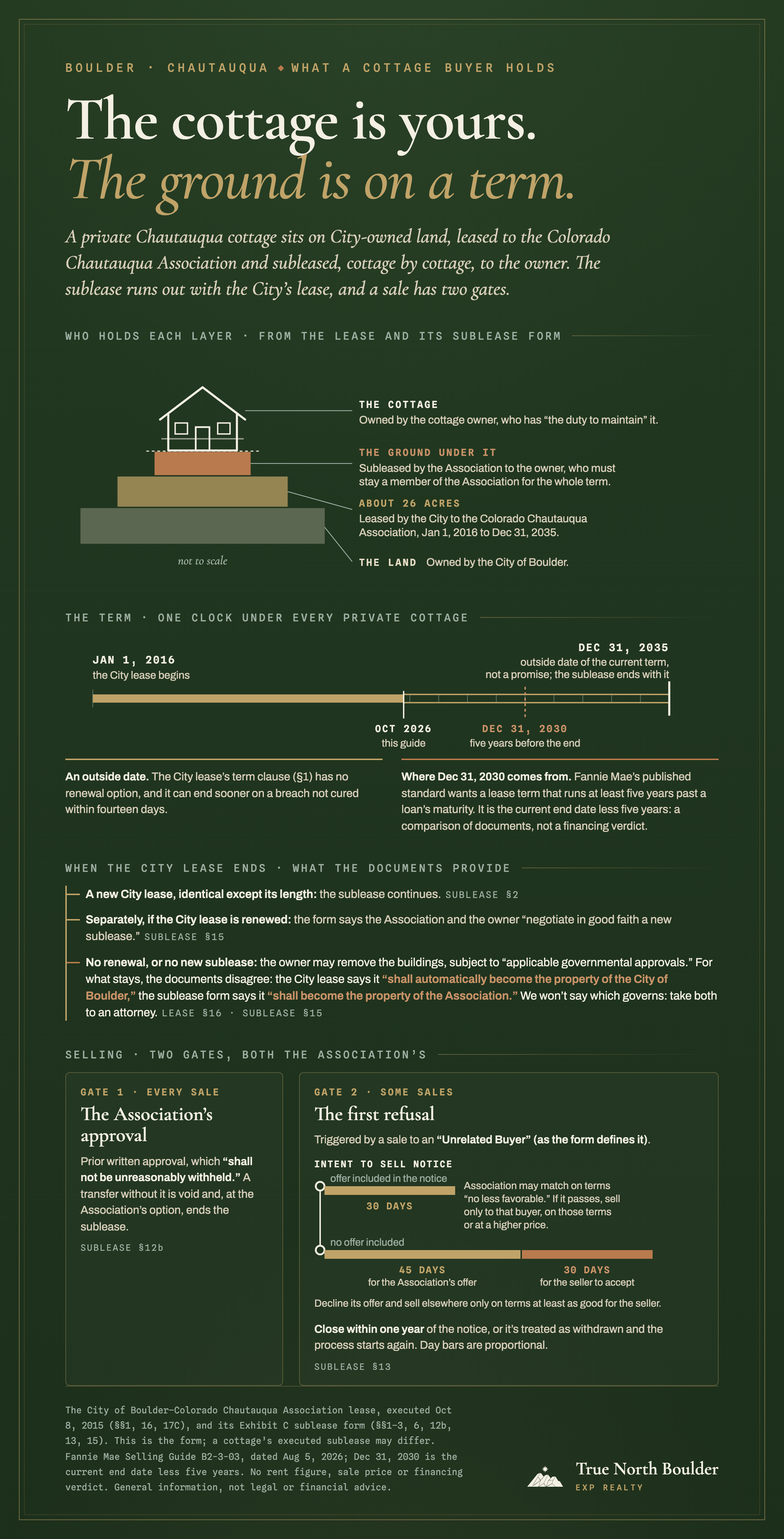
You can buy a Chautauqua cottage but not its land. It sits on a City-land sublease that ends with the City's lease, now running to December 31, 2035. A sale needs Association approval (not to be unreasonably withheld); one to an unrelated buyer, as the sublease defines it, triggers a first refusal.
If you're buying a Chautauqua cottage in Boulder, the listing is for a building. The City of Boulder owns the land, leases it to the Colorado Chautauqua Association, and the Association subleases the ground under each private cottage to that cottage's owner. That sublease ends when the City's lease ends, and the current City lease runs to December 31, 2035. Those terms decide what a cottage is worth to you and to a lender. That separates Chautauqua from other parts of Boulder's historic core: in a neighborhood like Newlands, a deed ordinarily conveys the land with the house.
A private Chautauqua cottage is a building on a sublease of City-owned land. The sublease ends automatically when the City's lease with the Colorado Chautauqua Association does, and that lease's current term runs to December 31, 2035, an outside date rather than a promise. Selling needs the Association's written approval, which "shall not be unreasonably withheld," and a sale to an "Unrelated Buyer," as the sublease defines one, triggers its right of first refusal. Read the cottage's own sublease before pricing it.
Buying a Chautauqua cottage: the house is for sale, the land isn't
Under a lease executed October 8, 2015, the City rents about 26 acres to the Association for one dollar a year, for twenty years ending December 31, 2035. The lease tells the Association to sublease the land under each private cottage to that cottage's owner, and the sublease form attached to it leases "the real property underlying Cottage No. __." The building isn't in that sentence; the lease calls the private cottages "privately-owned." The owner also has to stay a member of the Association for the whole term and follow its Rules and Regulations.
The private stock is small. The lease counted 39 privately owned cottages when it was signed in 2015 and states the parties' intent that the number "shall not change significantly." In 2023 the Association described 99 cottages, two-thirds its own and one-third privately held.
| What you're dealing with | Who holds it | What the document says | Where to read it |
|---|---|---|---|
| The land | City of Boulder | Leased to the Association for twenty years, January 1, 2016 to December 31, 2035 | City lease, §1 |
| The ground under the cottage | The Association, subleased to the owner | "the real property underlying Cottage No. __" | Sublease form, §1 |
| The building | The cottage owner | The owner has "the duty to maintain" the cottage | Sublease form, §3 |
| A sale | The owner, with the Association's approval | Approval "shall not be unreasonably withheld"; a first-refusal right on a sale to an "Unrelated Buyer," as the form defines one | Sublease form, §§12b and 13 |
| The exterior | The Association first, then the City where it applies | Changes "first approved in writing by the Association and, if applicable, by the City of Boulder" | Sublease form, §10 |
| The end of the term | City, Association and owner | Ends automatically with the City lease | Sublease form, §§2, 11 and 15 |
That table describes the form, not your cottage. The City lease lets the Association and an owner add terms to the form as long as they're consistent with, and don't impair or limit, the lease's terms, so the document that governs a given cottage is its executed sublease. You don't need the seller for everything: the 2015 City lease and the sublease form attached to it are a public City of Boulder record (a scanned copy), so you can read the term and the transfer gates ahead of an offer. The form says the owner was given the Rules and Regulations and the Transfer of Ownership Assurances Documents and is sent each year's rent notice, so ask through the listing broker for those three and for the cottage's executed sublease. Before there's a contract, that's a request. Once there's a contract, the standard form's "Other Documents" line is where they can be named, and that section's delivery, objection and resolution deadlines all need dates: under §3.2, a deadline left blank deletes the provision that contains it.
The sublease ends when the City's lease does
The sublease form says it "shall automatically terminate upon termination" of the City lease, and says so twice. December 31, 2035 is the outside date of the current term, not a promise. The City lease's term clause contains no renewal option, and either party can terminate the lease "upon any breach of the terms hereof," after notice and "fourteen days to cure." For a buyer closing in late 2026, that's about nine years at most. Whether there's a term after 2035 is between the City and the Association, and it's a part of this purchase no inspection reaches.
If a new City lease keeps the old terms apart from its length, the sublease form says the sublease continues. Separately, if the City lease is renewed, the form says the Association and the owner "shall … negotiate in good faith a new sublease." Without either, the owner may remove the improvements "subject to applicable governmental approvals," and the form says anything left after six months "shall become the property of the Association." The City lease says unremoved buildings "shall automatically become the property of the City of Boulder." The two documents name different owners for the same buildings. We won't say which governs; take both clauses and the executed sublease to a Colorado real estate attorney.
Rent moves each year with the Consumer Price Index, measured every October 1, with notice by December 1 and payment due January 1. Of each year's rent, $2,400 goes to the Association's capital improvements, and the form makes that the owner's "sole obligation" toward them. Charges for common-area maintenance, snow removal, trash and mail come on top. The form leaves the dollar rent blank, so ask the seller for this year's rent notice.
Selling can mean asking the Association twice
The first ask is approval. The sublease can't be assigned without "the prior written approval of the Association, which approval shall not be unreasonably withheld," and the Association may attach reasonable conditions, including its attorney's fees, an administrative fee and the buyer's signature on its "Transfer of Ownership Assurances Documents." A transfer made without approval "shall be void and will, at the option of the Association, terminate this Sublease." We couldn't find those assurance documents published, which is why they're on the list to ask the seller for. And no transfer is effective until the Association, the seller and the buyer have all signed "an assignment of this Sublease in form and content reasonably acceptable to the Association and Lessee." Your title company needs to know that early. The form sets no time limit on the approval itself, so leave room for it in the contract's dates.
The second ask is the first refusal. An owner may not sell to "a person not related to the Lessee within the fourth degree of consanguinity (an 'Unrelated Buyer')" without first offering the Association the chance to buy. The form defines that degree "including such relationships if established by marriage or adoption" and lists the relationships in an attachment.
It begins with the seller's Intent to Sell Notice. If a bona fide offer is included in the notice, the Association has 30 days to offer terms "no less favorable" to the seller. If it does, the sale goes to the Association. If it passes, the seller may sell only to that buyer, on those terms or at a higher price. If no offer is included in the notice, the Association has 45 days to make one and the seller has 30 days to accept it, and a seller who declines can sell elsewhere only on terms at least as good for the seller. Either way, within 10 days of the notice the seller has to let the Association inside the cottage to inspect it, and for each day of delay after the tenth, the Association gets one more day to make its offer. If the sale doesn't close within one year of the notice, the notice is treated as withdrawn and the process starts again.
If you're the seller, the starting point is a choice: you can send the Intent to Sell Notice before you've accepted a buyer's offer or after, and a notice sent after has to include that offer. Each path runs on a different clock, and you can set the two side by side from section 13 of the form yourself. The choice stays yours; weigh it with your attorney before you list, and if you're buying your next house at the same time, build the Association's window into that purchase's dates too.
If you're the buyer, the offer in the notice is yours. The form has the seller's notice include the offer it has "received and provisionally accepted (subject to the Association's right of refusal)," either by attaching the contract or by setting out its terms. If the Association answers within 30 days on terms no less favorable, the seller "shall sell the Cottage to the Association" instead. The sublease form says nothing about the costs a buyer has run up in that window.
The City lease records that the Association acquired a privately owned cottage only once during the prior twenty-year term. That record covers one past term, and it doesn't predict what the Association will do on the cottage you're buying. On a sale with your offer in the notice, the Association has 30 days, plus any days added for late interior access, to make its own offer. The seller can sell to you only after the Association says in writing that it won't make one, or its time runs out without one. Before you sign, find where your contract deals with your earnest money if the sale can't go to you; whether that covers an Association match is for your broker to check. What a buyer has to plan for is a clock the standard Colorado contract's deadline table doesn't carry, and setting the approval and the first-refusal window against an offer's dates is a job for your broker and attorney, working from the executed documents.
Why a lender reads the sublease before the house
Here a lender's collateral is a leasehold. Fannie Mae's Selling Guide on leasehold estates (B2-3-03, dated August 5, 2026) is one published standard. It buys leasehold loans "in areas in which this type of property ownership has received market acceptance" and counts a sublease as a lease. Set it beside the sublease form and five questions come out:
- The term. Fannie wants an unexpired term that "exceeds the maturity date of the loan by five (5) years or more." Against the current end date, a loan maturing after December 31, 2030 wouldn't leave that cushion, and a fifteen-year loan closed in 2026 matures in 2041.
- Transfers. It wants a lease that can be assigned and mortgaged "either without restriction or on payment of a reasonable fee and delivery of reasonable documentation," and that does not "require a credit review or impose other qualifying criteria" on an assignee. The form requires the Association's approval, membership and a first refusal.
- The master lease. On a sublease, "a default under the master lease will not automatically result in the termination of the sublease." The form ends with the City lease.
- Lender notice. Forfeiture terms must give the lender notice of a default and at least 30 days to cure it, take over the lease or foreclose. The form we read has no clause addressed to a lender and doesn't mention mortgaging.
- Recording. Fannie wants the lease recorded. The form leaves recording "at the option of the Association."
That's a comparison of two documents, not a financing verdict. Fannie also lets its lease requirements be met by "separate agreement(s) incorporated into the lease (e.g., addendum, amendment, or rider)," so ask a lender whether any such agreement exists for the cottage. An agreement added to the sublease doesn't change the City lease, which sets the end date and changes only by written amendment.
The same Fannie section sends the appraisal to Fannie's leasehold appraisal requirements (B4-1.4-05) and the title policy to its special title-coverage section (B7-2-04), so ask the lender about both, and ask the title company what leasehold coverage it will write. Fannie's rules reach conforming loans; a loan amount above Boulder County's 2026 conforming limit of $879,750 falls outside them, under the lender's own leasehold rules or its investor's. Take the five questions to a lender early, with the public sublease form if the executed one hasn't arrived yet, and again with the executed sublease once it has.
Two reviewers, then a duty to rebuild
Chautauqua became a City of Boulder landmark historic district in 1978 and a National Historic Landmark district in 2006, and the sublease binds owners to its design guidelines. An exterior change needs the Association's written approval first, then the City's where it applies. On the City's side, a Landmark Alteration Certificate is required "for all exterior changes to a property designated as an individual landmark or located within a historic district," and on a demolition application the Landmarks Board "can either approve, approve with modifications, or deny." Our Mapleton Hill guide covers how that review runs. What's new at Chautauqua is a landlord reviewing first. Who can change the rules a house lives under is a separate question with a piece of its own.
The sublease also turns damage into a schedule. If the cottage is destroyed or becomes uninhabitable, the owner must rebuild to plans approved by the Association and then the City, apply within six months, and start by the later of twelve months after the event or thirty days after approval, "subject to any construction moratorium imposed by the Association." If it's totally destroyed and not substantially rebuilt within twenty-four months, the Association may end the sublease under its default section, which has the owner vacate within 30 days and the Association pay "the fair value of the Cottage, as determined by an independent appraiser selected and paid for by the Association." The form doesn't say how that value is measured for a cottage that has been destroyed. The schedule doesn't change with how much of the term is left, so ask an insurance agent, before your contract's Property Insurance Termination Deadline, how a policy would handle a rebuild on that timetable, including one late in the term.
On the streets around the park, the land comes with the house
A few blocks away, a deeded house is a different asset: the land conveys with it, ordinarily with no term, no ground rent and no first refusal. Some portals and listings file those houses under "Lower Chautauqua," so a listing that says Chautauqua can mean either kind of ownership; check which before you read the price. Designation is set by address, so look the house up on the City's map. An older house that isn't individually landmarked or in a district still faces the City's demolition review for buildings over 50 years old, which is the subject of our Whittier guide.
About this data
We don't publish a Chautauqua cottage price, a median, or a place for the cottages in the $800K–$1.5M band. No CAR market report covers Chautauqua as its own area, the private stock is small, and the Association says its cottages range "from a few hundred square feet to four bedrooms." We couldn't verify the cottage sales we found against a primary record, and we won't print a figure we can't check. Boulder's published median, $1,299,900 for single-family homes sold year to date through August 2026, is a citywide figure dominated by houses that include their land and carry no term, so it tells you little about a cottage.
The bottom line
At Chautauqua the house isn't the whole purchase. A cottage on a sublease is priced by its remaining term and its exits before its porch: the City lease's end date, the Association's approval (which can't be unreasonably withheld) and, on a sale to an unrelated buyer, its first refusal, and whether a lender will lend on the leasehold. Read the executed sublease first, and price from it.
Frequently asked
Can you own a Chautauqua cottage outright?+
You can own a private cottage but not the land under it. The City of Boulder owns the land and leases it to the Colorado Chautauqua Association, which subleases the ground under each private cottage to its owner until the City's lease ends; the current term runs to December 31, 2035. The houses that come with their land are on the deeded streets around the park.
When does a Chautauqua cottage sublease end?+
It ends automatically when the City's lease with the Colorado Chautauqua Association does, and the current City lease runs to December 31, 2035. That's an outside date: the City lease's term clause contains no renewal option, and the lease can be terminated on a breach not cured within fourteen days. We don't forecast a renewal.
What does selling a Chautauqua cottage require?+
The Association's prior written approval, which the sublease says "shall not be unreasonably withheld," and a buyer who is a member of the Association. On a sale to a buyer who isn't related to the seller within the fourth degree of consanguinity, as the sublease defines it, the Association also has a right of first refusal.
Can you get a mortgage on a Chautauqua cottage?+
A guide can't answer that yes or no. The lender's collateral is a leasehold, so it reads the sublease; Fannie Mae's published standard, for one, wants a term running at least five years past the loan's maturity. Ask a lender how it treats the cottage's executed sublease.
Can you rent out a Chautauqua cottage?+
Only as the Association's Rules and Regulations allow. We couldn't find those rules published, but the sublease form says the owner was given a copy, and it lists failing to abide by them as a default that can end the sublease after two written notices and, if disputed, mediation. Ask the seller for the current rules before you count on any rental use.
Your attorney and your lender read the sublease. Our part is to ask the seller early for the four documents (the executed sublease, this year's rent notice, the Association's Rules and Regulations and its Transfer of Ownership Assurances Documents) and, with your attorney, build the Association's approval and, if it applies to your purchase, the first-refusal clock into your contract dates.
Sources & data notes
- The City of Boulder–Colorado Chautauqua Association lease, executed October 8, 2015 (effective January 1, 2016 to December 31, 2035), with its Exhibit C, "Colorado Chautauqua Association Sublease to Cottage Owner," a form marked approved by the Association's board on October 5, 2015: City of Boulder records copy, read in full as page images (the scan has no text layer). Quotations are from the lease's sections 1, 14, 15, 16 and 17C and the form's sections 1 to 16. Lease section 15 allows sublease provisions "supplemental or additional to the terms set forth above," provided they "are consistent with, and do not impair or limit, the terms set forth above," so a specific cottage's executed sublease may differ from the form.
- That the City lease's term clause (section 1) contains no renewal option, and that the lease changes only by written amendment (section 18), is read from the lease itself. We make no forecast about a renewal.
- The 26 acres is from the City of Boulder's Chautauqua Collaborative Stewardship Program page and the Association's own account below. That City page still describes an earlier lease, so the term is cited to the 2015 lease, not to it.
- Cottage counts are two dated figures, deliberately not merged: 39 privately owned cottages when the lease was signed (lease section 14, 2015), and 99 cottages, two-thirds owned by the Association and one-third privately held, in the Colorado Chautauqua Association's 2023 account, which is also the source of the size range in the data note.
- Fannie Mae Selling Guide B2-3-03, Special Property Eligibility and Underwriting Considerations: Leasehold Estates, version dated 08/05/2026. December 31, 2030 is arithmetic: the current end date less five years. Fannie's separate line on unexercised renewal or extension options applies to co-operative projects and is not used here.
- The 2026 one-unit conforming loan limit for Boulder County, $879,750, is from FHFA's county loan limit list.
- Landmark review: the City of Boulder's Landmark Alteration Certificate page and its demolition review for buildings older than 50 years page. The 1978 and 2006 designations are as recited in the lease and in sublease section 5.
- The Boulder median, $1,299,900, is single-family, sold, year to date through August 2026, from the CAR Local Market Update for Boulder (data from IRES).
- Deliberately not published: any cottage sale price or median, any ground-rent amount (the sublease form leaves the dollar rent blank), the Association's rental rules (we couldn't find them published), and any reading of which document governs unremoved buildings at the end of the term.
Daniel Hsieh is a licensed Colorado real estate broker with True North Boulder, brokered by eXp Realty. This is general information, not tax, legal, or financial advice; confirm your specifics with a Colorado real estate attorney or a lender before you act. We describe the City lease and the sublease form as published, and we don't interpret a specific cottage's sublease or say whether a cottage can be financed.