Buying a House From an Estate in Colorado: What to Know
Nothing about the rules changes when an estate is selling, and that is the problem. Both of a buyer's standard protections are keyed to a seller, and page one of Colorado's 2026 disclosure form now asks whether that seller ever lived in the house.
Nothing about Colorado's rules changes when an estate is selling. That's the problem. Both of a buyer's standard protections are keyed to a seller, and an estate doesn't have a seller in the sense the word usually carries. The disclosure form runs to what the seller actually knows. The covenants in a deed run to the words that deed happens to contain. Both are fully intact on an estate sale, and both are pointed at a person who may never have set foot in the house. Since January the Colorado Real Estate Commission's form asks about that on page one, so if you can get the form before you write, you can read how thin it's likely to be rather than finding out after you own the place. Have your broker ask the listing broker for it early. On an estate listing the form may not be completed yet, and a no is its own kind of answer.
Same contract, same form, same duties
There is no estate version of the Colorado purchase contract and no estate version of the disclosure form. The same CBS1 and the same SPD19 govern, and the seller's duties under both are unchanged. What changes is who the word "seller" refers to, and how much that person knows.
Read the form looking for a fiduciary carve-out and you won't find one. Across its fourteen pages the words fiduciary, executor, personal representative and trustee do not appear at all. The duty is intact. It's simply being answered by someone who may have inherited the house along with the obligation to sell it.
That word "may" is doing real work, and it's the reason the rest of this piece is a reading exercise rather than a warning. A surviving spouse who lived in the house for forty years and is now selling it as the estate's representative owes you a full and genuinely informed disclosure. An adult child in another state who last saw the house at a holiday twenty years ago owes you exactly the same duty and can honestly discharge it with almost nothing. Same form, same law, two completely different documents.
One thing this doesn't mean, and it's worth killing early because the fear is intuitive and wrong: you're not receiving a lesser ownership. Search this and the answer that comes back is that a personal representative's deed is "very similar to a quitclaim deed." That is true of the promises and false of the property, and the property is what you are buying. Colorado's deed statute says so directly, in the subsection that governs every deed regardless of its name. "Subject to any reservations specifically set forth in a deed," the form of deed used "does not affect the absolute nature of the fee simple conveyance of the property being conveyed and is not deemed to convey any lesser estate or interest." So unless the deed reserves something on its own face, and a mineral or water interest kept back for the heirs is an ordinary enough thing on an estate conveyance, what thins on an estate sale is your recourse, not your title.
The knowledge standard underneath all of this is general Colorado law rather than anything estate-specific, and we have written it up already for buyers arriving from states that do things differently. Our guide to moving to Boulder County from California explains that Colorado's disclosure is a knowledge instrument rather than a survey. What follows here is what that standard does when the person answering was never there. Separately, the ordinary purchase chronology from agency through closing is laid out in our Boulder County buyer's guide, which is the place to start if this is your first purchase in the county.
Page one now asks who lived there
Colorado's 2026 disclosure form added three lines to page one that tell you what the rest of the form is worth. They ask whether the seller currently occupies the property, when they last occupied it, and whether it sat vacant or was occupied by someone else in the meantime.
The block reads, in the form's own words: "Seller ☐is ☐is not currently occupying the Property. If Seller is not currently occupying the property, date Seller last occupied the Property: ____. During any period when Seller has not occupied the Property, the Property was ☐vacant ☐occupied by someone other than Seller."
One field near the block, the year the seller acquired the property, was already on the older form and is not part of the change. The three occupancy lines are. Page one of the superseded ten-page form carried no occupancy block at all, and on the fourteen-page current form the phrase "currently occupying" appears twice.
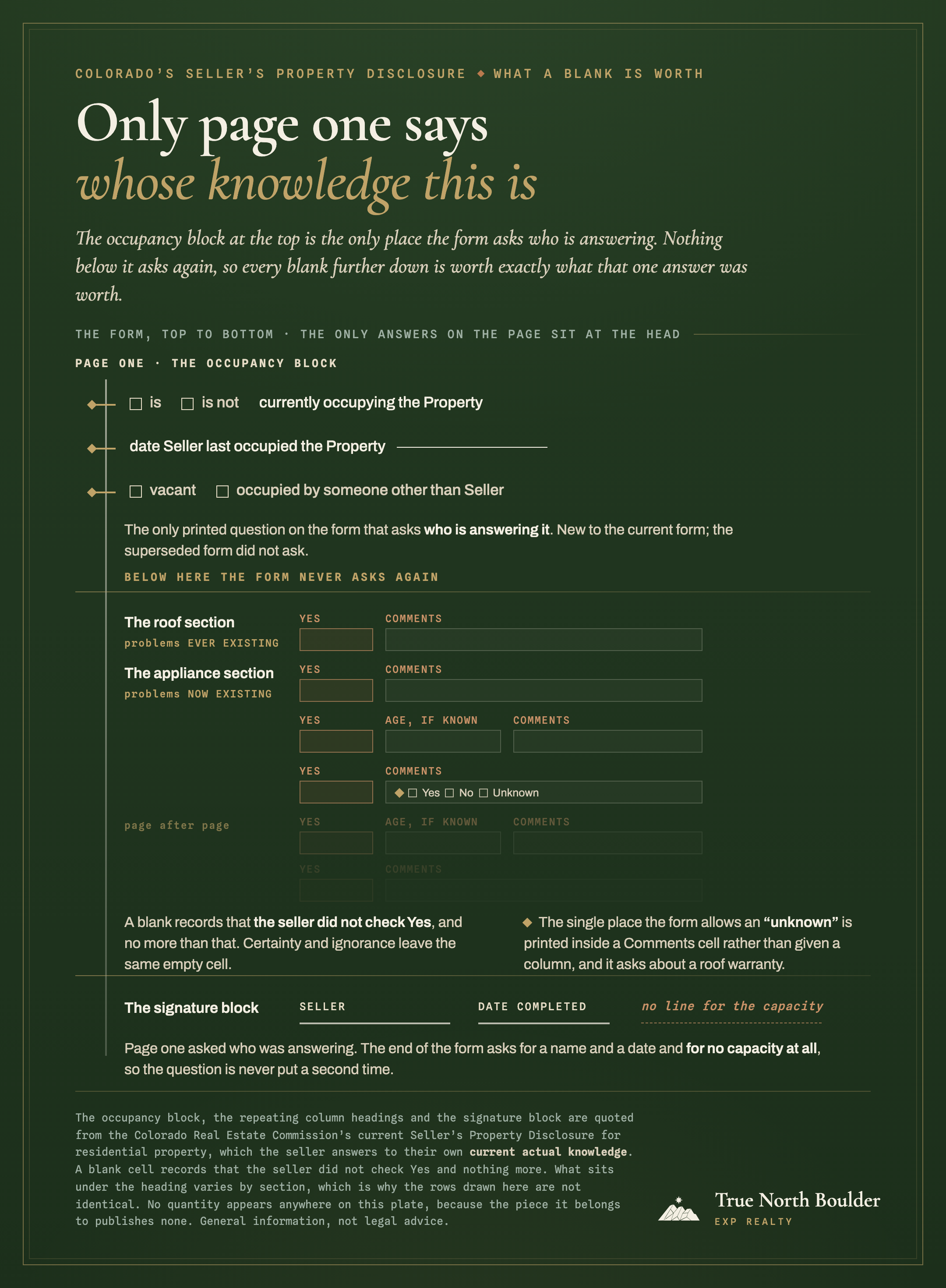
Those three lines are the only printed question on the form putting the issue directly. The signature block at the end is bare, just "Seller" and "Date Completed", with no line for the capacity in which someone is signing. The name field on page one may well read "Estate of" somebody, which is a tell, but a tell is not an answer to a question nobody asked. The occupancy block asks.
There's a second change worth knowing, because it connects page one to everything after it. The superseded form asked the seller to answer as of the date of the contract. The current form asks them to answer as of the date of the Seller's Property Disclosure Deadline, and it adds an express duty to disclose a newly discovered adverse material fact in writing. The form now pins its own knowledge date to a row in the contract's deadline table.
A blank row is worth what the signer knew
Twenty-five times across fourteen pages, Colorado's disclosure form gives the seller a "Yes" column. Not one of those columns is paired with a "No". So an unchecked row records that the seller did not check Yes and nothing more, and the value of every blank on the page depends entirely on who was answering.
The first half of that is general Colorado law. A blank means the seller does not know; it does not mean the hazard is not there, which the California relocation guide linked above unpacks at length. The part that belongs to an estate sale is the second half, and you can see it on the page.
Open the form to any condition section and the header repeats: a "Yes", and no paired "No". What sits underneath it varies more than people assume, so don't go hunting for one layout. Ten of those sections run three columns, with "Age, if known" between Yes and Comments. The governing instruction alternates too, between problems "EVER EXISTING" and problems "NOW EXISTING", depending on where in the form you are. The roof section asks about problems ever existing. The appliance section asks about problems now existing.
What is constant is the narrow Yes column and, beneath it, a run of empty cells. The seller who knows the roof has never leaked, and the seller who has no idea whether it has, leave an identical row. Both rows are blank, both are honest, and the form gives you no way to tell them apart. That's why page one matters so much. Nothing further down tells you whose knowledge you're reading, so the one block that does has to carry it.
The form does have one three-state answer, and its position is instructive. A "☐ Yes ☐ No ☐ Unknown" appears exactly once in fourteen pages, printed inside the Comments cell of the roof-warranty-transferability row rather than as a column of its own. So the single place the form lets someone say "unknown" sits outside the grid entirely, and it's answering a question about a warranty rather than about the condition of the house.
None of which stops a personal representative from writing "no personal knowledge" into a Comments cell, and a careful one will. The form invites it, telling sellers their answers are "NOT limited to only the space provided" and that they may attach additional pages, reports and receipts. The defect is not that a fiduciary seller cannot say so. It's that a blank doesn't say so, and blanks are what you'll mostly be reading. What conveys with a Colorado home works through the same form from a different angle.
One contract mechanic belongs here and then gets out of the way. The disclosure is delivered under a dated row in the contract's deadline table, and the contract's own rule is that a deadline left blank, or filled in with "N/A" or "Deleted", is not applicable and "the corresponding provision containing the deadline is deleted." The deadline named in that row appears in section 10.1. The adverse-material-facts provision at 10.2 is keyed to the date of the contract instead and carries no deadline row at all, so the deletion rule has nothing to act on there. The general rule about blank deadline rows is in our guide to the Colorado contract's deadlines. Underneath both sits a common-law duty to disclose latent defects known to the seller, recognised in In re Estate of Gattis, 2013 COA 145, ¶ 32.
What the Letters are certified to say
Letters Testamentary, or Letters of Administration, are a single court-issued page proving that a named person may act for the estate. The line to read is the one stating whether their authority is unrestricted or restricted, and the certification date at the bottom.
The Colorado form is JDF 915SC, and it's short enough to read standing up. It records which kind of letters these are, who was appointed and when, whether they are the personal representative or a successor, and the decedent's date of death. It states that the letters are proof of authority to act "pursuant to § 15-12-701, et. seq., C.R.S." Then the checkbox: "☐The Personal Representative's authority is unrestricted; or ☐The Personal Representative's authority is restricted as follows:", with a blank line after it. At the foot, a clerk's certification that this is a true copy "and to be in full force and effect as of" a stated date.
Why that checkbox earns its keep is a two-part answer, and the two parts are different rules that are easy to blur. In supervised administration, a restriction the court orders "must be endorsed on his letters of appointment and, unless so endorsed, is ineffective as to persons dealing in good faith." The general rule is in section 15-12-714, and it states both halves in one sentence: "Except for restrictions on powers of supervised personal representatives which are endorsed on letters as provided in section 15-12-504, no provision in any will or order of court purporting to limit the power of a personal representative is effective, except as to persons with actual knowledge thereof." Which regime a particular estate is in, and what that last clause does to a particular buyer on a particular file, are questions for a lawyer rather than for this page. The reason to read the line yourself is a practical one and belongs to the transaction: a restriction written there is a fact about what this representative can sign without going back to the court, a title company will have its own view about it before it agrees to insure, and if something is on that line you'd rather be reading it while your deadlines are still ahead of you than in the week before closing.
That same section is also the reassurance most articles on this subject leave out, presumably because worry reads better. A person who "in good faith either assists a personal representative or deals with him for value is protected as if the personal representative properly exercised his power", and knowingly dealing with a personal representative "does not alone require the person to inquire" into their power or how they used it. The protection expressly extends to cases where "some procedural irregularity or jurisdictional defect occurred in proceedings leading to the issuance of letters." So the statute, by its own terms, absorbs much of the risk sitting in the appointment itself, for a buyer acting in good faith and paying value. Hold that thought for the next section, because it changes what the title policy is actually for.
If two or more people were appointed together, the code requires "the concurrence of all" on acts of administration unless the will says otherwise, with exceptions for emergencies and delegation. It also protects a person who deals with one of them while "actually unaware that another has been appointed" to serve alongside. Both halves are in the same section and the second one matters as much as the first.
You don't chase the probate file at the courthouse yourself. The Letters arrive through the transaction: your broker asks the listing broker. What the title company needs from the estate before it will insure is set out in the requirements schedule of your commitment, and that is where a call for a certified copy would appear, which is why that certification date is printed on the form. The recording that follows is a county function, at the county the parcel sits in rather than the one the mailing address suggests: a Longmont address can record in Boulder County or in Weld, and our Longmont guide sets out what else that line decides.
A personal representative's deed, and the policy that does its work
Six deed checkboxes, and one of them is a personal representative's deed. That is section 13 of the Colorado contract, a document your own broker prepares, telling you in print and before anyone has to explain it that this transaction has a different shape.
Colorado's deed statute sets out four statutory forms: general warranty, special warranty, bargain and sale, and quitclaim. A personal representative's deed is not one of them. What the statute does is tie covenants to words rather than to names. Every deed, whether in one of those four forms or "in any other form permitted by Colorado law", conveys "with covenants on the part of the grantor, if any, as set forth in subsection (4)". Then subsection (4) does the work, by making the words "warrant(s) the title" mean three specific promises. That the grantor was lawfully seized in fee simple with full power to convey. That the property is free of encumbrances except as stated. That quiet possession will be defended. Omit the words and you omit the promises.
The reason those words are usually left out is not the one people reach for. It isn't incapacity. A personal representative "has the same power over the title to property of the estate that an absolute owner would have, in trust however, for the benefit of the creditors and others interested in the estate. This power may be exercised without notice, hearing, or order of court." That second sentence is the one a buyer arriving from another state usually wants, because it is the general rule here and it isn't the rule everywhere: no judge signs your purchase off. Whether a particular estate sits in a regime that changes that is the supervised-administration question from the last section, and it is a lawyer's to answer rather than ours. An absolute owner can give a warranty. Someone holding that power in trust for creditors and heirs generally declines to give a personal one, which is drafting convention and fiduciary prudence rather than a limit on what they could do. None of that changes the ownership you receive, for the reason set out in section one. And none of it is a reason to go and negotiate that checkbox. The point of the covenant question is only to explain what happens next.
Which is that the owner's title policy quietly becomes the instrument carrying the weight. Section 8.1.1 of the contract is a checkbox: "If this box is checked, Seller will select the title insurance company to furnish the owner's title insurance policy at Seller's expense", against a title commitment "in an amount equal to the Purchase Price". The closing sentence of section 8.1, which sits after the buyer's alternative, supplies the default: "If neither box in § 8.1.1. or § 8.1.2. is checked, § 8.1.1. applies." Seller-paid owner's coverage is what you get if neither box is ticked.
Here's the part to be careful about, and most writing on this subject gets it backwards. The policy is not mainly your protection against a defective appointment, because much of that is already absorbed by the statute in the last section, for a buyer acting in good faith and paying value. Both of those conditions do real work, and what they come to on a particular file is a lawyer's question rather than ours. What the policy is aimed at is a different set of risks altogether, ones that have nothing to do with this representative's authority, and how far any given policy reaches is bounded by what your own commitment excepts and by what the policy itself excludes. Land Title Guarantee Company, describing what an owner's policy may protect against, names "undisclosed heirs who surface years or decades later", "forged deeds, releases, or wills", and "liens for unpaid estate, inheritance, income, or gift taxes". Three estate-shaped risks, none of which is about whether the person signing was properly appointed. The company also notes that the premium is paid once at closing and the protection runs "for as long as you own your house". That's the real contrast with a covenant: one runs against a person, the other against an insurer, for as long as the house is yours. We quote that company because its own published description of the product category is the source for the list, not because we are pointing you at a title company; under section 8.1.1 the seller picks one by default in any case.
That's a description of a category of product, not a reading of your policy, and the contract says as much in twenty-two words of its own: "Matters set forth in this Section and others, may be excepted, excluded from, or not covered by the owner's title insurance policy."
The related box is Owner's Extended Coverage at section 8.1.3, a "Will / Will Not" choice about deleting certain standard exceptions, and the form then warns that the commitment may not provide it regardless of what the contract requires. Two things about that box belong in a budget rather than in a footnote. It carries its own allocation line, "Any additional premium expense to obtain OEC will be paid by", with boxes for Buyer, Seller or a split, so unlike the owner's policy under section 8.1.1 this is a title-side cost that can land on you, and it's decided when the contract is written rather than later. And the standard exceptions the box addresses begin with parties in possession, which is the occupancy question page one of the disclosure asks, arriving a second time on a different document. What your policy ends up covering is written in your commitment, which the contract delivers on or before the Record Title Deadline, so it reaches you after you are under contract rather than before you sign. The title company, whichever side selected it, can walk you through it then.
The inspection stops being a second opinion
On an ordinary sale the inspection tests a seller's account of the house. On an estate sale there is often no account to test, so the inspection changes status rather than scope: it becomes the primary record rather than the second opinion.
That the burden of discovery sits with the buyer's inspection is the design of Colorado's system generally, not a peculiarity of estates, and the California relocation guide takes that design apart. What is particular here is how much weight the design ends up carrying.
The Commission's own form concedes the point, and the conditional clause it opens with is the interesting part. The Advisory to Buyer begins: "Even though Seller has answered the above questions to Seller's current actual knowledge, Buyer should thoroughly inspect the Property and obtain expert assistance". That sentence assumes a floor beneath the buyer, a set of answers given by someone who knew something. On an estate sale that floor is at its lowest, so the advice the form gives every buyer is advice this buyer has less room to decline.
Practically that means budget and sequencing rather than technique. The techniques don't change, and they're the same ones in our guide to home inspections in Boulder County. What changes is that the specialist follow-ups you might skip on a well-documented house, the ones a seller's own history would ordinarily have prompted or ruled out, no longer have anything prompting them.
There is also a scheduling problem here that no statute flags. The utility accounts were in the decedent's name, and accounts in a decedent's name are commonly closed: gas off at the meter, water off at the curb, sometimes the service disconnected altogether. An inspector who cannot light the furnace cannot tell you anything about the furnace, and the same goes for the water heater, the fixtures and the air conditioning. Reopening an account that was closed on a death certificate isn't a same-day job, and the representative may have to do it in person. Your Inspection Objection Deadline runs either way. Page one already told you whether this house sat vacant, and if it did, that is an operational fact about the building as much as it is a fact about what the signer knows.
The reason this gets skipped is not that buyers don't know to do it. Every one of those requests lands on a family in the middle of settling an estate, and most buyers would rather not be the person making it. It's a normal request, and the estate's broker handles it as one. Route it broker to broker, ask for the same things you would ask of any seller, and expect what you would expect from any seller: sometimes useful, often nothing. There may be nobody left who can tell you the basement took water in 2019.
How much of this you actually have to read
Page one of the disclosure decides how much the rest of it is worth. If the person who signed lived in the house for decades, the rest of the form repays close reading. If they never lived there, the blanks tell you very little, and the two documents that carry your purchase are the inspection report and the title commitment.
Page one of SPD19, the occupancy block
The lines at the top of Colorado's disclosure form: whether the seller is currently occupying the property, the date they last occupied it, and whether it sat vacant or was occupied by someone other than the seller. They are what calibrates every blank further down the form.
The completed SPD19, in the light of page one
The same form with the seller's answers on it. A blank cell records that the seller did not check Yes and nothing more, so the row left by someone who knew and the row left by someone who never did look the same. A personal representative with no personal knowledge can write exactly that into a Comments cell, and the form invites answers beyond the space provided.
The Letters, JDF 915SC
The court's single page proving that a named person may act for the estate. The lines to read are the checkbox stating whether the authority is unrestricted or restricted as follows, and the clerk's certification date at the foot. It reaches you through your broker rather than through the courthouse.
The title commitment, and the deed box at section 13
The commitment sets out what the title company requires from the estate and what it excepts from your policy, and the contract delivers it on or before the Record Title Deadline, so it arrives once you are already under contract. Section 13 names the deed the estate will deliver, and a personal representative's deed is one of the boxes on it. Both are documents to read, not levers to pull.
The inspection, and the extended-coverage box at section 8.1.3
The items on this list you decide and pay for. What the inspection covers, and whether the utilities will be on for it, since an account closed in a decedent's name takes time to reopen and the Inspection Objection Deadline runs either way. Section 8.1.3 carries its own allocation line for any additional premium to obtain Owner's Extended Coverage, with boxes for Buyer, Seller or a split, and it is settled while the contract is being written.
Start with page one of the disclosure, before the rest of it. The occupancy block sets the exchange rate for every blank cell further down, and taking it out of order means reading the form twice. Then read the form itself, knowing now who was answering it and what a blank does and does not record. Then ask for the Letters, through your broker rather than the courthouse, and read the restriction line and the certification date. Then look at the deed box in section 13 and at what the title commitment requires, not to renegotiate anything, but because that is where the protection you are actually relying on is written down. Two decisions on that list are yours rather than the estate's, and they are the only ones here you pay for: what the inspection covers and whether the utilities will be on for it, and the section 8.1.3 box that says who pays for extended coverage.
A line runs across that list. The first two you can do before you write, if the estate will let you have the form; everything after them sits inside deadlines you've already agreed to, which is why the 8.1.3 box is worth settling while the contract is still being drafted.
It is more work than an ordinary purchase, and it's worth saying so rather than pretending otherwise: a form that tells you less, a court document to chase, an account somebody has to reopen before an inspector can do their job. What you get in exchange is a purchase resting on your own inspection and your own title commitment rather than on somebody's memory of the house, bought from a person on the other side of this contract who may know less about it than you'll know by closing.
Frequently asked
Does an estate have to complete Colorado's Seller's Property Disclosure?+
The duty is contractual rather than statutory, and it is worth being precise about that. Colorado has no general seller-disclosure act. What creates the obligation is the contract: section 10.1 of the Commission's Contract to Buy and Sell Real Estate requires the seller to deliver the current Seller's Property Disclosure form, completed to the seller's actual knowledge, on or before the Seller's Property Disclosure Deadline. Separately, Colorado recognises a common-law duty to disclose known adverse material facts, and the contract carries its own version of that duty in section 10.2. The form itself creates no carve-out for a fiduciary seller. Across its fourteen pages the words fiduciary, executor, personal representative and trustee do not appear at all. Whether any of this reaches a particular estate's sale is a question for a Colorado real-estate attorney.
Can I tell from the disclosure whether the seller ever lived in the house?+
Colorado's 2026 form asks the question directly, so the answer is on page one once the form reaches you, which on an estate listing is not always before you write an offer. Page one asks the seller to state whether they are currently occupying the property, the date they last occupied it if not, and whether the property was vacant or occupied by someone other than the seller during that period. Those three lines are new: page one of the superseded ten-page form did not ask. This matters more than it sounds, because everything further down the form is answered to that person's own knowledge. The block sits above the material it calibrates. Have your broker ask the listing broker for the form early, and if the estate will not release it before you write, treat that as its own answer.
What is a personal representative's deed, and does it mean I get less?+
You get the same ownership. What thins is your recourse against the person who signed. Colorado's deed statute sets out four statutory forms, general warranty, special warranty, bargain and sale, and quitclaim, and a personal representative's deed is not among them. The statute ties the covenants to the words: where a deed says warrants the title, the grantor makes three specific promises, and a deed without those words makes none of them. But the same statute is explicit that, subject to any reservations specifically set forth in a deed, the form of deed used does not affect the absolute nature of the fee simple conveyance and is not deemed to convey any lesser estate or interest. So unless the deed itself reserves something, and a mineral or water interest kept back for the heirs is an ordinary enough thing on an estate conveyance, the ownership you receive is unchanged. What changes is who you'd be suing later, and that is the reason the owner's title policy carries more weight on this kind of sale than it usually does.
What are Letters Testamentary, and why does the title company want a certified copy?+
Letters are the court's one-page proof that a named person was appointed to act for the estate. The Colorado form, JDF 915SC, records whether the letters are testamentary or of administration, who was appointed and on what date, the decedent's date of death, whether that person is the personal representative or a successor, and a checkbox stating that the authority is either unrestricted or restricted as follows, with a blank for the restriction. At the bottom the clerk certifies the copy to be true and to be in full force and effect as of a stated date. Where a title company requires a certified copy, it says so in the requirements schedule of your title commitment, and the reason is that the certification is what makes the document current rather than historical. You don't need to visit the courthouse to see it. It reaches you through the transaction, and your broker can ask for it.
Looking at an estate listing and unsure how much the disclosure is telling you?
If the estate will hand the form over before you write, page one tells you what the rest of it is worth, and if it won't, that answer calibrates too. We'll ask the listing broker for it, read the contract and disclosure documents with you, and point you to a Colorado real-estate attorney for the probate side. Asking is the ordinary thing to do on these files, and it's our job rather than yours.
Sources & data notes
- The disclosure form. Colorado Real Estate Commission form SPD19, Seller's Property Disclosure (Residential), adopted August 5, 2025, mandatory January 1, 2026, fourteen pages. The page-one occupancy block, the Advisory to Buyer, and the column structure are quoted from the blank form. The superseded ten-page SPD19-6-23 was used only for the version comparison, and no value from it is quoted.
- Form measurements. Counted by us across the fourteen-page current form: twenty-five condition-section column-header rows, none carrying a paired "No" column; ten sections running a three-column "Yes / Age, if known / Comments" shape; the governing phrase reading "EVER EXISTING" in twelve places and "NOW EXISTING" in eight; "☐ Yes ☐ No ☐ Unknown" appearing once, inside a Comments cell. "Currently occupying" appears twice on the current form; page one of the superseded form carries no occupancy block and does not use the phrase, which is the scope of the version comparison we make.
- The contract. Colorado Real Estate Commission form CBS1, Contract to Buy and Sell Real Estate (Residential), 2026 edition: § 3.1 row 11 and § 3.2 (deadline table and the effect of a blank row), § 8.1 through § 8.1.3 (evidence of record title, the neither-box default, Owner's Extended Coverage), § 8.8.5 (title insurance exclusions), § 10.1 and § 10.2 (the disclosure and adverse material facts), and § 13 (the deed selection).
- The deed statute. C.R.S. § 38-30-113, read in the 2026 Colorado Revised Statutes, Title 38, Office of Legislative Legal Services. Subsection (1) sets out the four statutory forms; subsection (3) carries the fee-simple guardrail and the "covenants … if any" language; subsection (4)(a) sets out what the words "warrant(s) the title" mean.
- The probate code. C.R.S. §§ 15-12-504, 15-12-711, 15-12-714 and 15-12-717, read in the 2026 Colorado Revised Statutes, Title 15. Section 15-12-504 is titled "Supervised administration — powers of personal representative" and its endorsement rule is scoped to supervised administration; section 15-12-714 states the general rule and says so in the same sentence.
- The Letters. Colorado Judicial Branch form JDF 915SC (R9/2020), Letters Testamentary / of Administration, one page, quoted from the form itself.
- Title insurance. Land Title Guarantee Company, on what an owner's policy "may protect you from" and on its duration. This is an underwriter's description of a category of coverage, not the operative text of any policy, and it is quoted as such.
- The common-law duty. In re Estate of Gattis, 2013 COA 145, ¶ 32, 318 P.3d 549, 557, cited for one proposition only: that a seller's duty to disclose latent defects known to the seller exists at common law alongside the contract. Citation form taken from CJI-Civ ch. 19, Instruction 19:5, Source and Authority note 6.
- What we are not telling you. We do not say whether a particular estate is in supervised or informal administration, whether a particular representative's authority is restricted, what a particular title commitment will require, or what any policy covers. We quote no figure for what a title policy costs, no estate-sale price data, and nothing about the circumstances of any seller. Those are questions for your own documents, your title company, and a Colorado real-estate attorney.
This is general information about Colorado's standard contract and disclosure forms and about published sections of the Colorado Revised Statutes. It is not legal, tax or financial advice, and it is not an opinion about any particular estate, appointment or transaction. Whether any of it reaches your purchase is a question for a Colorado real-estate attorney, and where it would change your decision, ask one before your deadlines run.
True North Boulder is a real-estate team with eXp Realty.