In Colorado, the Price Is the Number You Only Pay Once
Broker compensation is negotiated, not set by law, and ours is normally a percentage of the purchase price. So the number we're paid to move is the one that matters least over the years you own the house. Here's the arithmetic.
Broker compensation is negotiated, not set by law, and ours is normally a percentage of the purchase price — so the number we have the most direct interest in moving is the one we are about to argue matters least. Sharper still: we are normally paid only when you buy, and some of what follows argues against buying a particular house.
We will push on price anyway, because it is real money and that is the job. But you have only so much attention, and nearly all of it lands on the number at the top of the listing. The ones that govern the next decade get skimmed after you are under contract, if at all.
Key takeaways
- Single-family homes that sold in Boulder, Longmont, Loveland and Berthoud in June 2026 closed at 97.6% to 99.0% of their final asking price. In Boulder that gap is roughly $31,000.
- You settle the purchase price at one closing table. The recurring costs are paid every year, across a median hold of 11 years nationally.
- Spread over that hold, a recurring cost above about $2,800 a year that your price never discounted outruns the entire Boulder negotiation. In Longmont the line is nearer $560.
- The larger price move is usually choosing a listing that has already been reduced, not pushing harder on one that hasn't.
- Some of the recurring numbers are free to look up this afternoon; the rest arrive once you are under contract, which is why the contract's deadlines matter. Colorado puts a bold-faced paragraph in it telling you to go look.
What a Colorado price negotiation is actually worth
In June 2026, single-family homes that sold in Boulder closed at 97.6% of their final asking price. Longmont came in at 99.0%, Loveland at 98.7%, Berthoud at 98.1%. Lyons has no report at all: too few homes close there to publish one honestly.
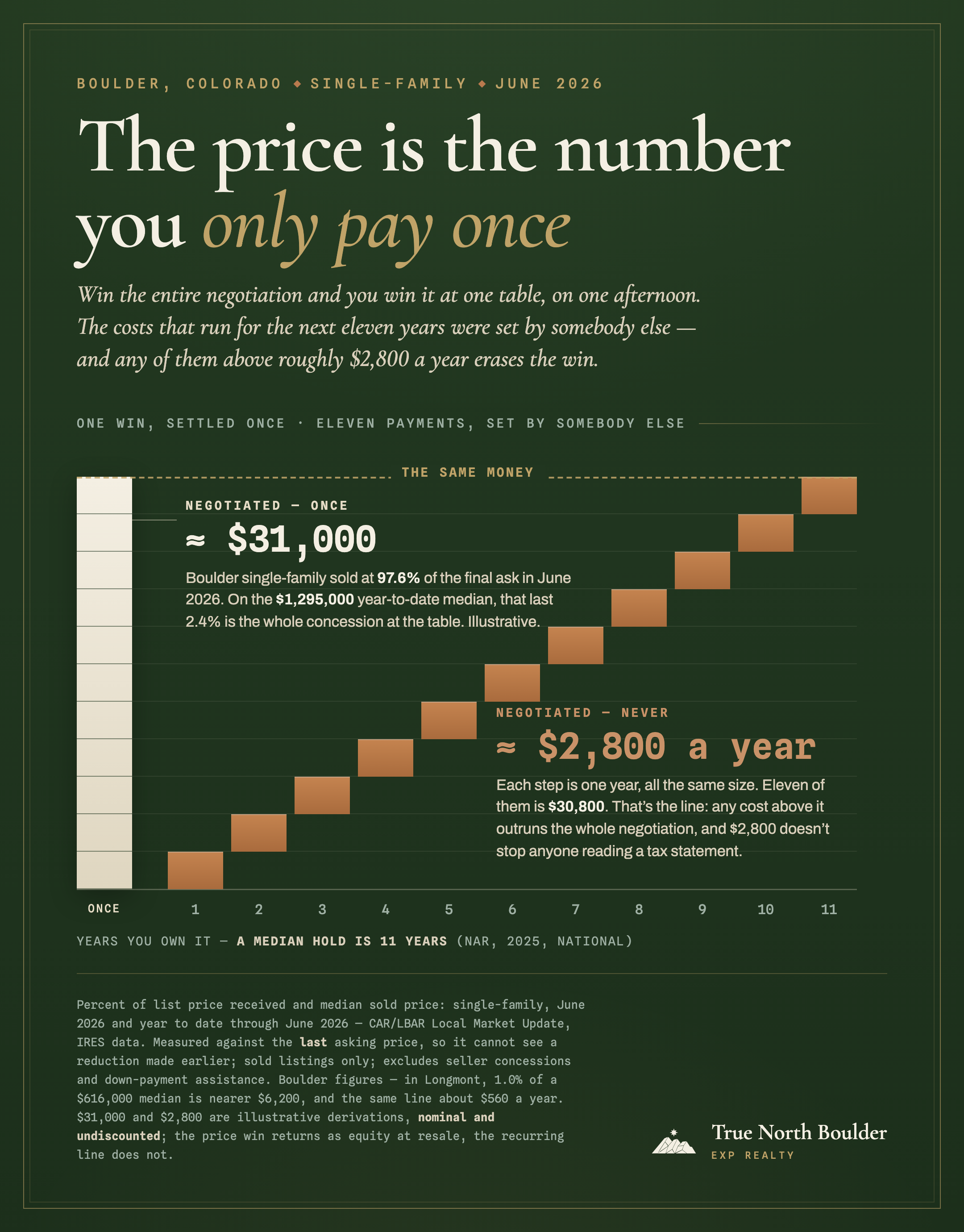
On Boulder's year-to-date median single-family sale price of $1,300,000, that last 2.4% is roughly $31,000. Run it on Longmont's $610,000 year-to-date median and 1.0% is closer to $6,200. Real money, and we'll push for every dollar of it.
The price does other work — the loan, the cash at closing, and in this band whether you land inside the conforming limit or above it, which is its own arithmetic — but all of it is settled once. Where assessments are capped at what you paid, a price win keeps paying, because it sets the value your tax runs off for as long as you own. Colorado has no acquisition-value cap. Arrive from a state that caps them and you are the most exposed to what follows, and the least likely to expect it.
The recurring costs are charged every year, against a long hold: in NAR's 2025 survey the typical American seller had owned 11 years, the longest it has recorded, and that is probably conservative here, since cheap locked-in rates have made owners slower to move.
$31,000 across eleven years is about $2,800 a year. That's the line: any recurring cost above it outruns the whole negotiation inside a median hold, and $2,800 doesn't stop anyone reading a tax statement. In Longmont, the same division on $6,200 lands at about $560.
The price lever that isn't at the table
Percent of list can't see a reduction made before you arrived. That's not discouraging. It relocates where your price leverage lives.
About this data
Percent of list price received measures less than its name suggests. It is measured against the last asking price, so a house listed high, reduced twice, then sold records the same 97.6% as a house that never moved off its opening ask. It counts only homes that sold, and the report's own footnote says it does not account for seller concessions or down-payment assistance, so a rate buydown or a closing credit is invisible in it. No companion original-list figure is published in any of the CAR reports we cite, so we cannot bound the gap and will not guess at it. We publish no Lyons figure at all: too few homes close there each month, and the public figures for it disagree wildly.
Total movement from a seller's original ask can be far larger than the gap you close at the table, because sellers reprice — and Boulder single-family homes averaged 68 days to an accepted offer in June 2026 against 4.5 months of supply (both town-wide; the move-up band is the more liquid slice). A market that slow puts reduction pressure on sellers, which is why an already-cut listing is worth finding. But some listings sit because they were priced wrong, and some sit for a reason that will still be there in eleven years. Find out which before you make it your leverage.
So the biggest price move available to you is usually not how hard you push but which listing you push on — a choice that comes before the offer.
The costs somebody else set
The bigger home's tax bill arrives with the deed, and your insurance reprices alongside it. We total that reset in the move-up guide.
If the house sits in a metropolitan district, its levy came from a service plan written before you were a buyer. Berthoud-Heritage Metropolitan District No. 6 levies 63.614 mills in debt service alone for collection in 2026 — one district of seventeen the same development runs, each with its own levy, so it is a question about a parcel in Berthoud, never a town. Nor is it fixed: it is a formula that adjusts, your lender escrows it, which shrinks your loan, and in a master-planned community it arrives as a stack of tolls.
A privately owned amenity costs whatever its owner decides, so a club can reprice its dues and access. An operated one may not be there at all: the reservoir behind a Loveland view is drawn down every fall by the company that owns the water.
None of this is our framing. Colorado puts a bold-faced special-district disclosure in every residential purchase contract in the state, telling the buyer to go investigate. No legislature does that for four neighborhoods. It arrives with the rest of the contract, after the offer is written.
But isn't that already in the price?
But the price win isn't spent. I get it back when I sell. You do. The levy runs with the house too, and discounts what your buyer pays you.
The price should already carry that discount, and that is the strongest objection to everything above: a district built something real, and in theory a house carrying a levy trades below one that doesn't. In practice the discount arrives roughly and late, because these submarkets are thin and a clean comparison is rare.
The part that matters is simpler than whether the discount is right. A buyer who never learned the number cannot tell whether it was applied. You can't be paid for a risk you didn't know you were carrying. Which is why the instruction is verify, not avoid.
Which number to argue over, and which to look up
Sort the numbers by what you can do about them, not by size. Negotiate the price — it responds, it is worth thousands, and a listing already repriced beats any amount of pushing.
Take what nobody can promise as a bet you make on purpose — knowingly, or decline to pay the premium. Don't pay for permanence and find later you bought an operating decision. And none of it shows up on closing day: it shows up about a year in, when the lender re-runs your escrow, resets the payment and bills the shortfall.
Then verify the rest, some of it free this afternoon: the assessor's record on the house, and the treasurer's parcel record, which carries the total mill levy, the district behind it, and the annual dollar it comes to. That dollar is the number to set beside $2,800. On a new build, check what is being valued — the first cycle is often the lot alone, so the figure you find is the land's tax, not yours. The rest arrives once you are under contract, which makes the contract's deadlines the second half of this instruction, not paperwork.
The price is the only number in this deal you have to win. The others you only have to find.
The bottom line
The price deserves the fight; it does not deserve all of your attention. You argue it once. The costs somebody else already set are still being charged in eleven years, and they were never on the table for you to argue in the first place.
Frequently asked
How much can you actually negotiate off a house price in Boulder County?+
Less than most buyers expect, once you are at the table. Single-family homes that sold in June 2026 closed at 97.6% of their final asking price in Boulder, 99.0% in Longmont, 98.7% in Loveland and 98.1% in Berthoud. On Boulder's year-to-date median single-family sale price of $1,300,000 that last 2.4% is roughly $31,000, and in Longmont, on a $610,000 year-to-date median, 1.0% is closer to $6,200. Two things about that figure matter. It is measured against the last asking price, so it cannot see any reduction the seller made before you arrived, and it ignores seller concessions and down-payment assistance entirely. And whatever you win, you win once. The larger price move is usually choosing a listing that has already been reduced, not pushing harder on one that hasn't.
Which Colorado home costs are set before you ever make an offer?+
Most of the recurring ones. You take over the more expensive home's property tax bill the day you own it, because Colorado has no acquisition-value cap that freezes anything at your purchase price. If the house sits in a metropolitan district, its levy was set by a service plan and a bond schedule written long before you were a buyer. If an amenity is privately owned, its dues and access are the owner's business decision, and if it is operated rather than merely owned, it can change on you. Colorado thinks this matters enough that state law puts a bold-faced special-district disclosure in every residential purchase contract telling the buyer to go investigate.
Is a metro-district mill levy priced into the home's purchase price?+
Partly, in theory, and imperfectly in practice. A house carrying a levy should trade below an otherwise identical house that does not, because the market discounts the carry. But these submarkets are thin and clean district-versus-non-district comparisons are rare, so the discount tends to be rough and late rather than precise. The practical point is simpler than whether the discount is accurate: if you never learned the number, you have no way to tell whether it was applied to your price.
Sources & data notes
- Percent of list price received, single-family, June 2026: Boulder 97.6%, Longmont 99.0%, Loveland 98.7%, Berthoud 98.1%. Colorado Association of Realtors Local Market Update, data from IRES. Measured against the last asking price, sold listings only; does not account for seller concessions or down-payment assistance.
- Median single-family sale price, year to date through July 2026: Boulder $1,300,000; Longmont $610,000. Same source and basis — and the same footnote, so the median is net of nothing either and concessions are invisible in it too.
- Days on market until sale (average) and months supply, Boulder single-family, June 2026: 68 days, 4.5 months. Same source. Both are town-wide figures covering every single-family price point, not a read on the move-up band this note is written for.
- Lyons: no Local Market Update is published; the town transacts too thinly for a monthly median.
- Median seller tenure, 11 years: National Association of Realtors, 2025 Profile of Home Buyers and Sellers, covering transactions July 2024 through June 2025. A national figure, not a Colorado one.
- 63.614 mills, from the Berthoud-Heritage Metropolitan District No. 6 2026 Final Budget. This is the debt-service levy alone, stated as the adjusted maximum for collection in 2026, for one numbered district of seventeen. Not a figure for Berthoud generally and not a total levy.
- Illustrative derivations, shown rather than measured: 2.4% of $1,300,000 is $31,080, and the implied concession on a $1,300,000 sale is $31,844: both rounded here to about $31,000. 1.0% of $610,000 is $6,160, and $6,222 on the sale basis: both rounded to about $6,200. $31,000 divided across 11 years is about $2,800 a year; $6,200 across the same 11 years is about $560 a year. These break-even lines are nominal, undiscounted, and take no account of the concession returning to you as equity at resale.
- The special-district disclosure requirement: C.R.S. 38-35.7-101. Cited here only for its existence and its instruction to investigate; the operative text and the lookup path are covered in the metro-district pieces linked above.
True North Boulder is a real-estate team with eXp Realty. This is general information for Boulder and northern Front Range buyers, not tax, legal, or financial advice; confirm how any figure or cost applies to your own purchase with your broker, a CPA, or a Colorado real-estate attorney.